In-app payment fees remain unchanged
Only developer fees, abnormally high domestically, are reduced
No change in service prices
No real benefit to consumers
[Asia Economy Reporter Seungjin Lee] Apple is undertaking a major overhaul of its App Store pricing policy, including lowering commission fees. However, critics argue that the in-app payment commission remains unchanged, and the reduction only affects the commission rates for developers in Korea, who were previously charged abnormally higher fees, making it a superficial gesture.
Lowering Commissions and Diversifying Payment Currencies
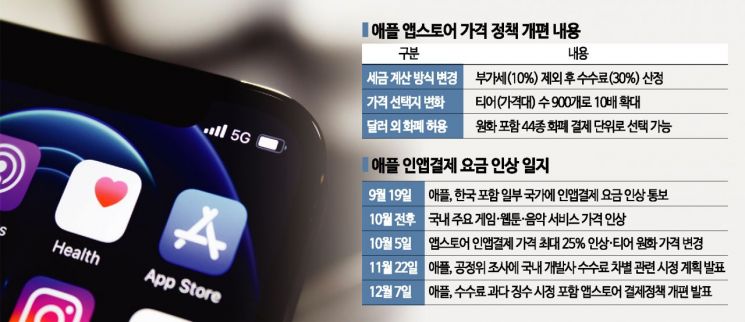
According to the IT industry on the 8th, Apple is implementing three major changes to the App Store. First, it will correct the discrepancy in commission rates applied overseas versus domestically. This will reduce the commission rate for Korean developers by 3 percentage points.
In September, the Korea Mobile Game Association reported to the Fair Trade Commission that Apple was charging a 33% commission rate including VAT domestically, unlike the 30% commission rate applied overseas. The Fair Trade Commission launched an investigation into unfair practices, and Apple ultimately decided to voluntarily rectify the issue. According to estimates by the Mobile Game Association, Apple unfairly gained 345 billion KRW in Korea through the higher commission rates.
Apple has expanded the option to pay in local currencies among 45 currency units across 175 countries’ App Stores. Previously, Korean developers had to price digital goods strictly in US dollars. This was also a factor behind the in-app payment price increase implemented last October.
As the ‘King Dollar’ phenomenon caused the won-dollar exchange rate to soar, Apple stirred controversy by adjusting the won payment prices per dollar. Before the October price hike, $0.99 was priced at 1,200 KRW and $1.99 at 2,500 KRW, but after the adjustment, $0.99 was priced at 1,500 KRW and $1.99 at 3,000 KRW, leading to a domestic service price increase.
The number of price tiers was also significantly expanded from 94 to 900. Previously, prices could only be set within Apple’s enforced ‘price list,’ such as 1,500 KRW, 3,000 KRW, 4,400 KRW, and 6,000 KRW. Even if a developer wanted to price an item at 2,500 KRW between 1,500 KRW and 3,000 KRW, it was impossible because that amount was not included in Apple’s available options.
Developer Revenue Increases but No Benefit for Consumers
Apple praised the changes, stating that "developer revenue will increase." However, the likelihood of this overhaul leading to actual service price reductions is low. Although the App Store pricing policy has changed, the in-app payment prices that influenced the app price hikes remain unchanged.
A gaming industry insider explained, "Apple only raised in-app payment prices two months ago, so they are unlikely to make any moves with this tier overhaul. Since this change does not lower the already increased in-app payment prices, there is no room to adjust prices."
Content industry representatives also assessed the impact of the overhaul as limited. A content industry official said, "A 3 percentage point reduction in commission rates may be significant for small and medium developers, but it does not offer much benefit to large developers, some of whom have already been subject to a 30% commission rate. For consumers to truly feel the impact, changes to the in-app payment prices that rose due to the ‘King Dollar’ are crucial."
Previously, at a National Assembly audit, Apple Korea’s Vice President of External Affairs, Cheolhyun Ahn, stated that if the won-dollar exchange rate falls again, prices could be adjusted downward accordingly in relation to the in-app payment price increase.
© The Asia Business Daily(www.asiae.co.kr). All rights reserved.

















