The Defense Semiconductor Convergence Research Group Develops Korea's First Gallium Nitride (GaN) Semiconductor Transmit-Receive Monolithic Microwave Integrated Circuit (MMIC) Technology
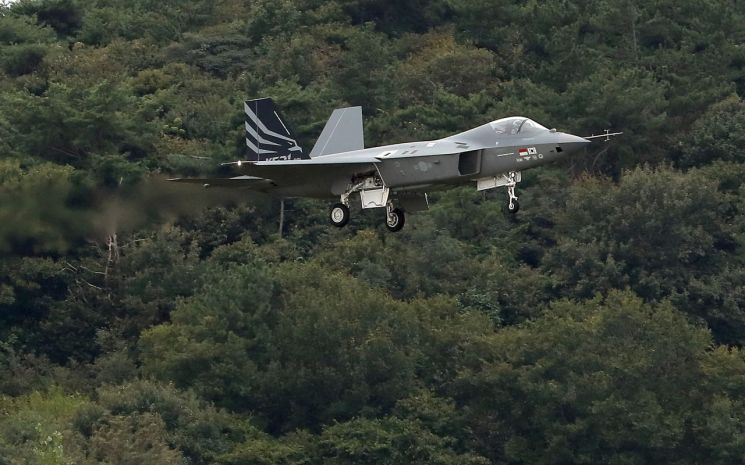
[Asia Economy Reporter Kim Bong-su] Domestic researchers have succeeded in domesticating key components of high-performance AESA (Active Electronically Scanned Array) radar and high-resolution Synthetic Aperture Radar (SAR) imaging radar, which serve as the brain of cutting-edge fighter jets such as the KF-21, independently developed by Korea. This marks a step closer to self-reliance in defense technology.
The National Research Council of Science & Technology announced on the 8th that the Defense Semiconductor (DMC) Convergence Research Group has developed gallium nitride (GaN) semiconductor transmit-receive monolithic microwave integrated circuit (MMIC) technology for the first time in Korea.
The gallium nitride semiconductor transmit-receive monolithic integrated circuit developed by the research group is a core component that adjusts the phase and amplitude of signals to detect and track targets in AESA radars mounted on the latest fighter jets such as the KF-21, independently developed by Korea. Previously, the research group succeeded in developing switch integrated circuit technology for transmitters and receivers in 2020 and power amplifier integrated circuit technology for X-band radar transmitters and receivers last year, accelerating the full localization of AESA radar technology.
This achievement is the X-band radar transmit-receive single frontend integrated circuit technology that integrates a high-power amplifier, a low-noise amplifier, and a switch MMIC into a single chip.
The research team also explained that the gallium nitride-based transmit-receive MMIC developed this time can be applied to high-resolution imaging radar (SAR) antennas, which are major systems onboard satellites. This is because it can also be used in transmit-receive modules, components responsible for transmitting and receiving antenna signals.
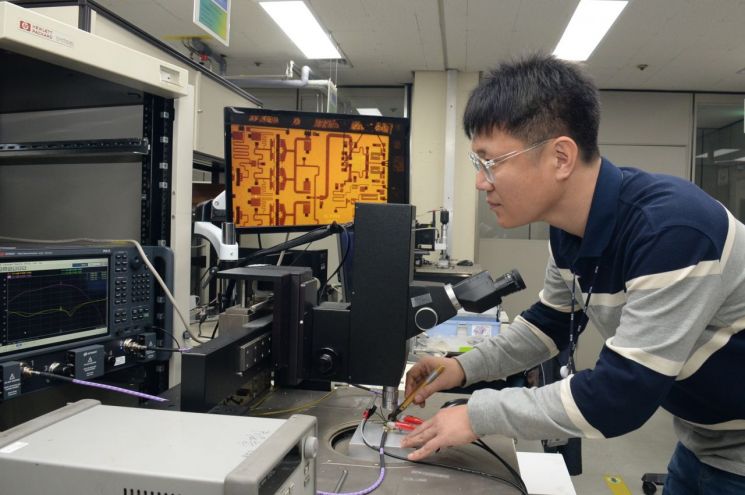 Researchers from the Defense Semiconductor Convergence Research Group at the Electronics and Telecommunications Research Institute (ETRI) are testing the performance of a gallium nitride semiconductor transmit-receive monolithic microwave integrated circuit (MMIC), a core component of high-performance active electronically scanned array (AESA) radar. Photo by ETRI
As a result, it is expected to greatly contribute to the miniaturization and weight reduction of satellite transmit-receive modules based on excellent power characteristics and high efficiency. Gallium nitride-based transmit-receive single frontend MMIC technology has only been secured by advanced foreign countries, and in the case of domestic securing technology, there has been no development record using overseas or domestic foundries. The transmit-receive MMIC developed through domestic design and manufacturing is expected to become a competitive product that can replace the currently fully imported transmit-receive MMIC market.
The research team's X-band single frontend MMIC can achieve a transmit gain of 36 dB, output power of 19 watts (W), and transmit efficiency of about 28% in a 1.5 GHz bandwidth, as well as a receive gain of 38 dB and a receive noise figure below 2.8 dB. The transmit gain, transmit output, and receive gain are world-class levels, and the receive noise figure and transmit efficiency are equal or superior.
However, the research group has developed only a prototype-level product. In the future, they plan to support commercialization through performance enhancement, reliability, and yield improvement of MMICs, as well as research such as space environment testing for SAR satellites, not only for military radar use.
Lim Jong-won, head of the DMC Convergence Research Group at the Electronics and Telecommunications Research Institute (ETRI), who participated in the research, said, "We were able to achieve this result based on over 20 years of research know-how in designing and manufacturing compound semiconductor devices. By independently designing and manufacturing integrated circuits for the first time domestically, we have laid the foundation for domesticating gallium nitride integrated circuit components in the military sector, which had relied on overseas foundries and imports. Through self-reliance in defense technology, we expect to actively respond to export regulations on materials, parts, and equipment, as well as satellite environment verification."
© The Asia Business Daily(www.asiae.co.kr). All rights reserved.
![Clutching a Stolen Dior Bag, Saying "I Hate Being Poor but Real"... The Grotesque Con of a "Human Knockoff" [Slate]](https://cwcontent.asiae.co.kr/asiaresize/183/2026021902243444107_1771435474.jpg)

















