FKI, Report on 'Trends in Attracting Foreign Professionals in Major Countries and Korea's Challenges'
US, China, EU Expand Conditions for Overseas Talent Inflow
"Dramatic Improvement Needed in Domestic Stay Conditions for Foreign Professionals"
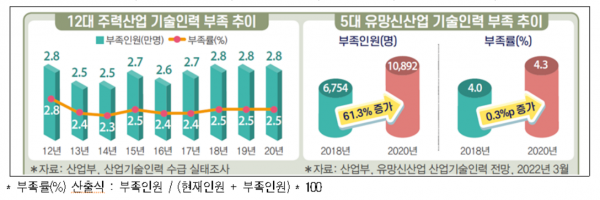
[Asia Economy Reporter Han Yeju] Amid intensifying global technological hegemony wars, a claim has been made that to overcome the chronic shortage of industrial technology personnel in 12 key industries and 5 promising new industries, the utilization of outstanding overseas talent must be increased.
The Federation of Korean Industries (FKI) stated this on the 8th through a report titled "Trends in Foreign Skilled Worker Attraction in Major Countries and Korea's Tasks."
In Korea, while the shortage of industrial technology personnel in 12 key industries and 5 promising new industries is deepening, the openness of the Korean labor market to foreign workers is at the lowest level among OECD countries. As of 2020, Korea's foreign-born population ratio was 2.4%, ranking 34th out of 37 OECD countries, placing it near the bottom.
Here, the 12 key industries refer to machinery, display, semiconductor, bio-health, textiles, automobiles, electronics, shipbuilding, steel, chemicals, software, and IT business, while the 5 promising new industries refer to IoT home appliances, digital healthcare, future vehicles, smart and eco-friendly ships, and aviation and drones.
Currently, the utilization of foreign skilled workers in Korea is only one-fifth that of competitor Japan. In 2021, the proportion of skilled workers among foreign employees in Japan was 22.8%, whereas in Korea it was only 5.3%. The large gap in the utilization of foreign skilled workers between Korea and Japan is due to Korea maintaining a foreign workforce policy focused on simple laborers for over 30 years since the implementation of the Industrial Trainee System (currently the Employment Permit System) in 1991, while Japan has strengthened its foreign talent attraction policy under the Japan Revitalization Strategy (commonly known as Abenomics) since 2013.
The United States, China, the EU, Japan, and Taiwan are competitively expanding conditions for attracting overseas high-level talent by easing requirements for foreign professional work visas and improving settlement conditions.
The Biden administration lifted the suspension on issuing new work visas to foreigners, which had been halted by former President Trump, eased the issuance requirements for professional work visas (H-1B), and in January 2022 added 22 major fields to the Optional Practical Training (OPT) program for graduates in science and technology from U.S. universities.
China, which has pursued a policy of attracting overseas high-level talent such as advanced technology researchers and entrepreneurs through the "Thousand Talents Plan" since 2008, has focused national capabilities on attracting foreign talent in strategic core fields and young scientists through the "High-Level Foreign Expert Recruitment Plan" since 2019. Additionally, since 2018, China has implemented the "Overseas Talent Visa System," which is valid for up to 10 years and significantly shortens review and issuance periods for Nobel laureates, world-class university professors, and degree holders.
In the EU, the Blue Card issuance criteria were relaxed in 2016 to utilize foreign high-level and professional personnel. The minimum annual salary requirement on employment contracts, which was previously 1.5 times the average wage of EU member countries, was lowered, and the employment contract period requirement was shortened from over one year to six months.
Japan has continuously strengthened its foreign skilled worker attraction policies since 2013 under Abenomics, including easing recognition requirements for high-level talent (December 2013), establishing unlimited residence periods for high-level talent (April 2015), and relaxing permanent residency acquisition requirements for foreign researchers and executives residing in Japan. As a result, the proportion of skilled workers among foreign employees in Japan increased by 4.3 percentage points from 18.5% in 2012 to 22.8% in 2021.
In Taiwan, to attract overseas high-level talent in science, technology, and engineering in 2021, tax benefits were provided such that for foreign experts earning more than 3 million New Taiwan dollars (approximately 130 million KRW), half of the excess income is excluded from taxation, and visa and residence-related regulations were eased.
Kim Bongman, head of the FKI International Headquarters, said, "With the advancement of new technologies such as AI and automation, innovation in human resources has become important, and as the technological hegemony competition accelerates, a major shift is urgently needed from the foreign workforce policy focused on simple laborers that has been sustained for over 30 years since the Industrial Trainee System (currently the Employment Permit System) was implemented in 1991." He added, "Since the government began policies to revitalize the inflow of overseas talent into Korea in 2021, it is necessary to analyze related policies of the U.S., China, Japan, and Taiwan, conduct demand surveys for foreign skilled workers, and make a clear targeting of overseas high-level talent, along with revolutionary improvements in domestic residence conditions for foreign skilled workers such as preferential visa systems by skill level."
© The Asia Business Daily(www.asiae.co.kr). All rights reserved.

















