Difficulties in Budget Negotiations Including Reduction Scale
Opposition Party's Decision on 'Lee Sang-min Dismissal Motion' as a Key Variable
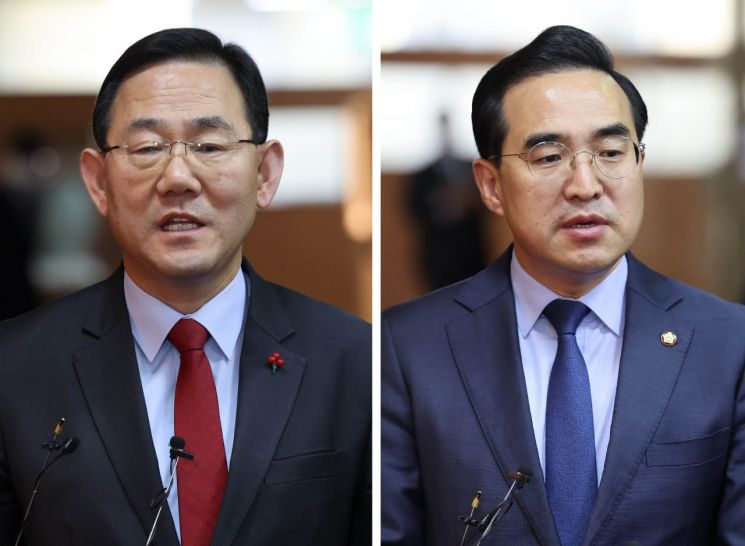 Joo Ho-young, floor leader of the People Power Party (left), and Park Hong-geun, floor leader of the Democratic Party of Korea.
 [Photo by Yonhap News]
[Asia Economy Reporter Han Ye-ju] The ruling and opposition parties met on the 7th to reach an agreement on next year’s budget bill but failed to find common ground. They will hold another decisive meeting on the 8th, one day before the regular National Assembly session ends on the 9th.
On the morning of the same day, Joo Ho-young, floor leader of the People Power Party, and Park Hong-geun, floor leader of the Democratic Party of Korea, met at the National Assembly with Deputy Prime Minister and Minister of Economy and Finance Choo Kyung-ho under the chairmanship of National Assembly Speaker Kim Jin-pyo to discuss the budget bill. It appears that differences over the scale of budget cuts were confirmed at this meeting.
Floor leader Joo told reporters, "Although tax revenue has increased, 40% must be sent to local governments, so the central government’s discretionary budget has been drastically reduced, according to the government’s explanation." He added, "We said the scale of cuts should not be the same as in previous years, but the Democratic Party did not agree."
In response, floor leader Park said, "The government continues to insist on an unreasonable position regarding the scale of cuts," and pointed out, "The gap in positions is significant and remains unresolved."
The ruling and opposition parties failed to find common ground during the '2+2' talks held on the 4th and 5th, which involved the policy chiefs of both parties and the budget and accounts special committee secretaries. From the 6th, a '3+3' negotiation body including the floor leaders of both parties was launched.
At this meeting, it is reported that considerable progress was made in reaching consensus on the budgets for so-called power institutions such as the presidential office, prosecution, police, and audit office, as well as some contentious budgets like small modular reactors (SMR) and renewable energy. The so-called 'Yoon Seok-yeol budget,' including youth cost-price housing, is being discussed with only a 5-10% cut instead of the full cut initially demanded by the Democratic Party, while the 'Lee Jae-myung budget,' such as public rental housing, is being discussed for partial increases. However, positions remain sharply divided over regional love gift certificates (local currency) and the budget for relocating the presidential office.
The floor leaders of both parties continued discussions in the afternoon. Although some progress was made regarding the scale of cuts, no conclusion was reached.
Despite this situation, since both parties agree on the need to pass the budget within the session, attention is focused on the possibility of a last-minute agreement.
A variable is that the Democratic Party decided at a party meeting on the same day to push for a motion of no confidence against Minister of the Interior and Safety Lee Sang-min at the plenary session on the 8th or 9th, holding him accountable for the Itaewon tragedy.
When floor leader Joo was asked by reporters in the afternoon whether the no-confidence motion would be a variable, he said, "When the no-confidence motion is reported and voted on at tomorrow’s plenary session, we will gather opinions at the party meeting on how to proceed," adding, "It is indeed a variable."
On the other hand, Democratic Party Deputy Floor Leader Jin Sung-jun appeared on KBS Radio’s 'Choi Kyung-young’s Strong Current Affairs' and criticized, "The budget bill is the budget bill, and the minister’s accountability is accountability," accusing the People Power Party of trying to link two completely separate issues.
If the ruling and opposition parties continue their head-to-head confrontation, there is a possibility that the budget will not be passed within the session. In preparation for this, the Democratic Party submitted a request to Speaker Kim Jin-pyo on the same day to convene an extraordinary December session on the 10th.
The ruling and opposition parties have also failed to narrow their differences regarding revenue-related subsidiary bills, including income tax, corporate tax, and comprehensive real estate tax.
Democratic Party leader Lee Jae-myung, especially at the highest-level meeting on the same day, expressed conditional agreement on the two-year postponement of the financial investment income tax (financial investment tax) scheduled to be implemented next year, saying, "I agree that a postponement is necessary as per the government’s proposal," but added, "The proposal to lower the securities transaction tax or exempt shareholders holding up to 10 billion won in listed stocks must be withdrawn."
© The Asia Business Daily(www.asiae.co.kr). All rights reserved.

















