Despite Bold Declarations, Increase Compared to Last Year
Hit-and-Run Manslaughter in Cheongdam-dong Not Applied
Complex Issues in Each Accident Hinder Legal Application
Minsik Law Not Applied Due to Excavator Use
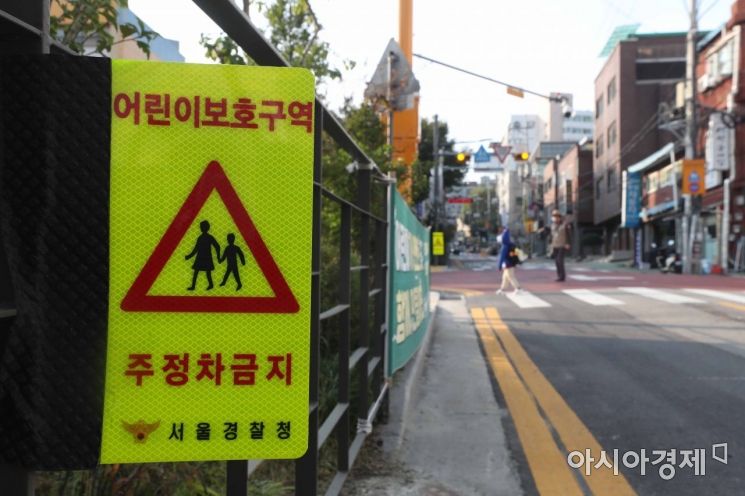 On the first day of the revised Road Traffic Act, which includes no-parking zones in child protection areas and mandates special traffic safety education for drivers who cause traffic accidents in these zones, students are attending school at an elementary school in Seoul on the 21st. Photo by Mun Ho-nam munonam@
[Asia Economy Reporter Jang Sehee] The government set a goal to reduce traffic accident fatalities within children's protection zones (school zones) to zero by 2026, but it has been confirmed that the number of deaths has actually increased. Each accident involves complex circumstances, causing difficulties in applying the law.
According to the police on the 7th, there have been 3 child traffic accident fatalities in school zones this year. Despite the government's major declarations, the number of child deaths increased compared to last year (2 deaths).
On the 5th, a man in his 30s, Mr. A, who was driving under the influence in Cheongdam-dong, Gangnam-gu, Seoul, was arrested for hitting and killing an elementary school student. The Gangnam Police Station applied only the charge of causing death in a children's protection zone under the Specific Crimes Aggravated Punishment Act, known as the Min-sik Law, to Mr. A, excluding the charge of hit-and-run causing death under the same act.
The reason was that CCTV footage showed Mr. A parking the accident vehicle at his home and arriving at the scene within 40 seconds, holding his mobile phone and attempting to report the incident himself. In fact, although Mr. A did not call 112, the police did not apply the hit-and-run causing death charge under the Specific Crimes Aggravated Punishment Act.
A police official explained, "The charges were applied after comprehensively considering the temporal and spatial proximity and the driver's behavior." Currently, the bereaved family of the victim student is protesting, demanding that hit-and-run charges be applied. Mr. A is accused of hitting and killing a third-grade elementary school student who was returning home after after-school classes near an elementary school in Cheongdam-dong, Gangnam-gu, Seoul, at around 4:57 p.m. on the 2nd.
There have also been cases where the Min-sik Law was not applied to child fatalities in school zones because excavators are not considered "automobiles."
In July, an 11-year-old girl, Ms. B, was hit and killed by an excavator near an elementary school in Cheongbuk-eup, Pyeongtaek City. However, the Min-sik Law excludes construction machinery and only applies to "automobiles including motorized bicycles," so the law was not applied.
The excavator operator, Mr. C, denied the charges, claiming he was unaware of the accident at the time. The police applied only charges of violation of the Special Act on Traffic Accident Handling (causing death or injury) and violation of the Road Traffic Act (failure to take action after an accident). The Min-sik Law carries a maximum prison sentence of 30 years, which can be increased to up to 50 years with aggravated punishment. In October, a 9-year-old boy, Mr. D, was hit and killed by a car near a children's protection zone at an elementary school in Changnyeong-gun, Gyeongnam Province.
Most school zones were vulnerable in terms of safety. Some areas were not designated as one-way zones, or lacked speed enforcement cameras. In the recent Gangnam Cheongdam-dong school zone accident, the one-way zone designation was not implemented due to opposition from residents. In February 2020, Gangnam District Office conducted a "Resident Opinion Survey on Changing Traffic Direction," but out of 50 respondents, 48 opposed changing the two-way road to one-way. A Gangnam District Office official stated, "Survey questionnaires were sent to nearby apartment residents and hospital staff, but only 50 responses were received, of which 48 opposed. There are many conflicting interests, so changing from two-way to one-way or vice versa is not easy."
Attorney Seo Ji-won of the law firm Naran pointed out, "The Min-sik Law was enacted in September 2019 after traffic accidents in children's protection zones became a social issue," adding, "There are unclear aspects regarding the applicable vehicles and types of accidents." Attorney Seo also noted, "Although it is a negligence crime, only imprisonment is stipulated for fatalities, making it difficult to apply charges easily."
© The Asia Business Daily(www.asiae.co.kr). All rights reserved.

















