'2022 Statistics on Single-Person Households'
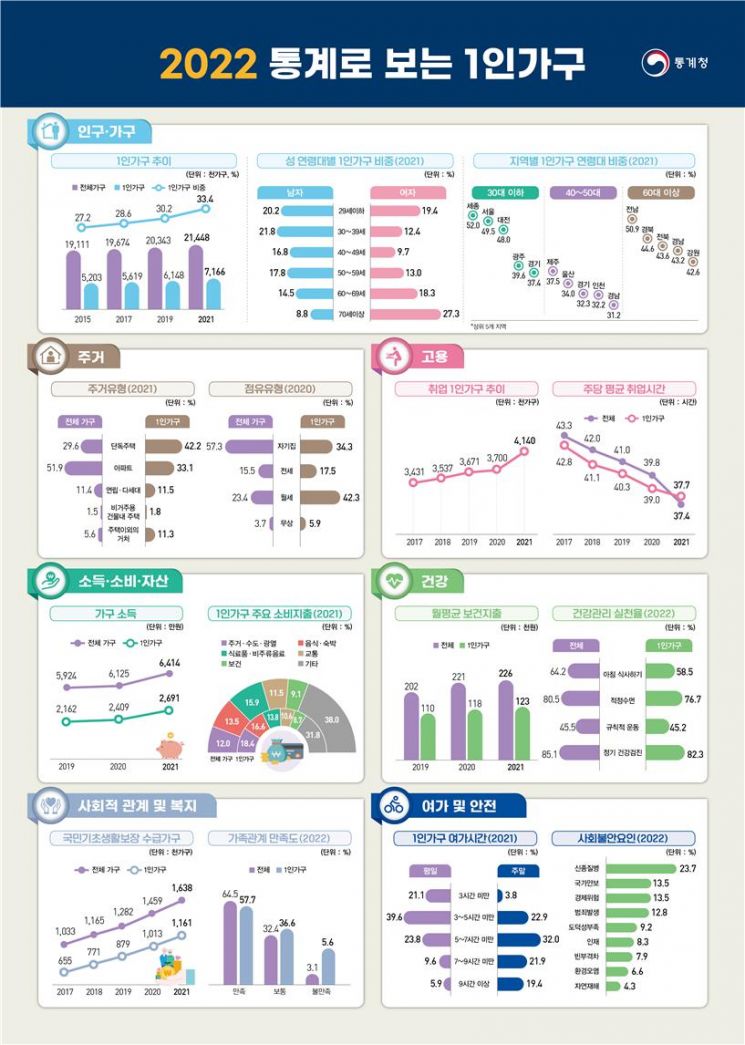
Last year, the proportion of 'single-person households' among all households in South Korea was found to be 33.4%. This ratio is expected to approach 40% by 2050.
According to the '2022 Single-Person Household Statistics' released by Statistics Korea on the 7th, single-person households last year accounted for 33.4% of all households, totaling 7.166 million households. In 2005, it was only 20%, but it has rapidly increased every year, surpassing 30%. Statistics Korea projects that the proportion of single-person households will rise to 35.6% by 2030 and reach 39.6% by 2050.
Among major OECD countries, the proportion of single-person households exceeds 30% in South Korea, the United Kingdom, France, and Japan, while Germany, Sweden, and Finland exceed 40%.
By age group, the highest proportion of single-person households in South Korea was among those aged 29 and under at 19.8%, followed by those aged 70 and over at 18.1%, those in their 30s at 17.1%, and those in their 60s at 16.4%. By region, Daejeon had the highest proportion at 37.6%, followed by Seoul (36.8%), Gangwon (36.3%), and Chungbuk (36.3%).
The housing types of single-person households were mostly detached houses (42.2%), apartments (33.1%), and row houses/multi-family houses (11.5%). The housing occupancy type was mostly monthly rent at 42.3%, followed by owner-occupied at 34.3%, and jeonse (long-term deposit lease) at 17.5%. Annual income was 26.91 million KRW, an increase of 11.7% compared to the previous year. However, this was only about 42% of the average for all households (64.14 million KRW).
The average monthly consumption expenditure of single-person households was 1.409 million KRW, which was 56.5% of that of all households (2.495 million KRW). Assets were 211.08 million KRW, 38.5% of all households (547.72 million KRW), and liabilities were 35.83 million KRW, 39.1% of all households (91.7 million KRW).
This year, 57.7% of single-person households responded that they were satisfied with their overall family relationships, which was 6.8 percentage points lower than the family relationship satisfaction rate of the entire population (64.5%). Considering that last year, only 46.7% responded that they were satisfied with the same question, the figure has increased significantly. However, as of last year, 1.161 million single-person households were recipients of the National Basic Livelihood Security, accounting for 70.9% of the 10 households eligible for benefits.
The leisure activity that single-person households participated in the most over the past year was rest activities at 93.8%, followed by hobbies and entertainment activities (79.0%), and social and other activities (63.7%). The average daily leisure time was 4.4 hours on weekdays and 6.4 hours on weekends, which was 0.6 hours longer than the overall population.
Single-person households identified the biggest sources of anxiety in our society as new infectious diseases (23.7%), national security (13.5%), economic risks (13.5%), and crime occurrence (12.8%). 34.0% responded that society is generally safe, and 27.2% said they feel safe from crime.
© The Asia Business Daily(www.asiae.co.kr). All rights reserved.

















