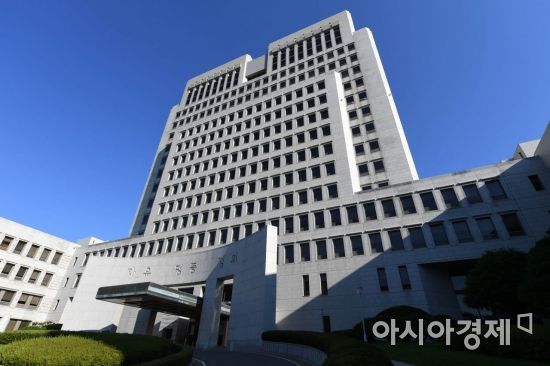
[Asia Economy Reporter Choi Seok-jin, Legal Affairs Specialist] The Supreme Court has confirmed a guilty verdict for obstruction of business against a building manager who removed an office water meter for not paying water usage fees in advance.
The Supreme Court's First Division (Presiding Justice No Tae-ak) announced on the 7th that it dismissed the prosecutor's appeal in the final trial of Mr. A, who was indicted on charges of obstruction of business and assault, upheld the guilty verdict for obstruction of business, and confirmed the original sentence of a 1 million won fine.
Mr. A, who built 50 country houses in a residential complex in Cheongju City and installed and managed facilities such as motors and water meters supplying groundwater, demanded on October 18, 2017, that Mr. C, an employee of company B residing in one of the houses, prepay 100,000 won for three months of groundwater usage fees and management costs.
When Mr. C did not comply, Mr. A removed the handle of the water meter's shut-off valve the next day, cutting off the water supply and preventing groundwater use until the following day.
Furthermore, despite removing the shut-off valve handle, Mr. A removed the water meter itself two days later on the 21st of the same month, because company B continued to use groundwater, thereby preventing company B from using groundwater until the 25th of that month.
The prosecutor judged that Mr. A's unilateral demand for advance payment of groundwater usage fees without prior consultation with company B, followed by the water cut-off when the demand was not met, obstructed company B's business by interfering with the use of its office and lodging, and indicted Mr. A on charges of obstruction of business.
Mr. A was also charged with assault for grabbing Mr. C's collar, who was filming him with a mobile phone camera when removing the water meter, and for confiscating Mr. C's phone and throwing it on the floor.
In the first trial, Mr. A was found guilty of obstruction of business and fined 1 million won.
In court, Mr. A's side argued that the action was an unavoidable measure taken in a situation where company B was continuously delinquent on electricity bills, claiming it was a 'justifiable act.'
However, the court ruled, "Although the defendant's reason for cutting off the water supply was to facilitate the smooth supply and management of groundwater for the entire residential complex, including the house in question, through proper fee collection, it is difficult to see that the requirements for justifiable act, such as appropriateness of means and methods, balance of legal interests, urgency, and subsidiarity, were met."
The court cited as grounds for this judgment: ▲ lack of sufficient basis or consultation between the parties regarding groundwater usage fees, ▲ no delinquency in usage fees by the victim company (company B), ▲ insufficient efforts such as prior notice by the defendant, and ▲ imbalance between the benefits gained by the defendant's actions and the extent of damage suffered by the victim company.
The court acquitted Mr. A of the assault charges.
Since Mr. A denied the assault, and the closed-circuit television (CCTV) footage recorded at the time only showed a verbal dispute without any clear assault, it was difficult to convict based solely on the victim Mr. B's testimony.
The second trial court also found no problem with the first trial's judgment.
Mr. A did not appeal the second trial verdict, but only the prosecutor appealed the acquittal on assault charges; however, the Supreme Court rejected the appeal.
The Supreme Court stated, "Regarding the assault charges in this case, there was no proof of the crime, so the first trial's acquittal was upheld," and added, "There was no error in the lower court's judgment such as failing to conduct necessary hearings, violating the rules of logic and experience, exceeding the limits of free evaluation of evidence, or misunderstanding the legal duty of the court to judge reduced facts," as the reason for dismissing the appeal.
The court's duty to judge reduced facts means, for example, that if the prosecutor indicts the defendant on four assault acts, even if some of these acts are not recognized as assault, the court must determine guilt or innocence by judging the remaining charges.
© The Asia Business Daily(www.asiae.co.kr). All rights reserved.

















