Hankyung Research Institute "5 Urgent Reasons for the Passage of the Corporate Tax Act Amendment"
[Asia Economy Reporter Park Sun-mi] Voices from the business community are growing louder, urging the National Assembly to urgently pass the government’s Corporate Tax Act amendment, which has been stalled, to ease the liquidity crisis faced by companies. The amendment primarily includes a reduction in the corporate tax rate.
On the 7th, the Korea Economic Research Institute (KERI) presented five urgent reasons for the passage of the Corporate Tax Act amendment: ▲red alerts on key corporate financial indicators, ▲preparation for a full-scale economic downturn next year, ▲enhancement of corporate international competitiveness, ▲expectation of virtuous economic cycle effects such as increased investment and employment through corporate tax cuts, and ▲greater tax reduction benefits for small and medium-sized enterprises (SMEs) and mid-sized companies.
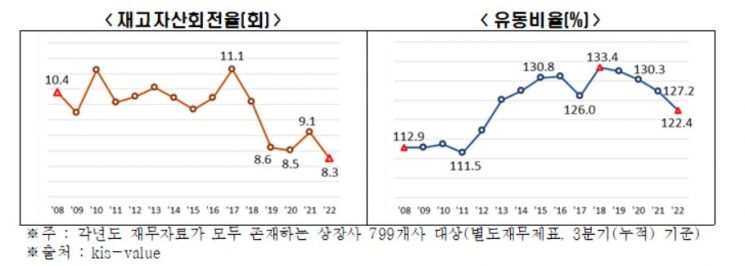
KERI analyzed key financial indicators of listed companies every third quarter since the 2008 global financial crisis and found that the inventory turnover ratio, an indicator of activity, peaked at 11.1 times in the third quarter of 2017 and has been declining since. In the third quarter of this year, it fell to 8.3 times due to increased inventory caused by the economic recession. This level is even lower than the 10.4 times recorded in 2008. The current ratio, a financial stability indicator, improved after the global financial crisis, reaching 133.4% in the third quarter of 2018, but has declined for four consecutive years, dropping to 122.4% in the third quarter of this year. This is due to worsening corporate profitability amid economic sluggishness and a contraction in the bond market, leading to a sharp increase in short-term liabilities centered on commercial paper and other short-term borrowings.
As the Korean economy is expected to slow to a growth rate in the 1% range next year due to export and private consumption stagnation, there are concerns about an economic downturn marked by reduced investment and rising unemployment. Therefore, the argument for reducing corporate tax to prepare for this is also a reason for advocating corporate tax relief. KERI stated, "There are concerns about negative shocks such as decreased investment and increased unemployment due to underutilization of production factors like production facilities and labor in our economy."
There is also a claim that easing the corporate tax burden is necessary to enhance companies’ international competitiveness. Over the past decade, the average corporate tax rate among the five major countries (G5: USA, Japan, Germany, UK, France) has fallen by 7.2 percentage points. OECD countries have seen an average decrease of 2.2 percentage points, whereas Korea has increased its rate by 3.3 percentage points, running counter to the global trend.
KERI argued that lowering corporate taxes would increase corporate investment and employment, stimulate consumption, and thus create a virtuous economic cycle. Professor Hwang Sang-hyun of Sangmyung University analyzed in his report “Economic Effects of Corporate Tax Cuts” that a 1 percentage point reduction in the top corporate tax rate would increase the investment ratio relative to total corporate assets by 5.7 percentage points and employment by 3.5%.
Furthermore, the benefits of corporate tax cuts would extend to stakeholders such as shareholders and workers, generating positive ripple effects throughout society. The government’s Corporate Tax Act amendment includes expanding the tax base limit for applying a 10% special tax rate to SMEs and mid-sized companies from the current 200 million KRW to 500 million KRW, thereby providing relatively greater benefits to SMEs and mid-sized companies compared to large corporations.
Choo Kwang-ho, Director of Economic Policy at KERI, said, "Next year, our economy is expected to enter a severe recession phase with both exports and domestic demand freezing simultaneously, raising concerns about increased difficulties for companies. It is necessary for the National Assembly to promptly pass the Corporate Tax Act amendment so that companies can overcome the current economic crisis and secure global competitiveness."
© The Asia Business Daily(www.asiae.co.kr). All rights reserved.

![Clutching a Stolen Dior Bag, Saying "I Hate Being Poor but Real"... The Grotesque Con of a "Human Knockoff" [Slate]](https://cwcontent.asiae.co.kr/asiaresize/183/2026021902243444107_1771435474.jpg)















