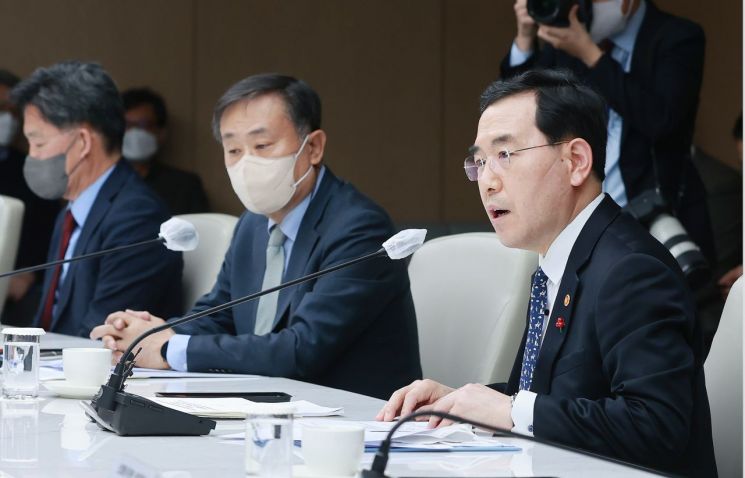
 Minister Lee Chang-yang of the Ministry of Trade, Industry and Energy is presiding over the Carbon Composite Materials Industry Strategy Roundtable Meeting at the Korea Chamber of Commerce and Industry in Seoul on the 6th, discussing measures to strengthen competitiveness. (Photo by Ministry of Trade, Industry and Energy)
[Asia Economy Sejong=Reporter Dongwoo Lee] The government will invest 185 billion KRW by 2030 to advance the technology of carbon composites, an essential material for future aerospace and defense industries. It plans to promote three major demonstration projects in the aerospace sector worth 100 billion KRW to nurture carbon composites as the "second steel industry."
On the 6th, the Ministry of Trade, Industry and Energy held the "4th Industrial Strategy Roundtable" at the Korea Chamber of Commerce and Industry in Jung-gu, Seoul, chaired by Minister Chang-yang Lee, announcing these plans. Carbon composites are high-strength, lightweight intermediate materials made by adding plastic resin to carbon fibers. They are more than 10 times stronger than steel and weigh only about a quarter of steel, making them a promising future material. The government forecasts that the global market size for carbon composites will grow to 100 trillion KRW by 2030. This is why it is investing around 200 billion KRW to achieve technological independence in high-performance carbon composites and develop "half-price carbon fibers."
By August this year, the country secured the third source technology worldwide for high-strength carbon fibers (tensile strength 6.4 GPa) and aims to establish a mass production system by 2025. The goal is to secure source technologies for ultra-high-strength carbon fibers 15 times stronger than steel and ultra-high-elastic carbon fibers 13 times stronger than steel by 2028. To produce carbon fibers priced at 10 dollars per kilogram, half the current price of 20 dollars, development of low-cost raw materials and low-energy process technologies will also be pursued. Demonstration projects will be conducted to directly mount parts made of carbon composites on four-seater Urban Air Mobility (UAM) vehicles, small launch vehicles, and low-earth orbit small satellites, which are expected to see increased domestic and international demand. The Ministry of Trade, Industry and Energy plans to invest about 100 billion KRW in developing carbon composite parts, assembly, and launches.
A domestic institution similar to Germany's "Labfactory," which supports prototype manufacturing of carbon composite launch vehicles for aerospace startups and venture companies, will be established. Financial and certification support will be provided to domestic companies planning to invest 2.1 trillion KRW in carbon composite production facilities by 2030. Annual interest subsidies of about 300 billion KRW will be offered for loans to related companies, and up to 10 million KRW will be supported for acquiring international certification for carbon composites.
Minister Chang-yang Lee of the Ministry of Trade, Industry and Energy said, "Just as the strategic development of steel laid the foundation for the advancement of the automobile and shipbuilding industries, internalizing carbon composites is very important," adding, "The public and private sectors must work together to achieve self-reliance in carbon composites, which are called the rice of future industries."
© The Asia Business Daily(www.asiae.co.kr). All rights reserved.
![From Bar Hostess to Organ Seller to High Society... The Grotesque Con of a "Human Counterfeit" [Slate]](https://cwcontent.asiae.co.kr/asiaresize/183/2026021902243444107_1771435474.jpg)
















