Can't Attract Talent with Salary Alone, Expand Universal Welfare
SKT Allows Choosing Comfortable Work Locations
KT Prioritizes Salary Increase for Young Employees... Offers In-House Loans at 1% Interest
LGU+ Provides Congratulatory Money and Leave to Employees Declaring Single Status

[Asia Economy Reporter Lim Hye-seon] Anthony Klotz, a professor at the Texas A&M University Mays Business School who predicted the large-scale departure of workers after the COVID-19 pandemic and dubbed it the "Great Resignation Era," says the pandemic has become an opportunity to redefine the "meaning of work." Employees who once found fulfillment in high salaries and job content now place greater importance on "how they work and how they are treated."
Reflecting this trend, telecommunications companies have begun innovating employee work cultures. While in the past they provided selective welfare benefits such as child tuition support and various allowances to encourage loyalty and long-term employment, they are now competing to offer universal welfare benefits that even newly hired employees can enjoy.
SK Telecom: "Work where and when you want"
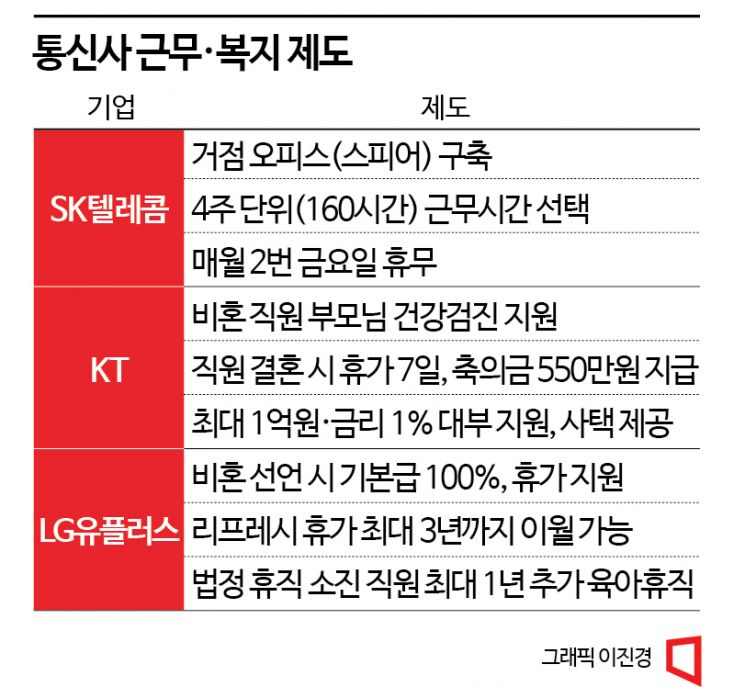
SK Telecom operates a flexible work system that allows employees to work without being restricted by location or time. SKT employees can choose the place most convenient for them to work. The company has established “base offices (Sphere)” near residential areas. Spheres are located at Walkerhill Hotel, Sindorim, Bundang, and Ilsan.
Since SK Telecom started operating the base office system in April for six months, the cumulative reduced commuting time has totaled 21,459 hours. The overall utilization rate of base offices (the ratio of occupied seats to total seats in the base offices) averages about 75%. The cumulative number of visitors who have visited the four base offices at least once is 2,170, with 420 at Ilsan, 1,069 at Sindorim, 703 at Walkerhill Hotel, and 769 at Bundang. The revisit rate reaches 73.7%, indicating high employee satisfaction with this system.
The average commuting time for employees going to the Sphere has decreased by 49 minutes per day. If an employee commutes daily to a base office, the annual reduction in commuting time amounts to 213 hours, which is comparable to a full month’s working hours. According to a survey conducted by SKT targeting employees who have used the base offices, overall satisfaction with the base offices was about 24% higher compared to traditional workspaces. The reasons include proximity to residences and provision of personal workspaces, which allow for much better concentration than working from home or coffee shops.
SKT also operates a “choice work system” that is not bound by working hours. Instead of the uniform 9-to-6 schedule, employees can freely select their working hours within a 4-week cycle (160 hours). The “Happy Friday” program, which allows employees to take two Fridays off each month, is also well received by staff.
KT Raises Starting Salaries for New Employees... LG U+ Provides Congratulatory Money and Leave for Unmarried Employees
The main point of KT’s wage collective agreement this year is to increase salaries for young employees. KT plans to gradually raise the starting salary for new employees to 60 million KRW by 2024. Additionally, basic salaries for employees and assistant managers with less than 10 years of experience will be increased by an average of 17.2% by 2024. For in-house loans, unmarried employees are prioritized as recipients. Loans of up to 100 million KRW are supported at a 1% interest rate. When an employee gets married, they receive 7 days of leave and 5.5 million KRW in congratulatory money.
Welfare programs for unmarried employees are also expanding. Instead of separate congratulatory money and paid leave, health checkups for parents are provided. There is also a company housing system. Unmarried employees can use KT dormitories in Seoul and Daejeon or company housing nationwide. Future development points are regularly given to employees with less than 10 years of service and those under 40 years old.
LG Uplus has introduced a support system for unmarried employees. Starting January 1 next year, employees who declare themselves unmarried will receive the same benefits as marriage congratulatory money: 100% of their basic salary and 5 days of paid leave. Eligible employees must have at least 5 years of service and be 38 years or older. However, they must commit to working for 2 years from the declaration date and will not be eligible for marriage congratulatory money if they marry later. This is the first such initiative among Korea’s five major conglomerates (Samsung, SK, Hyundai Motor, LG, Lotte). A new leave carryover system has also been established.
Considering employee demands for sabbatical leave, LG Uplus allows refresh leave to be carried over for up to 3 years. The parental leave system has also been made more flexible. Working hours during pregnancy can be reduced by 2 hours, and employees who have exhausted statutory parental leave can take up to an additional year off. The comprehensive health checkup system has been improved as well, expanding the number of designated medical institutions from 52 to 56 next year. Unmarried and single-person household employees can also receive support for one additional family member beyond themselves.
Telecommunications companies are making these changes to attract young talent who will be responsible for the company’s future. For young employees, the company is merely a means to sustain their own lives. The concept of a “lifetime job” held by older generations has long disappeared. Companies intend to provide the “carrots” that young employees want to foster loyalty. An industry insider explained, “We internally deliberate every year to communicate with young employees,” adding, “Companies are focusing on improving working conditions to attract talent and prevent existing employees from leaving.”
© The Asia Business Daily(www.asiae.co.kr). All rights reserved.


















