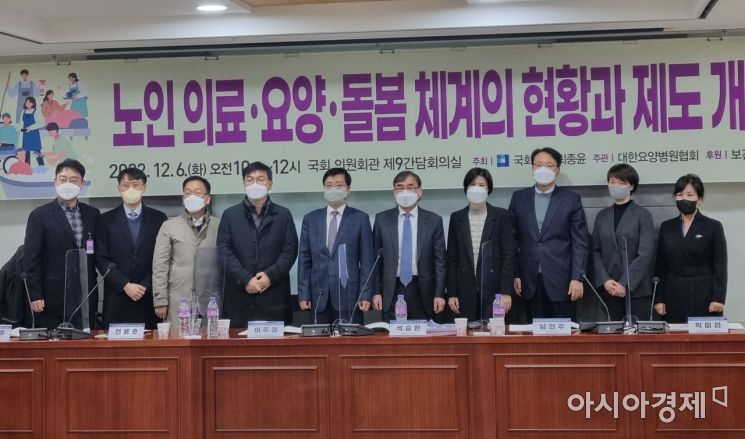
 On the 6th, the 'Current Status and System Improvement Discussion on Elderly Medical Care, Nursing, and Care System' was held at the National Assembly Members' Office Building.
 Photo by Kim Young-won
[Asia Economy Reporter Kim Young-won] As South Korea is expected to enter a super-aged society in less than three years, opinions have emerged emphasizing the need for linkage between the segmented elderly care, medical, and nursing systems.
On the 6th, health and welfare experts attending the "Current Status and Institutional Improvement Discussion on Elderly Medical, Nursing, and Care Systems," hosted by Rep. Choi Jong-yoon of the Democratic Party of Korea and organized by the Korea Association of Nursing Hospitals, made these suggestions.
On this day, experts pointed out that although Korea is predicted to enter a super-aged society with an elderly population exceeding 10 million by 2025, the domestic medical, nursing, and care systems have developed and operated in a segmented manner, making it difficult to provide integrated services demanded by the elderly population. Currently, nursing hospitals providing medical services are covered by health insurance, while nursing facilities providing care are covered by long-term care insurance.
Professor Lee Ju-yeol of the Department of Health Administration at Namseoul University stated, "Since the promotion of community care in 2018, the connectivity with areas such as nursing hospitals and facilities, which had previously developed independently, has decreased," adding, "It is necessary to create a single link among these areas and prepare a legal foundation and a big umbrella to prepare for the super-aged society." He noted that there has been insufficient consideration of linkage methods with facility care while focusing only on community-based care.
Not only linkage with community care such as home care and day care but also role sharing and relationship establishment between nursing hospitals and nursing facilities are necessary. Professor Lee explained, "Among inpatients in nursing hospitals, 33% have no special health problems and do not require medical treatment, whereas about 30% of residents in elderly nursing facilities require medical treatment," adding, "Since nursing hospitals and elderly nursing facilities operate under independent insurance systems and the admission criteria for each institution are not clearly distinguished, there is an issue of overlapping characteristics among residents."
Therefore, he added that it is necessary to assess the medical and care needs of the elderly and allow them to use community care, facilities, or nursing hospitals accordingly. For example, elderly people requiring high medical and nursing care would use integrated medical and nursing institutions, while those assessed as needing low medical and nursing care would receive community care. Professor Lee said, "Korea has a unique medical system structure where care and medical service users have strong choice rights," and emphasized, "Like countries in Europe, institutional linkage is needed to enable integrated assessments to determine where a person should go."
Although the government is promoting such integrated assessments as a pilot project, there is analysis that the significance will fade if it does not lead to institutional reform. Professor Jeon Yong-ho of the Department of Social Welfare at Incheon National University said, "Reformative policies must accompany the systematic selection of beneficiaries and the establishment of a system where they can use services at appropriate institutions through incorporating nursing hospitals into long-term care insurance or linking the health insurance and long-term care insurance systems, as some suggest."
Experts also pointed out that the government cut budgets related to care and medical linkage to respond to the increasing elderly population. Professor Nam Hyun-joo of the Department of Social Welfare at Gachon University said, "The budget for linking housing, health, nursing, and care services to build a community care foundation has been drastically cut," adding, "In this situation, there are concerns that the integrated care implemented over the past few years may collapse." The Ministry of Health and Welfare allocated 3.5 billion KRW for next year's project to establish a community-based health and welfare linked home service system, which is about 20% of this year's budget of 15.8 billion KRW.
© The Asia Business Daily(www.asiae.co.kr). All rights reserved.
![Clutching a Stolen Dior Bag, Saying "I Hate Being Poor but Real"... The Grotesque Con of a "Human Knockoff" [Slate]](https://cwcontent.asiae.co.kr/asiaresize/183/2026021902243444107_1771435474.jpg)
















