Korea Electronics and Telecommunications Research Institute
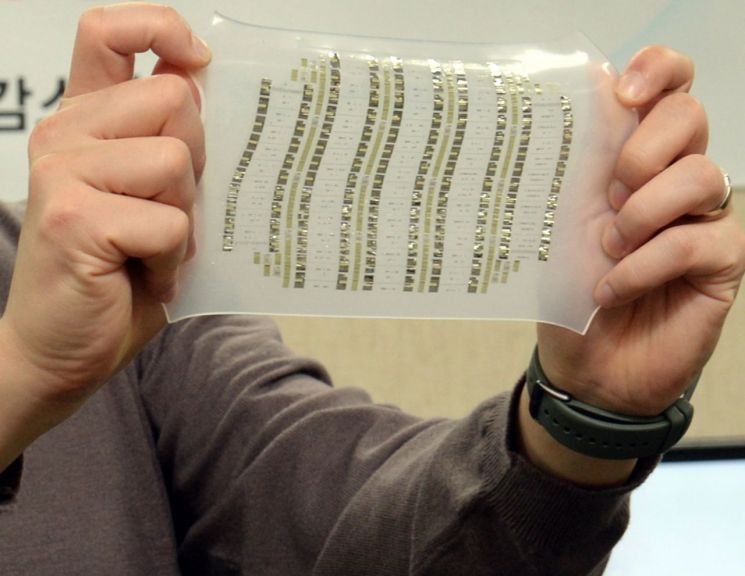
[Asia Economy Reporter Kim Bong-su] Domestic researchers have developed a stretchable inorganic semiconductor device capable of creating stretchable displays that can stretch and bend like rubber bands.
The Electronics and Telecommunications Research Institute (ETRI) announced that it has succeeded in developing the world's first high-performance, high-reliability stretchable inorganic thin-film transistor (TFT) technology capable of high-density integration. The research results were published online on August 24 in the international journal Nature Communications.
Stretchable displays are next-generation display panels that can be stretched and contracted tightly like rubber bands. To realize highly versatile, high-resolution stretchable displays, high-performance stretchable semiconductor devices are required. Semiconductor devices control screen pixels by regulating current. Until now, stretchable semiconductor devices mainly used flexible organic materials, but research is expanding into the rigid inorganic materials field such as silicon and metal oxides. Although these materials have less flexibility, they offer superior electrical performance, reliability, and durability.
ETRI researchers developed a semiconductor device structure that places inorganic oxide electronic devices directly on stretchable metal wiring for the first time in the world. This technology adds flexibility to high-performance inorganic semiconductors while dramatically increasing device integration density. The semiconductor device developed by ETRI improved device integration density by about 15 times compared to existing stretchable oxide semiconductor devices, and the current driving performance also increased more than twofold. This simultaneously demonstrated the possibility of product miniaturization and high-resolution display implementation.
The researchers implemented stretchable devices by densely integrating high-performance oxide semiconductor transistors on a serpentine horseshoe-shaped polyimide flexible substrate wiring. The principle is that the serpentine substrate gradually straightens and stretches like a spring. The fabricated device maintains its performance without damage even when stretched up to twice its length.
Previously, inefficient spatial structures repeatedly connected stretchable metal wiring and non-stretchable electronic devices, resulting in low device integration density. However, this development is expected to achieve both stretchability and high image quality of display panels. The newly developed stretchable electronic device is compatible with semiconductor standard processes and can be applied to various stretchable products such as displays, smartphones, TVs, automobiles, healthcare, and skin electronics, attracting particular attention.
Oh Him-chan, a senior researcher at ETRI's Flexible Electronic Device Research Lab, said, "The rapid research and development pace in China has significantly narrowed the semiconductor and display technology gap with our country. We expect that through stretchable electronic device technology, Korea can take the lead in the next-generation semiconductor and display fields."
A researcher involved in the study stated, "Going forward, we plan to focus on simplifying the stretchable semiconductor process to reduce costs and prepare for rapid industrial application."
© The Asia Business Daily(www.asiae.co.kr). All rights reserved.
![Clutching a Stolen Dior Bag, Saying "I Hate Being Poor but Real"... The Grotesque Con of a "Human Knockoff" [Slate]](https://cwcontent.asiae.co.kr/asiaresize/183/2026021902243444107_1771435474.jpg)











