Ministry of the Interior and Safety Approves Organizational Revision Proposals for 20 Ministries at Cabinet Meeting
31 Ministries to Revise Organizational Structures This Month
Staff Reduction for Similar and Overlapping Tasks Following Organizational Diagnosis
Reallocation to Core Tasks Including National Policy Projects
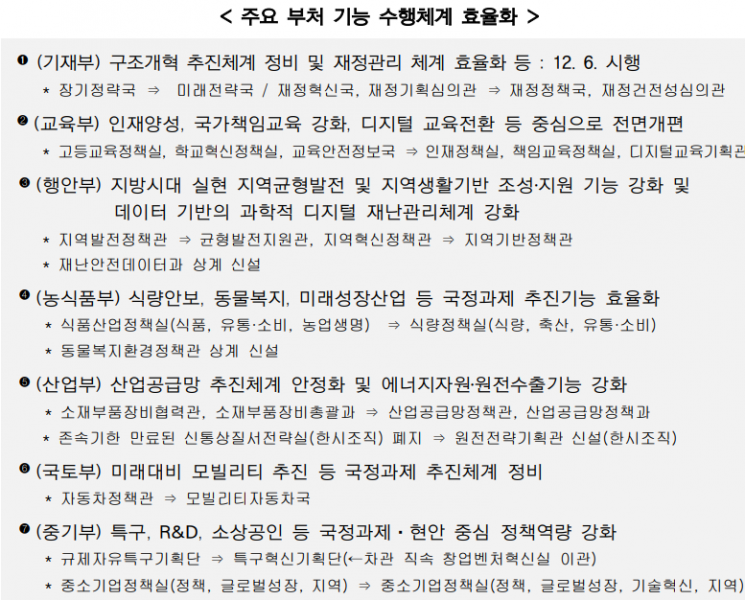
The government is revising the organizational structures of 51 ministries and agencies all at once. The Ministry of Economy and Finance's Long-term Strategy Bureau will be reorganized into the 'Future Strategy Bureau,' and the Ministry of Education's Higher Education Policy Office will be restructured into the 'Talent Policy Office.' One percent of each ministry's personnel will be utilized as a government-wide talent pool and redeployed to new areas such as national agenda projects.
On the 6th, the Ministry of the Interior and Safety announced that the organizational revision proposals for 20 ministries were reviewed and approved at the Cabinet meeting, and the organizational structures of the remaining ministries will be revised within this month. Each ministry conducted a public-private joint government organization diagnosis, identifying personnel reductions in declining functions or overlapping and redundant tasks, and devised a plan to optimize personnel by assigning them to core tasks.
The government redesigned organizational structures reflecting national governance philosophy, minimizing the establishment of additional bodies, adjusting functions between divisions and bureaus, and promoting name changes.
The Ministry of Economy and Finance's Long-term Strategy Bureau will become the Future Strategy Bureau, the Fiscal Innovation Bureau will be renamed the Fiscal Policy Bureau, and the Fiscal Planning Inspector will be changed to the Fiscal Soundness Inspector. The Future Strategy Bureau will be responsible for comprehensive preparation of mid- to long-term national development strategies and demographic structure.
The Ministry of Education will also undergo a large-scale organizational restructuring for the first time in 10 years to respond to digital transformation and demographic changes. The Higher Education Policy Office will be abolished, and a new 'Talent Policy Office' will be established to foster regional talent in cooperation with local governments. The School Innovation Support Office, which was responsible for improving the elementary and secondary education system during the previous administration, will be changed to the 'Responsible Education Policy Office,' focusing on basic academic skills, early childhood education and care, and customized education. Additionally, a 'Digital Education Planning Office' will be established to transition to a digital education system, and a 'University Regulation Reform Bureau' will be created to promote deregulation and structural improvement of higher education.
The Ministry of the Interior and Safety will strengthen functions for balanced regional development and the creation and support of local living infrastructure by renaming the Regional Development Policy Officer to the Balanced Development Support Officer and the Regional Innovation Policy Officer to the Local Infrastructure Policy Officer. To enhance the digital disaster management system based on data, a Disaster Safety Data Division will be newly established.
The government will fully implement the 'Integrated Utilization Quota,' which utilizes 1% of each ministry's personnel as a government-wide talent pool annually. When the integrated utilization quota is designated through organizational diagnosis by each ministry, the Ministry of the Interior and Safety will support necessary ministries with personnel according to priority within the designated scope.
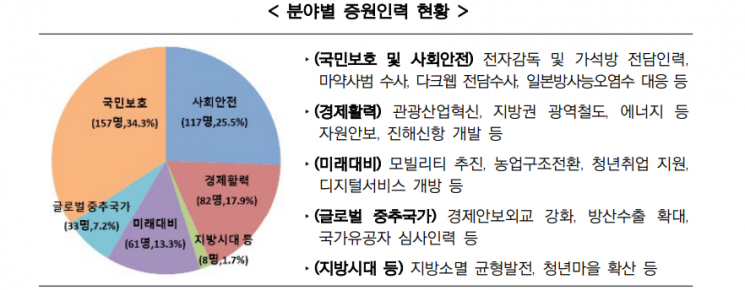
The areas where personnel will be increased include: 274 people in public protection and social safety fields such as electronic monitoring for recidivism prevention, electronic travel authorization for immigration, direct investigation of drug offenders, and dedicated investigations of the dark web; 61 people in future mobility, agricultural structural transformation for carbon neutrality, and youth employment support; and 82 people in tourism industry innovation, resource security such as energy, and the development of Jinhae New Port.
According to this organizational revision, 1,752 personnel will be added to 38 ministries in the 2022 regular organizational allocation. While 1,134 government positions were reduced due to the operation of the integrated quota, including 458 personnel added for national agenda projects, a total of 676 personnel were cut.
Along with government personnel optimization, local governments will maintain their standard personnel levels at this year's level for the next five years. The plan is to efficiently operate new administrative demands through redeployment rather than increasing personnel.
Han Chang-seop, Vice Minister of the Ministry of the Interior and Safety, said, "We are efficiently managing government personnel to improve recent changes in the administrative environment and the national fiscal burden caused by the increase in government personnel. Going forward, we will respond to new personnel demands for national governance within the scope of personnel reductions under the integrated utilization quota, maintain the current scale of government personnel, and manage organizations and personnel efficiently."
© The Asia Business Daily(www.asiae.co.kr). All rights reserved.


















