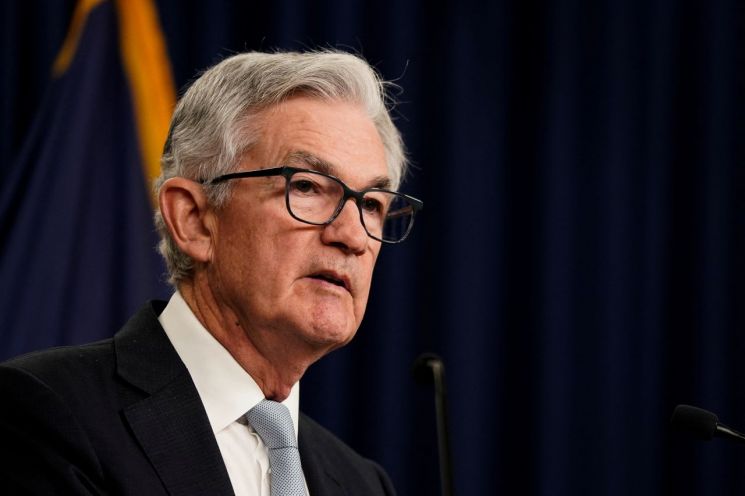
[Asia Economy New York=Special Correspondent Joselgina] The U.S. benchmark interest rate is expected to surpass 5% next year. This is due to the overheated labor market showing little signs of cooling down, increasing the likelihood that the Federal Reserve (Fed) will act more hawkishly (favoring monetary tightening) than initially anticipated by the market. This also explains why Fed Chair Jerome Powell, despite signaling a slowdown in pace, warned that the Fed could maintain "higher interest rate levels for a longer period."
On the 5th (local time), the Wall Street Journal (WSJ) reported that the central bank Fed is expected to raise its interest rate forecast to 4.75-5.25% in the dot plot to be released after the Federal Open Market Committee (FOMC) meeting on the 13th-14th. This would officially mark the beginning of the 5% benchmark interest rate era. The forecast in the September dot plot was 4.5-4.75%.
This is because, despite the overall inflation rate peaking and slowing down recently, the labor market remains overheated. In particular, the November employment report released late last week played a decisive role. Nonfarm payrolls in the U.S. exceeded expectations by more than 30%, and the average hourly wage rose to twice the forecast (0.6% month-over-month).
Especially as wage growth pressures, which Chair Powell has expressed concern about multiple times, were confirmed, there is growing speculation that interest rates could be raised to higher levels than investors currently expect. Bank of America (BoA) described the November employment report as "a message that the Fed has more work to do," predicting that the terminal rate will rise to 5-5.25%. Former Treasury Secretary Larry Summers said, "Wage growth is too high. The Fed needs to raise rates further," adding, "6% is not excessive, not just 5%."
The economic indicators released that day also fueled concerns about Fed tightening. The November ISM Services Purchasing Managers Index (PMI) recorded 56.5, exceeding the baseline of 50 that separates expansion from contraction. It surpassed both the previous month’s 54.4 and the forecast of 53.5%. October manufacturing orders also increased by 1% month-over-month.
Considering that Fed officials have stated that future interest rate levels will depend on data, these strong indicators ultimately support the case for a prolonged tightening cycle. WSJ noted, "The wage growth trend and inflation in the service sector could push the Fed’s terminal rate above the 5% currently expected by investors," adding, "If the labor market does not cool down, the Fed will worry that inflation could rise again."
Currently, the market expects the Fed to take a big step of raising rates by 0.5 percentage points at next week’s FOMC, which would bring the U.S. benchmark interest rate to 4.25-4.5%. Some predict that big steps will continue until February next year. According to the Chicago Mercantile Exchange (CME) FedWatch tool, the federal funds (FF) futures market currently prices in a 50% chance of a big step in February and a 36.8% chance of a baby step (0.25 percentage point increase). WSJ reported that there could be a clash at the February FOMC between hawks advocating for a big step and doves preferring a baby step.
Amid concerns over prolonged tightening, New York stock markets fell across the board. The Nasdaq index, which is sensitive to interest rates and tech stocks, slid 1.93% from the previous close. The Dow Jones Industrial Average, composed of blue-chip stocks, and the large-cap S&P 500 index also closed down 1.40% and 1.79%, respectively. Meanwhile, Treasury yields jumped. The interest rate on the U.S. 2-year note, sensitive to monetary policy, rose 11 basis points to 4.39%, and the 10-year note yield increased 8 basis points to 3.57%.
© The Asia Business Daily(www.asiae.co.kr). All rights reserved.
![Clutching a Stolen Dior Bag, Saying "I Hate Being Poor but Real"... The Grotesque Con of a "Human Knockoff" [Slate]](https://cwcontent.asiae.co.kr/asiaresize/183/2026021902243444107_1771435474.jpg)










