Institutions and LG Energy Solution Lead in Sales
Most Top Net Sold Stocks Focused on Semiconductor and Secondary Battery Sectors
Market Leaders' Investor Sentiment Weakens
Year-End Santa Rally Expectations Deteriorate
[Asia Economy Reporter Minji Lee] The stock index continues to struggle to avoid a downward trend as major investors show net selling in semiconductor and secondary battery stocks. Since these stocks had shown a steep upward trend as leading stocks until recently, profit-taking sales exerted downward pressure on the index. Market experts predict that it will be difficult for the KOSPI to show a rally toward the end of the year, as the sectors that could drive the market are showing sluggish performance.
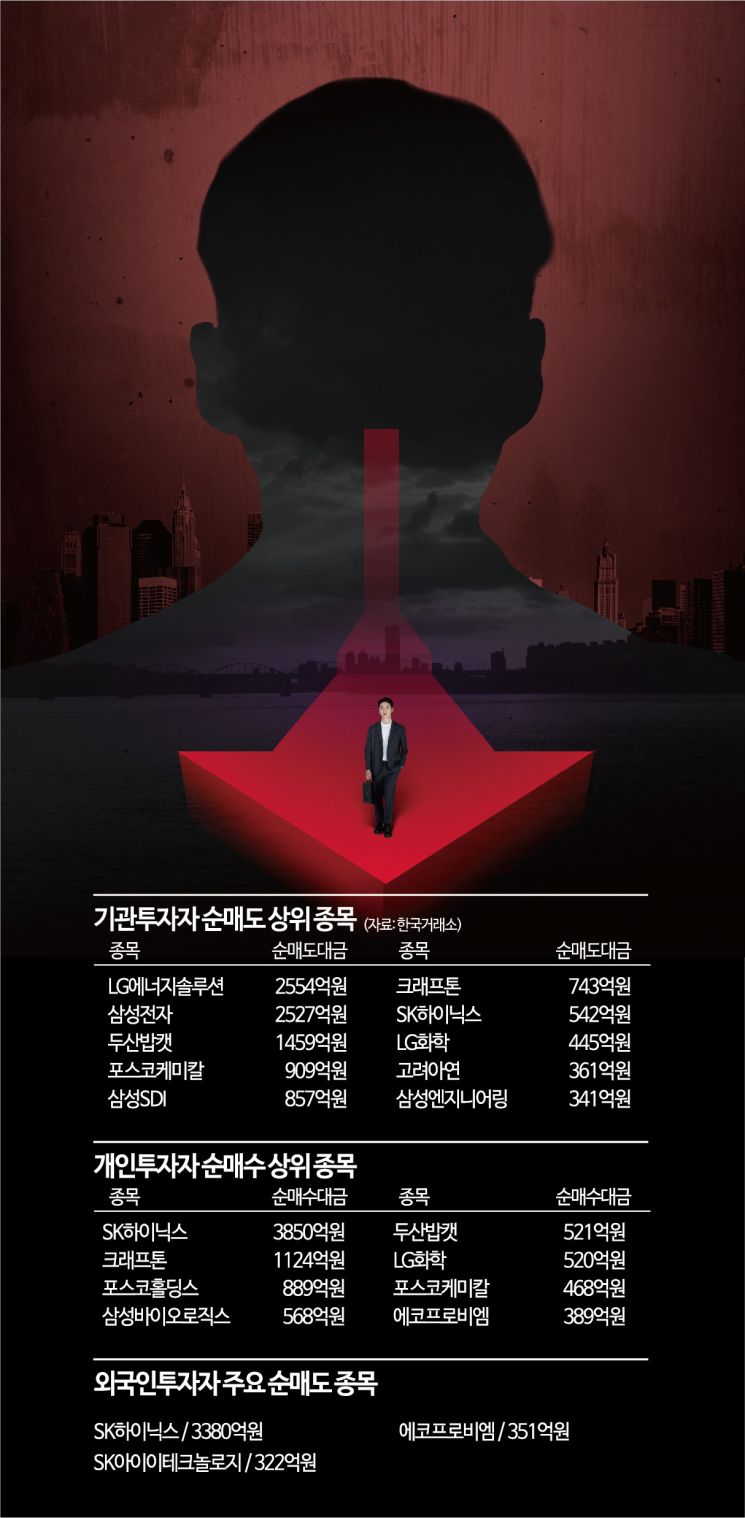
According to the Korea Exchange on the 6th, the stock most sold by institutional investors from the 28th of last month to the day before was LG Energy Solution, totaling 255.4 billion KRW. This was followed by Samsung Electronics (252.7 billion KRW), Doosan Bobcat (145.9 billion KRW), POSCO Chemical (90.9 billion KRW), and Samsung SDI (85.7 billion KRW). Most of the top net sold stocks by institutions were concentrated in semiconductor and secondary battery-related stocks.
Foreign investors appeared to continue buying semiconductor and secondary battery stocks by purchasing Samsung Electronics (279 billion KRW), LG Energy Solution (234.7 billion KRW), and Samsung SDI (100.6 billion KRW), which institutional investors had sold. However, they sold large volumes of SK Hynix (338 billion KRW) and SK IE Technology (32.3 billion KRW). These sell orders were absorbed by individual investors, with net buying amounts led by SK Hynix (385 billion KRW), POSCO Chemical (46.8 billion KRW), EcoPro BM (38.9 billion KRW), and SK IE Technology (35.5 billion KRW).
Since October, as expectations for a shift in the U.S. Federal Reserve's (Fed) interest rate policy and the attractiveness of low valuations focused investor sentiment on semiconductor and secondary battery stocks, profit-taking sales are presumed to have occurred. At that time, as institutional and foreign buying increased, stock prices of companies such as LG Energy Solution (31%), SK IE Technology (27%), and Samsung Electronics (13%) soared significantly.
In particular, concerns about a downturn in the semiconductor industry are believed to have increased the volume of sell orders. As the economy enters a slowdown phase, worries are spreading that the demand decline will be greater than expected. Micron, the largest U.S. memory semiconductor manufacturer, announced plans to reduce semiconductor production by 20% next year. Meanwhile, in November, the export volume of semiconductors, a key export item, in South Korea dropped nearly 30% compared to the previous year.
The market expects further slowdown in semiconductor exports, which could lead to additional declines in stock prices. Amin Kwon, a researcher at NH Investment & Securities, said, “The low point after the financial crisis in December 2008 (-50%) was in October 2019 (-32%), which is similar to the current situation. Considering that the decline period lasted more than two years back then and the current external economic conditions, it is highly likely that the semiconductor growth rate will further slow down.”
Seungwoo Lee, a researcher at Eugene Investment & Securities, also analyzed, “Although semiconductor stocks could have rebounded due to the continuous decline since the beginning of the year and expectations for the Fed's interest rate policy shift, most semiconductor companies’ guidance is not positive. Considering the current inventory situation, it seems difficult to seek an additional rebound after the semiconductor stock price has already rebounded.”
As investor sentiment toward leading stocks weakens, expectations for a year-end Santa rally are also deteriorating. On the 1st, the KOSPI closed at 2,501.43, but it has since fallen nearly 100 points and is trading around the 2,410 level. Kyungmin Lee, a researcher at Daishin Securities, said, “It is difficult to expect a trend reversal in the KOSPI as the previously leading semiconductor and secondary battery sectors continue to weaken. Although short-term rotation continues and the KOSPI fluctuates within a box range between 2,400 and 2,500 points, the upward momentum is weakening.”
© The Asia Business Daily(www.asiae.co.kr). All rights reserved.

![Clutching a Stolen Dior Bag, Saying "I Hate Being Poor but Real"... The Grotesque Con of a "Human Knockoff" [Slate]](https://cwcontent.asiae.co.kr/asiaresize/183/2026021902243444107_1771435474.jpg)















