[Seoul District News] Jung-gu, Seoul Creates Communication Space 'Noldaga' for Single-Person Households at Hwanghak-dong Life Culture Support Center, Pilot Operation from the 13th ... Gwanak-gu Youth Hangout 'Sillim-dong Three Room' Single-Person Household Youth Housing Management Program Popular ... Seodaemun-gu Welfare Patrol Team Checks Every Corner of the Community Care Area ... Yeongdeungpo-gu Wins Seoul Mayor's Award at 'Seoul Dementia Management Project Performance Evaluation Contest' ... Yongsan-gu Conducts Survey to Identify and Support Isolated Single-Person Households
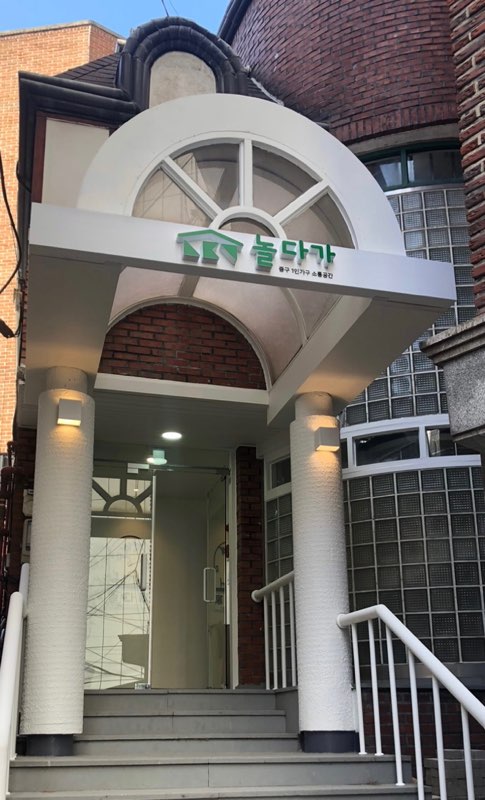
[Asia Economy Reporter Park Jong-il] Jung-gu, Seoul (District Mayor Kim Gil-seong) is creating a communication space called ‘Noldaga’ for single-person households and will begin pilot operation from the 13th.
The district remodeled the Hwanghak-dong Life Culture Support Center (20-7 Nangye-ro 17-gil) to create a space of about 200㎡ from the basement 1st floor to the 2nd floor for the increasing number of single-person households. The construction, which took place from the 8th to the end of November, includes ▲ Basement 1 private rooms (media viewing room, resting area) ▲ 1st floor Singlebonggeul Sarangbang (lounge, lecture room, resting area) ▲ 2nd floor Everyone’s kitchen and conversation room. The rooftop will also be newly transformed through additional construction next year.
During the pilot operation period (from the 13th to January 27 next year), it will be open every Tuesday to Saturday (1 pm to 8 pm), and visitors will receive souvenirs on a first-come, first-served basis. Various events, including ‘Golbang Cinema’ on the 15th, are also planned.
Since 40% of households residing in Jung-gu are single-person households, various customized supports have been provided to create a ‘Jung-gu where it is good to live alone.’ Starting with the ‘Hongdangmu Market’ in March, eight programs under ‘Jung-gu Singlehak Introduction’ such as ‘Happy Table’ and ‘Financial Management Special Lecture’ for middle-aged and older adults were operated until November, with 658 residents participating.
Going forward, ‘Noldaga’ will serve as a base for relaxation and hobby gatherings, raising expectations among single-person households.
District Mayor Kim Gil-seong said, “The communication space ‘Noldaga’ is expected to help prevent social isolation of residents living alone and form social networks,” adding, “Jung-gu will continue to implement various policies so that single-person households are not marginalized and can participate in community activities.”
Gwanak-gu (District Mayor Park Jun-hee)’s youth cultural space ‘Sillim-dong Three Room’ is gaining popularity among young people with its ‘Single-Person Household Housing Support Program.’
Gwanak-gu, which has the highest youth population ratio nationwide (41%), also has a youth single-person household ratio of 62.4%. Reflecting these regional characteristics, the district provides comprehensive support for young people through a one-stop housing service for single-person households at Sillim-dong Three Room.
Located on Nokdu Street in Daehak-dong, which is easily accessible to youth, ‘Sillim-dong Three Room’ is a youth cultural space where young people gather in one place to communicate and exchange ideas on common interests such as employment, housing, and daily life.
The ‘Youth Housing Management Program,’ which provides living rooms, studies, and workshops for mostly single-person youth households and supports youth activities through housing legal, financial, and policy counseling and housing accompaniment services, is a specialized project of the Seoul Youth Center Gwanak Orang Sillim-dong Three Room.
Programs most favored by youth include legal housing education by lawyers for tenant youth, housing policy education that simplifies youth housing policies, and housing finance education in collaboration with Woori Bank Sillim-ro Financial Center. The number of applicants was 2 to 5 times the number of participants, and the program was successfully conducted from July to October.
The ‘Youth Housing Accompaniment Service’ for stable housing settlement of young workers and single-person households introduces basic knowledge about finding a house and real estate prices and accompanies youth from housing search to lease contract, playing a strong role in preventing unfair fraud such as double contracts and ‘empty lease’ scams.
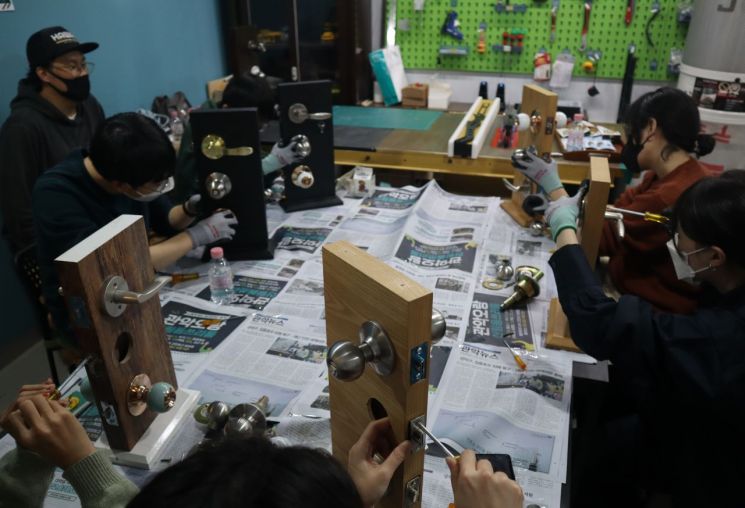
Also, the ‘Home Repair School Program’ with famous YouTuber ‘Kang Saem Hardware’ teaches how to easily solve many household problems alone, such as using tools, replacing door handles and electrical devices, and woodworking repairs, attracting great interest from youth. After the announcement, the recruitment quota was exceeded within a day, with about three times the number of applicants compared to the recruitment number.
By November, about 300 young people had selected and received the single-person household housing support services they needed, and the satisfaction of participating youth reached 4.8 out of 5 points, receiving favorable reviews.
A participant in the single-person household housing support project at Sillim-dong Three Room said, “I think it is a very good plan because I can choose and listen to the housing policies I need through professional instructors currently working in the field,” adding, “I got the impression that policies for young single-person households are systematically implemented in this area.”
A district official said, “Through the one-stop service for young single-person households at Sillim-dong Three Room, we continuously provide essential information and services to young people living alone,” and “Next year, when ‘Gwanak Youth’ is launched, we will promote more diverse information provision and support policies that resonate with young people’s lives.”
Seodaemun-gu (District Mayor Lee Seong-heon) will operate a Welfare Patrol Team and Community Care Group from January next year after preparation this month to discover vulnerable households in welfare blind spots and prevent solitary deaths.
The district aims to build a dense social safety net to thoroughly discover vulnerable households so that incidents like the death of a mother and daughter in Sinchon do not recur.
The Welfare Patrol Team consists of members of local professional organizations and honorary social welfare officers who are familiar with the neighborhood.
They patrol designated neighborhood areas on assigned days, checking for signs of resident crises such as mailboxes piled with unpaid bills.
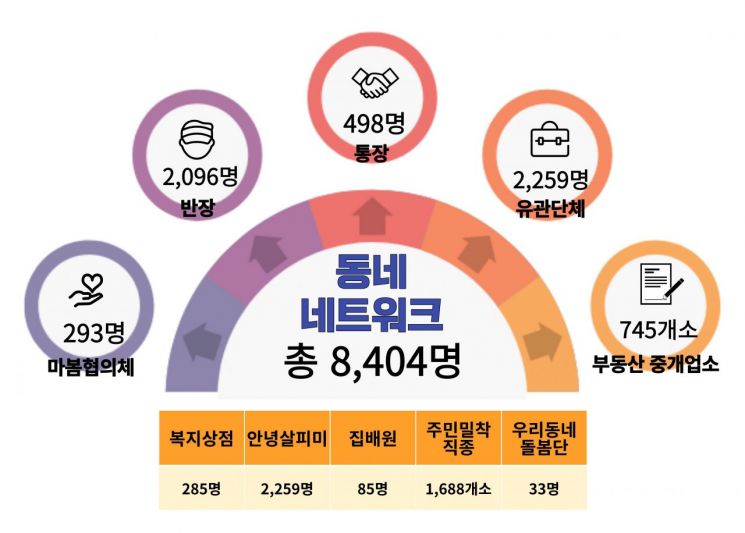
The district plans to expand the number of honorary social welfare officers participating from about 3,300 to about 8,400. To this end, gas, water, and electricity meter readers and yogurt delivery workers will be regularly commissioned quarterly. To enhance the effectiveness of the project, they will also receive training on ‘Welfare Blind Spot Discovery and Reporting Manual.’
The district will also appoint community leaders and block chiefs as members of the Community Care Group to strengthen the role of discovering welfare blind spots.
Additionally, to proactively discover vulnerable households living in motels, small rooms, rooftop residences, and socially isolated households, a welfare network involving about 740 real estate agencies in the area will be established this month.
Real estate agents will guide tenants to report to the local community center if rent is overdue during lease contracts and provide welfare service information.
Furthermore, the district will activate a direct text reporting center to the district mayor, a vulnerable household reporting window on the district website, and non-face-to-face IT welfare services (Happy 1004 Call, Angel Talk, Angel Chatbot), and actively communicate with related ministries and agencies to secure overdue utility bill information based on actual residence rather than registered residence.
To promote these projects, a ‘Public-Private Cooperation Vulnerable Household Discovery T/F’ consisting of about 30 people including related academics, field experts, representatives of collaborative organizations and professional groups, and public officials will be formed and operated.
District Mayor Lee Seong-heon said, “Socially isolated households are continuously increasing due to the weakening of family-centered care functions,” adding, “We will do our best to activate neighborhood networks and support the discovery of welfare blind spots so that no more tragic incidents occur.”
Yeongdeungpo-gu (District Mayor Choi Ho-kwon) announced that it was selected as an excellent institution and received the Seoul Metropolitan Mayor’s Award at the ‘2022 Seoul Dementia Management Project Performance Evaluation Competition.’
The ‘Seoul Dementia Management Project Performance Evaluation Competition’ is held annually to enhance the quality of services and solidify future project operations by sharing the achievements and best practices of dementia management projects conducted throughout the year.
The competition evaluated quantitative and qualitative indicators across all dementia management project activities targeting dementia safety centers in 25 autonomous districts, and the award ceremony was held on December 1 using both online and offline methods.
At this competition, Yeongdeungpo-gu Dementia Safety Center received high evaluations across indicators such as ▲ dementia early screening achievement rate ▲ discovery of high-risk groups and blind spots ▲ use and satisfaction of dementia safety center programs ▲ customized case management and community resource linkage ▲ promotion and awareness improvement, earning the honor of the award.
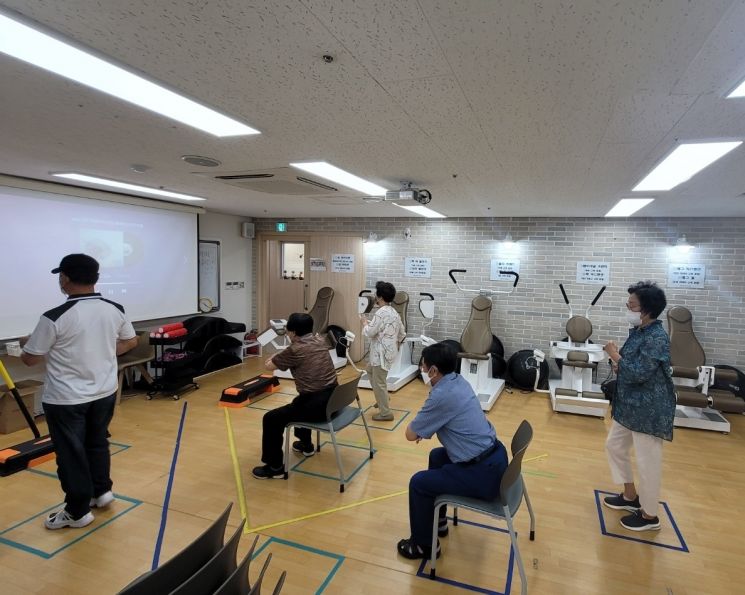
Since its opening in 2009, Yeongdeungpo-gu Dementia Safety Center has actively carried out various projects for dementia prevention and management in the community. It has led early detection of dementia through ‘visiting screening services’ considering accessibility for elderly with mobility difficulties and has strived to provide customized programs reflecting the needs of the target group, such as operating cognitive play cafes and distributing cognitive learning materials.
It also stood out for efforts to create a dementia-friendly environment by inducing active interest and participation from the community. Currently, it has formed a network with 221 related institutions such as senior universities and welfare centers in the area, maintaining close cooperative relationships for dementia care, and has established a dense dementia safety net with 42 dementia safety affiliated stores, 24 dementia overcoming leading institutions, and 117 volunteers.
A district official said, “The valuable results were achieved through the joint efforts of the center and the community to overcome dementia, from prevention and early detection to systematic treatment and management,” adding, “We will continue to do our best to create a dementia-friendly Yeongdeungpo-gu where dementia patients, their families, and local residents can live without worry.”
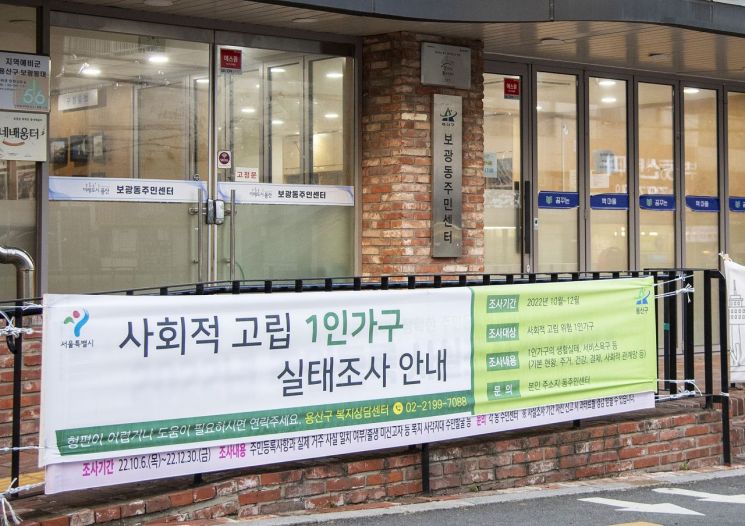
Yongsan-gu (District Mayor Park Hee-young) has launched a survey to discover and support socially isolated single-person households.
The purpose is to detect vulnerable households in welfare blind spots early and prevent risk situations such as solitary deaths in advance. The district conducted a survey last year targeting middle-aged and older (50 years and above) single-person households in vulnerable residential areas such as rental housing and goshiwon (small, cheap rooms).
The current survey period runs until January next year, with survey teams organized and operated according to the circumstances of each of the 16 community service centers. Face-to-face surveys are the principle, but non-face-to-face methods can be combined depending on the situation.
The survey targets 6,587 people. In last year’s survey of middle-aged and older single-person households, there were ▲ 4,407 residents who refused or were absent during the survey ▲ 2,053 at risk of solitary death ▲ 127 subjects of community center’s own projects.
The survey covers ▲ basic information and social networks such as age, gender, marital status, family and acquaintances status, and degree of social activity ▲ economic, residential, and health status such as occupation, income, housing type, housing environment, and health condition ▲ major problems and solitary death risk group investigation.
A district official said, “If the survey results determine a household to be at risk, we plan to provide welfare services by linking them to various supports including basic living allowance, public benefits, emergency welfare, and care services,” adding, “We will continue to carefully manage to prevent welfare blind spots from occurring.”
Meanwhile, the district conducted a pre-education session for personnel conducting the socially isolated single-person household survey on the 17th of last month. The session covered overall topics such as survey subjects and methods.
© The Asia Business Daily(www.asiae.co.kr). All rights reserved.
![Clutching a Stolen Dior Bag, Saying "I Hate Being Poor but Real"... The Grotesque Con of a "Human Knockoff" [Slate]](https://cwcontent.asiae.co.kr/asiaresize/183/2026021902243444107_1771435474.jpg)


















