'Coercion to Refuse Transport and Obstruction of Transport' Alleged Violation of the Fair Trade Act
Cargo Solidarity Union "Ambiguity in Scope of Allegations and Data Submission" Protest
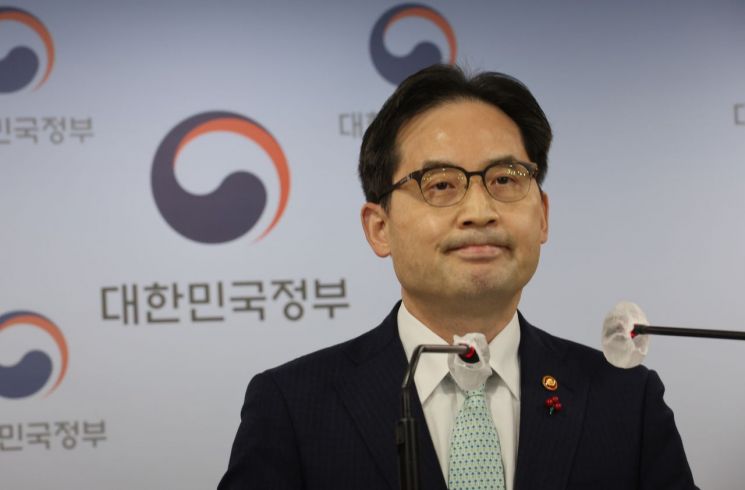 Kang Ki-jung, Chairman of the Fair Trade Commission, is announcing the principle of strict response to the 'Cargo Solidarity's obstruction of investigation' at the briefing room of the Government Seoul Office Building on the 2nd.
 [Image source=Yonhap News]
[Asia Economy Reporter Jang Hee-jun] The Fair Trade Commission attempted again on the 5th to conduct an on-site investigation of the Cargo Solidarity Headquarters (Cargo Solidarity) of the Korean Confederation of Trade Unions Public Transport Workers' Union three days after the initial attempt, but it was unsuccessful. The Fair Trade Commission plans to attempt the investigation again on the 6th.
At around 10 a.m. that day, the Fair Trade Commission sent investigators to the Public Transport Workers' Union building in Gangseo-gu, Seoul, where the Cargo Solidarity office is located. However, similar to the situation on the 2nd, the Cargo Solidarity side blocked entry to the building, citing the absence of representatives of the organization, preventing the investigation from starting.
Both sides attempted negotiations in the afternoon but failed to narrow differences regarding the specificity of the allegations and the scope of data submission.
Cargo Solidarity stated that the investigation purpose written on the investigation commencement notice, "Investigation of violations of Article 40 Paragraph 1 and Article 51 Paragraph 1 of the Monopoly Regulation and Fair Trade Act," is excessively vague.
In a statement released that day, Cargo Solidarity argued, "The investigation into the Fair Trade Act violations against Cargo Solidarity, a labor union of cargo workers, is unjust," and claimed, "Defining Cargo Solidarity as a business association violates International Labour Organization (ILO) conventions." They further criticized, "The Fair Trade Commission's investigation purpose is abstract, and its methods and scope are unlimited, infringing on the rights of the investigated party," adding, "Requesting submission of all materials related to union operations and activities, including personal information, without specifying the allegations, violates the constitutional warrant principle and the proportionality principle under the Fair Trade Act."
The Fair Trade Commission's Busan office also revisited the Cargo Solidarity Busan Regional Headquarters in Nam-gu, Busan, around the same time three days later, but withdrew around 4 p.m. as the office door was closed.
The Fair Trade Commission is investigating whether Cargo Solidarity violated Article 40 (Prohibition of Unfair Joint Acts) and Article 51 (Prohibited Acts of Business Associations) of the Fair Trade Act during the general strike. The core issue is whether they coerced affiliated businesses to refuse transportation (participate in the strike) or obstructed transportation by other businesses. Even if it is a union, if it has the characteristics of a business association, the regulations on prohibited acts of business associations can be applied, and it is presumed that cargo truck owners affiliated with Cargo Solidarity are considered business operators.
The Fair Trade Commission's Busan office reportedly demanded the submission of materials such as struggle guidelines, member lists, withdrawal lists, general meeting minutes, strike and transportation refusal notices, disciplinary records for non-participating members, and instructions related to obstructing non-union transportation in the report and submission order delivered to the Cargo Solidarity Busan Regional Headquarters on the 2nd.
The Fair Trade Commission holds the position that on-site investigations are urgent because if internal materials related to agreements are destroyed, it would be difficult to prove illegality. They plan to respond strictly, viewing continued refusal of investigation as obstruction under the Fair Trade Act. Deliberately blocking or delaying entry to the site to refuse, obstruct, or evade investigation can result in imprisonment of up to three years or a fine of up to 200 million won.
However, since the Fair Trade Commission does not have compulsory investigation rights such as seizure and search, it is expected to be difficult for them to forcibly enter the office immediately.
© The Asia Business Daily(www.asiae.co.kr). All rights reserved.
![Clutching a Stolen Dior Bag, Saying "I Hate Being Poor but Real"... The Grotesque Con of a "Human Knockoff" [Slate]](https://cwcontent.asiae.co.kr/asiaresize/183/2026021902243444107_1771435474.jpg)
















