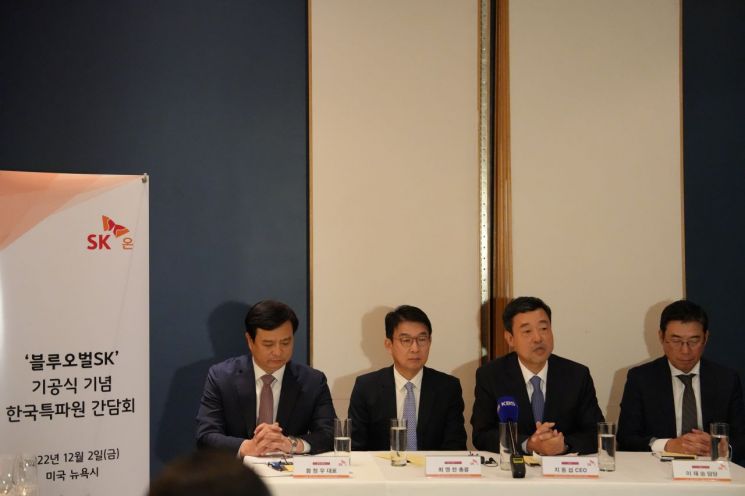
 Jidongseop, President of SK On (third from the left), is holding a press briefing to commemorate the groundbreaking ceremony of BlueOvalSK in Manhattan, New York, USA (local time) on the 2nd. From the left, Ham Changwoo, CEO of BlueOvalSK; Choi Youngchan, President of SK On's Management Support Division; President Ji; and Lee Jaeseung, Marketing Manager.
 [Photo by SK On]
[Asia Economy New York=Special Correspondent Joselgina] "By 2025, the production scale in the United States will become the largest. Since we have proactively invested in batteries within the U.S., we believe the implementation of the Inflation Reduction Act (IRA) will also be advantageous in the long term."
Ji Dong-seop, President of SK On, stated this during a press briefing held in Manhattan, New York, on the 2nd (local time), a few days before the groundbreaking ceremony of the Kentucky plant in the U.S. He said, "When the BlueOvalSK expansion investment is completed in 2025, SK On will rank among the global top 3 battery manufacturers." The BlueOvalSK project is a joint venture between SK On and Ford Motor Company (BlueOvalSK), investing a total of 10.2 trillion KRW to establish the largest electric vehicle battery production facility in the U.S.
Visiting the U.S. for the groundbreaking ceremony on the 5th, President Ji evaluated this expansion by saying, "The importance of the U.S. business is increasing. It is very meaningful to secure a definite business position in the U.S." Through the BlueOvalSK project, SK On plans to build three plants by 2025: Kentucky plants 1 and 2, and Tennessee plant 1. The combined annual production capacity of these three sites will be 129 GWh, enough to produce 1.2 million units of Ford's popular model, the F-150 Lightning.
Accordingly, SK On's global production system will undergo significant changes. Based on confirmed investments so far, the U.S. production scale is expected to expand to 180 GWh by 2025, accounting for the largest share of total battery production (280?300 GWh). This will be followed by China (75 GWh) and Europe (50 GWh+a). President Ji said, "I thought it was important to have a balanced global production system for producing batteries, which are the core of electric vehicles," adding, "The opportunity for investment in China, which drove the electric vehicle market, came first; then Europe in terms of OEM orders; and now the U.S." He also emphasized, "The U.S. climate change response policy will contribute to strengthening the competitiveness of the electric vehicle industry ecosystem," and "By employing more than 10,000 people, it will also revitalize the local economy."
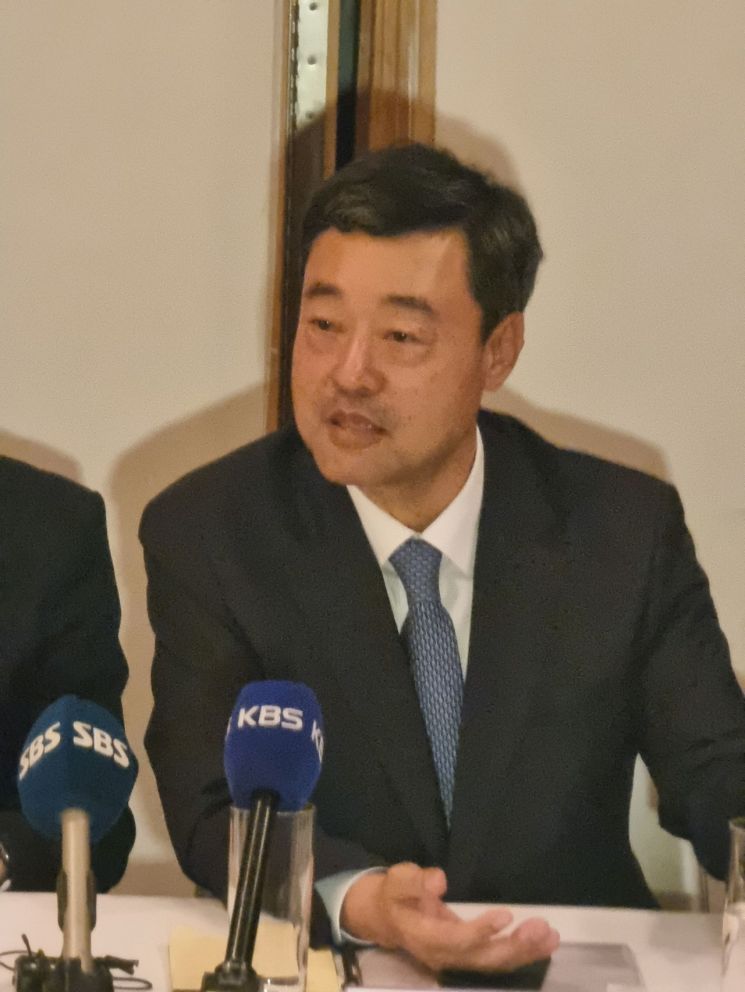 Ji Dong-seop, President of SK On, held a press briefing with correspondents on the 2nd in Manhattan, New York, USA (local time) to commemorate the groundbreaking ceremony of Blue Oval SK.
 [Photo by SK On]
SK On also expressed confidence regarding the implementation of the U.S. Inflation Reduction Act. The act primarily provides subsidies only for electric vehicles assembled in North America that use batteries containing a certain percentage of critical minerals sourced from the North American region.
President Ji said, "We did not predict the implementation of the Inflation Reduction Act, but we have prepared intercontinental raw material and logistics systems for China, Europe, and the U.S.," adding, "The batteries produced in the U.S. have sourced (critical minerals) from FTA countries." This proactive logistics network setup has positioned them to benefit from the Inflation Reduction Act.
He acknowledged, "It is true that the supply chain regulations announced by the U.S. are inconvenient," but emphasized, "Competition regarding regulations is relative; if companies respond quickly first, they can gain a competitive advantage in a favorable environment." He continued, "We are already prepared and will reinforce any lacking parts," adding, "Although the expansion speed of electric vehicles by Ford, Hyundai Motor Company, and others in the U.S. is fast, there will be no disruption in preparation."
On this day, President Ji evaluated not only SK On but also the entire Korean battery industry, saying, "LG and our expansion investments are more proactive than other battery companies," and "From the perspective of the two companies leading the way, it is advantageous in the long term." Regarding the specific scale of benefits from the Inflation Reduction Act, he replied, "Detailed regulations will be announced by the end of this year, so estimates can be made then."
He drew a line on the recently heightened U.S.-China tensions, saying they have not yet felt significant damage to their business. President Ji said, "We must accept the geopolitical environment," adding, "Governments are changing industrial promotion and supply chain policies, so companies have no choice but to adapt quickly. We will faithfully navigate according to each country's environment."
SK On recently signed a memorandum of understanding for battery supply cooperation for North American electric vehicles with Hyundai Motor Group. Starting proudly by saying that Hyundai Motor is selling electric vehicles well, he explained, "SK On supplies 100% of the batteries for models like the Ioniq 5." He added, "We will proceed quickly with joint venture establishment, expansion, and other agreements." He also cited SK On battery's strengths as being 'longer,' 'faster,' and 'safer.'
Additionally, President Ji mentioned factors considered when deciding investments, such as whether the region is preferred by OEMs, whether the investment cost is relatively low, whether quality employment is possible, and whether the logistics supply chain is well established. He said, "The U.S. is relatively disadvantaged in terms of labor costs compared to Asia," but added, "We can gain a competitive edge in terms of government incentives and policies. We also need to consider relationships with OEMs and volume orders."
© The Asia Business Daily(www.asiae.co.kr). All rights reserved.
!["The Woman Who Threw Herself into the Water Clutching a Stolen Dior Bag"...A Grotesque Success Story That Shakes the Korean Psyche [Slate]](https://cwcontent.asiae.co.kr/asiaresize/183/2026021902243444107_1771435474.jpg)

















