Representative Assembly's Personnel System Committee Points Out "Cause of Judicial Populism Expansion"
Chief Justice Kim's Term Expires in September Next Year... Judicial Community Interested in Assembly's Conclusion
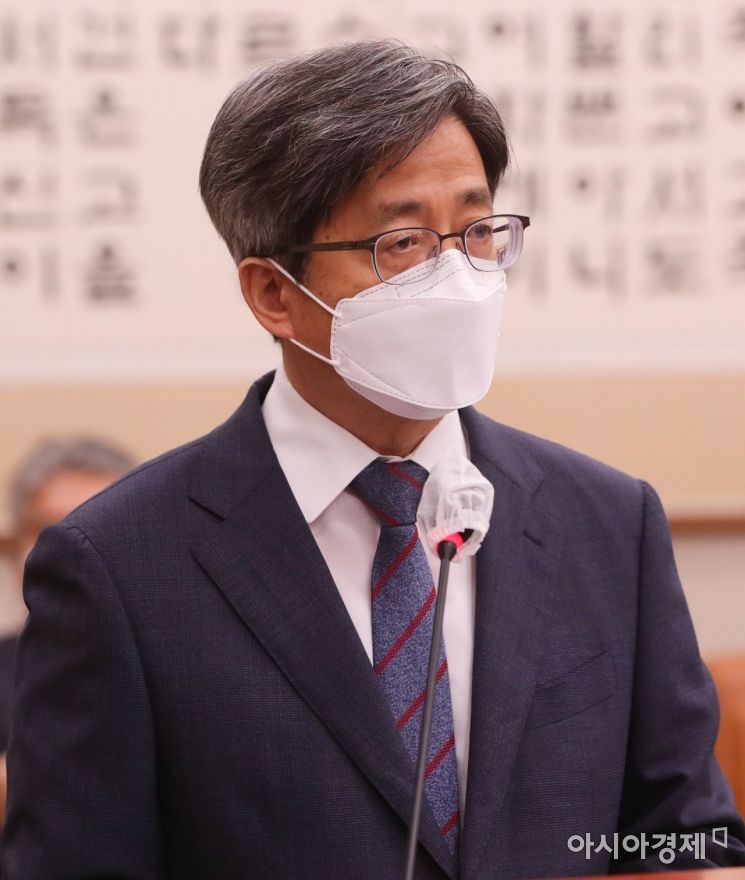 Chief Justice Kim Myung-soo is delivering a greeting at the National Assembly audit on the Supreme Court held on October 4. Photo by Yoon Dong-joo doso7@
[Asia Economy Reporter Heo Kyung-jun] As criticism arises against the ‘Court Chief Judge Candidate Recommendation System’ promoted by Chief Justice Kim Myung-soo since his inauguration, discussions on the matter are taking place at a meeting where representative judges from courts nationwide gather. Since the conclusion drawn at the meeting reflects the consensus of judges across the country, analyses suggest that Kim Myung-soo’s key policy, the Court Chief Judge Candidate Recommendation System, is at a critical crossroads depending on the meeting’s outcome.
The National Judges’ Representative Meeting held a session on the 5th at the Judicial Research and Training Institute in Goyang, Gyeonggi Province, to discuss the Court Chief Judge Candidate Recommendation System and related issues. The National Judges’ Representative Meeting is an official forum where judges can express opinions or make recommendations on judicial administration and judicial independence matters.
At the meeting, a total of seven agenda items were discussed. Among these, the Court Chief Judge Candidate Recommendation System attracted the most attention. This system was introduced by Chief Justice Kim to establish horizontal judicial administration and a dual-track judge personnel system, and it will be expanded next year to 20 district courts nationwide.
Court chief judge candidates must meet the following criteria: ▲ at least 22 years of legal experience ▲ at least 10 years of service as a judge ▲ be among district court chief judges who have received recommendations from three or more judges. Judges who receive recommendations become candidates, and the judges belonging to the court vote to decide. The candidate with the most votes does not automatically assume the position of court chief judge; rather, the Chief Justice refers to the voting results when appointing court chief judges. However, there have been many cases where the judge with the most votes in the candidate election became the court chief judge.
On the other hand, criticism has continuously been raised within the judiciary that deciding court chief judge candidates through a popularity vote is problematic. Also, since the final decision authority lies with the Chief Justice and the candidate elected by frontline judges does not automatically become the court chief judge, there are concerns that this system effectively strengthens the Chief Justice’s autocratic power.
Justice Oh Seok-jun also expressed a negative stance on the Court Chief Judge Candidate Recommendation System during his confirmation hearing. Justice Oh said, "I somewhat agree with the criticism that the system delays trials and undermines the hardworking atmosphere of the courts," adding, "Judges are not accustomed to elections or voting, and the purpose of the court chief judge recommendation system seems to be to select from those who serve mostly long-term or lifetime positions within their respective courts."
In this context, the Judges’ Personnel System Subcommittee under the Judges’ Representative Meeting raised concerns, stating, "There are criticisms that the Court Chief Judge Candidate Recommendation System is a popularity vote and a cause of expanding judicial populism." This is the first time the judiciary has officially raised issues regarding the Court Chief Judge Candidate Recommendation System.
Lee Young-hoon, chief judge of the Seoul Western District Court and chairman of the Judges’ Personnel Subcommittee under the Representative Meeting, recently criticized the system in a post on the internal court bulletin board, calling it "an unreasonable legacy-securing effort by the Chief Justice with little time left in his term." Judge Lee stated, "There are criticisms that the Court Chief Judge Candidate Recommendation System is a popularity vote and a cause of expanding judicial populism," and argued, "Before the decision to expand the system next year, the Court Administration Office and the Supreme Court should clarify whether they have reviewed the system’s achievements, pros and cons, and gathered opinions from members."
In response, the Court Administration Office stated, "The implementation of the Court Chief Judge Candidate Recommendation System has fostered a democratic and horizontal judicial administrative culture and facilitated smooth communication between court chief judges and members."
After drawing conclusions through the Representative Meeting, opinions on the Court Chief Judge Candidate Recommendation System will be conveyed to Chief Justice Kim Myung-soo, making it highly likely that the system’s continuation or abolition will be decided based on the meeting’s results. If negative opinions about the system gather at the Representative Meeting, it is expected within the judiciary that Chief Justice Kim, whose term expires in September next year, will not be able to maintain the candidate recommendation system.
© The Asia Business Daily(www.asiae.co.kr). All rights reserved.
![Clutching a Stolen Dior Bag, Saying "I Hate Being Poor but Real"... The Grotesque Con of a "Human Knockoff" [Slate]](https://cwcontent.asiae.co.kr/asiaresize/183/2026021902243444107_1771435474.jpg)
















