Seongmo Hospital Seoul St. Mary's Professor Ansdeban Research Team
Human Allogeneic 'Gamma Delta T Cells'
Proven Tumor Size Reduction and Survival Extension Effects in Animal Models
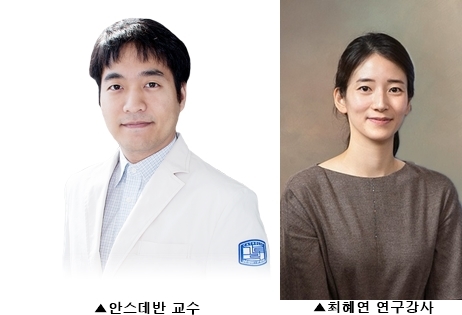 Professor An Seudevan, Department of Neurosurgery, Catholic University Seoul St. Mary's Hospital; Research Lecturer Choi Hyeyeon, Department of Microbiology, College of Medicine.
[Asia Economy Reporter Lee Gwan-joo] Domestic researchers have proposed a new anticancer immunocyte therapy for glioblastoma, a malignant brain tumor known as the 'worst cancer.' The potential of 'gamma delta T cells' to treat glioblastoma was confirmed in animal models.
Professor An Se-devan of the Department of Neurosurgery at Seoul St. Mary's Hospital, The Catholic University of Korea, and Research Lecturer Choi Hye-yeon of the Department of Microbiology at the College of Medicine announced on the 5th that when allogeneic human gamma delta T cells extracted from healthy individuals were directly injected into tumors of glioblastoma animal models (rats), tumor size was reduced and survival was extended.
Glioblastoma is a representative type of glioma, the most common malignant brain tumor, and is a brain cancer with a poor prognosis, with an average survival rate of less than two years even after standard treatments including surgery, chemotherapy, and radiation therapy. Recently, various immuno-oncology cell therapies have been proposed as new treatment strategies for glioblastoma, which is close to incurable.
Recently, in the medical field, 'Adoptive Cell Transfer,' a therapy that isolates human immune cells called T cells, enhances their ability to recognize and attack cancer cells, and then reintroduces them into the patient, has been gaining attention. Allogeneic cells refer to cells received from donors other than the patient themselves. Gamma delta T cells account for about 5% of total T cells but exhibit tumor suppressive effects in various ways. Unlike alpha beta T cells, they have fewer immune rejection reactions, allowing the use of donor cells rather than the patient's own cells.
Professor An's team conducted experiments to identify the most important receptor-ligand binding occurring during glioblastoma treatment. As a result, various ligands were expressed on glioblastoma cells, and it was confirmed that gamma delta T cells bind well with DNAM-1 ligands. Receptors are proteins that enter cells for signal transmission, and numerous types of receptors are found in normal cells. Molecules that bind to receptors are called ligands, and attaching ligands that target receptors specifically present on cancer cells allows for more precise attacks on cancer, leading to research on various ligands for treatment.
Professor An stated, "This study established the preclinical efficacy of gamma delta T cells against glioblastoma and biomarkers for patient groups likely to respond well to the treatment." He added, "Since gamma delta T cells bind well with DNAM-1 ligands, selecting glioblastoma patients with high DNAM-1 ligand expression through clinical trials using gamma delta T cells for anticancer immunocyte therapy is expected to yield high therapeutic responses."
This study was published in the international journal of tumor therapy and immunology, OncoImmunology (5-Year IF: 8.240). It also won the Best Poster Award at last month's Autumn Conference of the Korean Society for Immunology.
© The Asia Business Daily(www.asiae.co.kr). All rights reserved.

















