Controversy Rekindled as Local Governments Announce 'Independent Lifting' Amid Slowing Trend
Health Authorities and Experts Emphasize 'Unified Quarantine Network'
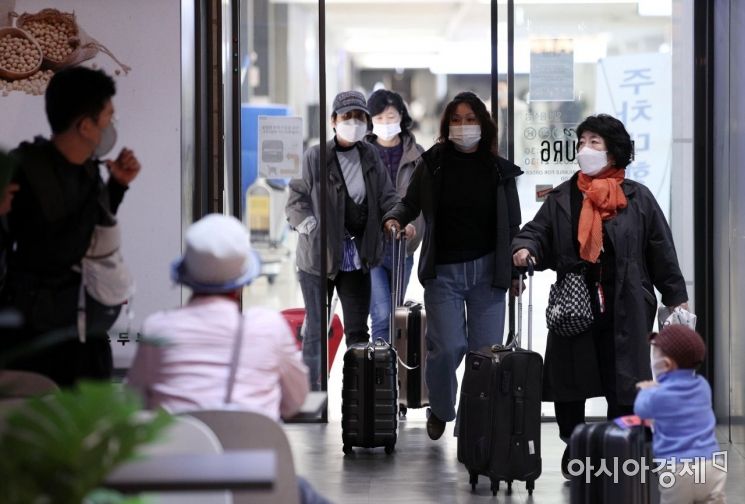
[Asia Economy Reporter Jo In-kyung] As the COVID-19 resurgence slows down, Daejeon City has announced that it will be the first local government in the country to independently lift the indoor mask-wearing mandate. Although health authorities emphasized a 'unified quarantine network' and effectively put the brakes on this move, discussions about lifting the indoor mask mandate, one of the last remaining preventive measures, are likely to gain momentum again.
According to health authorities on the 4th, Daejeon City recently sent an official letter to the Central Disaster and Safety Countermeasures Headquarters for COVID-19 stating that "if the government does not lift the indoor mask-wearing mandate by the 15th, the city will issue its own administrative order to implement the lifting."
This is the first time a local government has officially expressed a stance different from the government regarding mask mandates. Daejeon City cited reasons for pushing to lift the indoor mask mandate, including the fact that most people already remove masks in places like restaurants and cafes, reducing effectiveness, and that mask-wearing does not help children's emotional and language development.
In response, the Central Disease Control Headquarters (CDCH) said, "The lifting of the indoor mask mandate will be implemented through a decision by the Central Disaster and Safety Countermeasures Headquarters," adding, "Since operating a unified quarantine network is important, we plan to closely coordinate with Daejeon City to include this in the CDCH's action plan."
It seems unlikely that a government-level decision regarding indoor masks will be made before the 15th, the date proposed by Daejeon City. Health authorities stated, "We plan to monitor the epidemic situation and specify the timing for easing the indoor mask mandate through public forums and advisory committee discussions," with the first expert forum scheduled for the 15th. After the first and second expert forums and advisory committee meetings, the Central Disaster and Safety Countermeasures Headquarters will make the final decision on quarantine measures.
Authorities: "Maintain Until Epidemic Stabilizes"
However, if Daejeon City insists on lifting the mandate independently without waiting for the CDCH decision, it is uncertain whether the central government can intervene. Currently, the Infectious Disease Prevention and Control Act stipulates that, besides the Minister of Health and Welfare and the Director of the Korea Disease Control and Prevention Agency, local government heads such as mayors and governors can also take infectious disease prevention measures.
A CDCH official said, "So far, COVID-19 quarantine measures have been implemented through discussions and consultations at the CDCH level, involving related ministries and 17 local governments. While local government heads can decide on stricter measures than those decided by the CDCH, they have been required to consult with the CDCH in advance when intending to ease quarantine measures," adding, "We will continue to consult with Daejeon City."
Experts generally agree that a consistent quarantine response at the central government level is preferable. Professor Eom Jung-sik, an infectious disease specialist at Gachon University Gil Medical Center, pointed out, "It is true that local governments have authority in deciding quarantine measures, but it is necessary to consider whether they are sufficiently prepared for that level of responsibility."
In particular, considering the possibility of an increase in critically ill patients due to other respiratory infections such as influenza from December to January, lifting the indoor mask mandate may be premature. Professor Eom said, "It is reasonable for major quarantine decisions to be coordinated with the central government and other local governments rather than made unilaterally by a local government," adding, "I am curious whether there has been sufficient consultation with regional medical institutions that will have to handle the increased disease burden, and whether the risk of increased severe cases and deaths has been fully assessed."
Korea Disease Control and Prevention Agency Director Baek Kyung-ran also emphasized in a briefing last month, "The indoor mask-wearing mandate and the 7-day isolation requirement for confirmed cases will be maintained until the winter epidemic stabilizes," adding, "Indoor mask-wearing is a necessary measure to safely get through the winter epidemic."
However, regardless of Daejeon City's move, if the COVID-19 resurgence that began in earnest last month stabilizes faster than expected, discussions about lifting the indoor mask mandate may gain momentum again. Some experts diagnose that the resurgence is already passing its peak. Currently, among major countries in the United States and Europe, almost none maintain a full indoor mask mandate, and mask-wearing requirements are applied only in specific places such as medical facilities or public transportation.
© The Asia Business Daily(www.asiae.co.kr). All rights reserved.

















