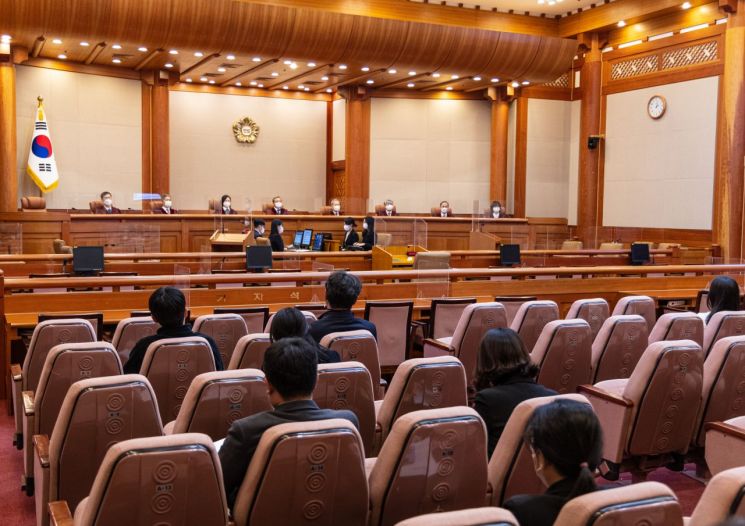
 Chief Justice Yoo Nam-seok of the Constitutional Court and the constitutional justices entered the Grand Bench of the Constitutional Court in Jongno-gu, Seoul, on the afternoon of the 24th to begin the November ruling.
 [Image source=Yonhap News]
[Asia Economy Reporter Heo Kyung-jun] The Constitutional Court has ruled that the current legal provision punishing those who obstruct the work of others, organizations, or public officials performing their duties through malicious pranks or similar acts does not violate the Constitution.
On the 4th, the Constitutional Court announced that it unanimously dismissed a constitutional complaint claiming that Article 3, Paragraph 2, Subparagraph 3 of the Minor Offenses Punishment Act suppresses free expression due to its vague definition.
The petitioner, Mr. A, posted several opinions related to COVID-19 on the local government’s website between November and December 2020. The local government deemed Mr. A’s posts as malicious complaints and requested a police investigation. The police applied the Minor Offenses Punishment Act to Mr. A and filed a summary trial request. Subsequently, the court suspended the imposition of a 100,000 won fine.
Mr. A filed a constitutional complaint arguing that the phrase “malicious pranks, etc.” can be interpreted in various ways and that its scope is too broad, raising concerns that investigative agencies might exercise arbitrary judgment. Article 3, Paragraph 2, Subparagraph 3 of the Minor Offenses Punishment Act, which was the subject of the review, stipulates punishment such as fines for “persons who obstruct the work of others, organizations, or public officials performing their duties through malicious pranks, etc.”
The Constitutional Court dismissed Mr. A’s petition. The Court viewed the scope of “malicious pranks” as acts that annoy and bother others to the extent that they interfere with others’ work, exceeding the general tolerance limit and being subject to criticism, but possessing illegality that does not reach the level of criminal offenses such as obstruction of business or obstruction of official duties under the Criminal Act.
The Court stated, “Although these acts do not fall under obstruction of business or obstruction of official duties under the Criminal Act, the types of acts that interfere with work or official duties or pose such risks are very diverse. Therefore, if these were to be specifically identified or enumerated as examples, regulatory gaps could occur.”
It further ruled, “The somewhat broad provision of ‘malicious pranks, etc.’ allows judges to comprehensively consider the content of the obstructive act, the counterpart of the act, and the circumstances before and after the act in individual cases to determine whether to apply the provision under review.”
Additionally, the Court added, “When applying the provision under review, careful attention must be paid to avoid unjust infringement of citizens’ rights, and the law must not be applied for purposes other than its original intent.” It noted that the abuse prohibition clause prevents the Minor Offenses Punishment Act from being applied arbitrarily and extensively.
© The Asia Business Daily(www.asiae.co.kr). All rights reserved.

















