Surcharge Applied from 10 PM
Empty Taxis Lined Up
Civilians Express Mixed 'Welcome' and 'Burden' Reactions
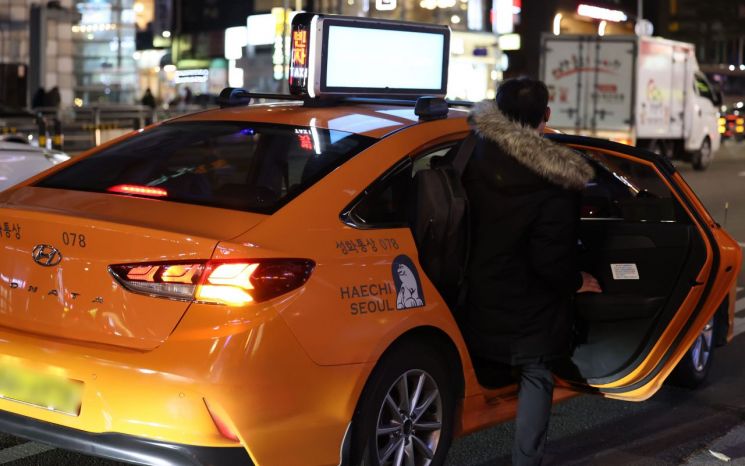 A taxi operating in downtown Seoul on the afternoon of the 1st, when the late-night surcharge adjustment for taxi fares was implemented. [Image source=Yonhap News]
[Asia Economy Reporter Seongpil Cho] Around 10 p.m. on the 1st, office worker Mr. A was shivering in the cold below freezing while waiting for a taxi at the west taxi stand of Seoul Station. Expressing dissatisfaction with the earlier start of the surcharge time, he soon got into a taxi that arrived at the stand, saying, "It's cold and if I want to get home quickly, I have no choice."
Near Seoul Station and Gangnam Station close to midnight, taxis were lined up along the street. Since COVID-19, citizens in this area have had to endure severe "taxi crises" every night. However, on this day, a scene of many empty taxis lined up was seen. Citizens were boarding taxis immediately without having to wait.
Since Seoul City changed the taxi surcharge fare system this month, the scenery at taxi stands in Seoul has changed. Starting from the 1st, the late-night surcharge for Seoul taxis began two hours earlier than before, from 10 p.m. From 11 p.m. to 2 a.m. the next day, a 40% surcharge, double the usual 20%, was applied. The basic fare for a mid-sized taxi, normally 3,800 won, rose to 4,600 won from 10 p.m. to 11 p.m. and from 2 a.m. to 4 a.m., and jumped to 5,300 won from 11 p.m. to 2 a.m. This adjustment to Seoul's late-night surcharge fares is the first in 40 years since 1982.
Public reactions are mixed. Office worker Mr. Yoo (35) said, "It was usually hard to catch a taxi late at night, but now it's good because I can get one right away." Mr. Jang (41) also said, "After the subway stops running, I had no choice but to take a taxi, but it was frustrating because I couldn't catch one before. Now that taxis are lined up, I don't have to waste my emotions anymore."
Many citizens also felt burdened by the fare increase. Mr. Kang (28) said, "I took a taxi after 10 p.m. and was surprised that the basic fare started at 4,600 won. It used to cost about 10,000 won for the distance, but now it was over 12,000 won." He added, "The fare increase is steep, so I strongly feel that I should get home before the subway stops running if possible." Another office worker, Mr. Jeon (29), sighed, "There are many days when I work overtime until dawn when public transportation stops. Since I have no choice but to take a taxi, the surcharge increase hits me hard."
There were also opinions that the fare increase was inevitable. Office worker Mr. Son (45), who was waiting for a taxi at Seoul Station, said, "As prices rise, taxi fares need to increase as well. Since 10 p.m. is not even a time when public transportation stops, it doesn't seem like an unreasonable situation where you are forced to take a taxi."
Taxi drivers generally welcomed the expansion of the late-night surcharge. Working conditions for taxi drivers have been very poor, so there is some expectation that income might increase a little. On the other hand, among corporate taxi drivers, while they welcome the fare increase, there is concern that the daily quota they pay to the company might also rise. Corporate taxi driver Mr. Lim (65) said, "The treatment of corporate taxi drivers might remain the same as now. Maybe that's why we haven't heard news of drivers returning yet."
© The Asia Business Daily(www.asiae.co.kr). All rights reserved.
![Clutching a Stolen Dior Bag, Saying "I Hate Being Poor but Real"... The Grotesque Con of a "Human Knockoff" [Slate]](https://cwcontent.asiae.co.kr/asiaresize/183/2026021902243444107_1771435474.jpg)











