Morgan Stanley & S&P "India, with current growth rate, will be world's 3rd largest by 2030"
Concerns raised over high trade dependence and geopolitical events
[Asia Economy Culture Young Intern Reporter] Experts from Wall Street in the United States have predicted that India will surpass Japan to become the world's 3rd largest economy by 2030.
According to CNBC on the 1st (local time), S&P Global and Morgan Stanley jointly released a report forecasting that if India maintains its current growth rate, it could surpass Japan and Germany to become the 3rd largest economy in the world within 10 years.
As of 2021, the GDP rankings by country are led by the United States with $22.9961 trillion. China ranks 2nd with $17.734 trillion, Japan is 3rd with $4.9374 trillion, and Germany is 4th with $4.2231 trillion. The United Kingdom is 5th with $3.1868 trillion, while India currently holds 6th place with $3.1733 trillion and already surpassed the UK's GDP in the first half of 2022.
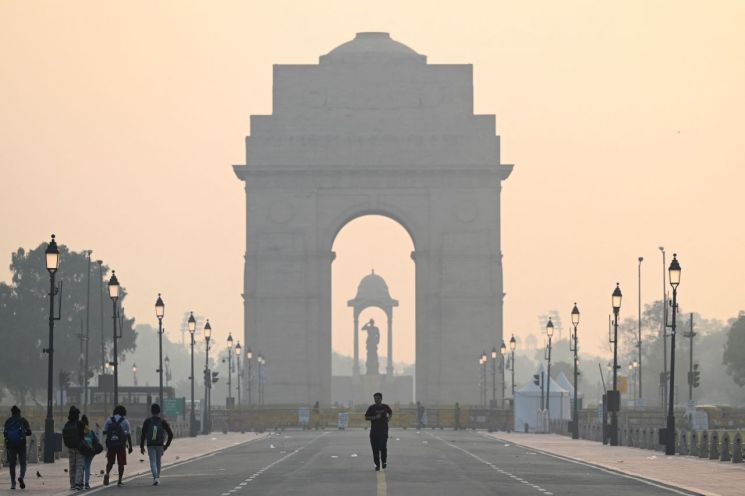 The capital New Delhi shrouded in smog due to the Hindu festival Diwali in India last October. Photo by AFP Yonhap News
Morgan Stanley predicted that India's GDP could more than double by 2031. Analysts at Morgan Stanley stated in the report, "India has the conditions to enjoy an economic boom through offshoring, manufacturing investment, energy transition, and advanced digital infrastructure," adding that the global economy will be reorganized into a tripartite system of the United States, China, and India.
S&P also projected that assuming India's annual nominal GDP growth rate averages 6.3% until 2030, India will surpass Japan by 2030. Wall Street experts highly praised the Indian government's efforts to transform the country into a manufacturing powerhouse and a hub for foreign investment, noting that the PLIS (Production Linked Incentive Scheme), which provides tax benefits and incentives to domestic and foreign companies relocating production facilities to India, is expected to play a crucial role in the growth of India's manufacturing sector.
In fact, supported by strong domestic demand and the service sector, India's GDP in the second quarter of this year increased by 13.5% compared to the same period last year, and the growth rate in the third quarter recorded 6.3%, slightly exceeding Reuters' forecast of 6.2%.
However, concerns have been raised that high trade dependence amid the global recession could impact India's economic growth. Additionally, risks to the Indian economy include the supply of skilled labor, geopolitical concerns, and political missteps. The Indian Ministry of Finance recently expressed concerns that exports could shrink due to the global economic slowdown.
© The Asia Business Daily(www.asiae.co.kr). All rights reserved.
![Clutching a Stolen Dior Bag, Saying "I Hate Being Poor but Real"... The Grotesque Con of a "Human Knockoff" [Slate]](https://cwcontent.asiae.co.kr/asiaresize/183/2026021902243444107_1771435474.jpg)











