Emergency Inspection Meeting of the Ministry of Agriculture, Food and Rural Affairs
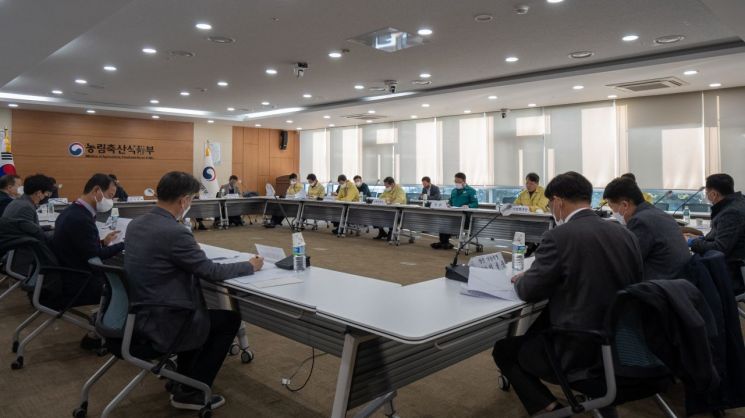 On the 2nd, officials are discussing at an emergency inspection meeting regarding the Cargo Solidarity transport refusal, hosted by the Ministry of Agriculture, Food and Rural Affairs. (Photo by Ministry of Agriculture, Food and Rural Affairs)
[Asia Economy Sejong=Reporter Son Seonhee] Due to the collective transportation refusal by the Cargo Solidarity Union, disruptions in feed supply have caused significant concerns about damage to livestock farms. Additionally, disruptions are expected in the export of fresh agricultural products such as strawberries, prompting the government to take countermeasures.
On the afternoon of the 2nd, the Ministry of Agriculture, Food and Rural Affairs held an emergency inspection meeting chaired by Vice Minister Kim Injoong regarding the current situation. Attendees included representatives from feed companies, agricultural product export companies, transportation companies, the Korea Agro-Fisheries & Food Trade Corporation, the Korea Rural Community Corporation, and the National Agricultural Cooperative Federation.
The participants focused on inspecting the distribution and export logistics status of feed and fresh agricultural products. In particular, the livestock industry relies on imports for most of the raw materials for compound feed and some forage. Currently, feed factories only have enough raw materials for 2 to 3 days, so if the transportation stoppage prolongs, delays in feed supply could cause significant damage to livestock farming.
The Ministry of Agriculture, Food and Rural Affairs plans to establish direct communication lines with producer organizations, the National Agricultural Cooperative Federation, and affiliated companies to monitor real-time developments, and discuss alternative transportation using normally operating ports, as well as additional shipments during nights and weekends.
Exports of fresh food products are also expected to face disruptions. Agricultural product export companies are taking measures such as adjusting shipments and securing alternative vehicles, but if the situation prolongs, they expressed concerns about increased logistics costs (freight and storage fees) and deterioration in the freshness of fresh food products.
Considering that exports of fresh agricultural products such as strawberries are in full swing, the Ministry plans to support securing alternative transportation vehicles and operate a consultation desk for export difficulties. If logistics disruptions worsen, they plan to support the use fees for logistics warehouses near ports.
Vice Minister Kim stated, "Due to the Cargo Solidarity Union strike, significant disruptions are expected in feed and fresh agricultural product export logistics," and took a firm stance, saying, "The Cargo Solidarity Union must stop the illegal strike that causes great damage to the national economy."
© The Asia Business Daily(www.asiae.co.kr). All rights reserved.

















