Seoul National University Records Largest Ever Enrollment Increase
Many Medical School Multiple Admit Students Give Up
High Enrollment Rates in Top-Tier and Popular Majors
Changes in Admission Groups Also Affect Enrollment Rates
 On the 18th, parents participating in the 'Jongno Academy, 2023 Regular Admission College Entrance Explanation Session' held at Sejong University Convention Hall in Gwangjin-gu, Seoul, are listening to explanations related to college entrance exams. Photo by Jang Jin-hyung aymsdream@
[Asia Economy Reporter Han Jinju] Ahead of the 2023 academic year university regular admission, if you wish to apply to a higher-tier school, you need to strategize by considering the 'regular admission fill rate.'
According to JinHakSa on the 3rd, last year’s regular admissions saw an increase in fill rates at Seoul National University, Yonsei University, Sogang University, and Hanyang University, while Korea University and Ewha Womans University experienced a decline.
Seoul National University filled the most spots since officially announcing the number of additional admissions. In particular, the number of additional successful candidates in the humanities field increased significantly. Many students who applied to Seoul National University’s humanities division (Group B) and the medical divisions in Groups A and C, and who were accepted to multiple schools, appear to have declined Seoul National University.
The fill rate refers to the ratio of unregistered spots filled (additional admissions) relative to the number of recruitment spots. A fill rate of 100% means the number of filled spots equals the number of recruitment spots. Generally, fill occurs when there are multiple acceptances, and popular majors with a high proportion of top-tier applicants tend to have many multiple acceptances and high fill rates. For top universities, the fill rate is higher in natural sciences than in humanities because top-tier natural science applicants often withdraw due to multiple acceptances in medical fields, causing a chain reaction of fill within top universities.
A higher fill rate lowers the effective competition ratio. For example, if a department at University A recruits 10 students and 100 apply, the initial competition ratio is 10:1. If 5 of the initially accepted 10 students choose other universities, then to fill those 5 spots, candidates ranked up to 15th get a chance. Since 15 out of 100 are accepted, the effective competition ratio drops to about 6.67:1. When the initial competition ratio in regular admissions is below 3:1, it is practically considered under-enrolled for this reason.
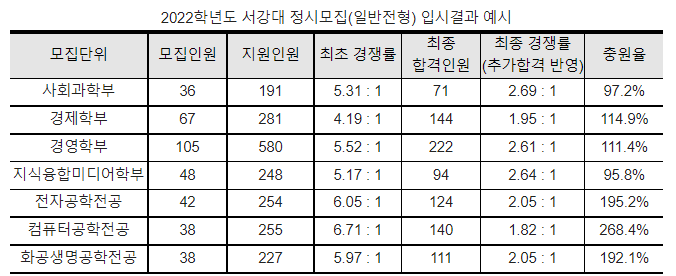
At Sogang University, many departments saw the final competition ratio drop to less than half of the initial ratio compared to the previous year. The Social Sciences Department dropped from 5.3:1 to 2.69:1, the Electronic Engineering major from 6.05:1 to 2.05:1, and the Computer Engineering major from 6.71:1 to 1.82:1, decreasing to half or even one-third of the original ratio.
Except for some major universities in Seoul, most universities experienced a decrease in fill rates. This is analyzed as a result of the integrated CSAT (College Scholastic Ability Test) implemented for the first time last year. As it was the first year of the integrated CSAT, predictions were difficult, and the issue of cross-application by natural science students contributed to a general trend of applying to higher-tier schools. When there are many upward or confident applications, multiple acceptances decrease, leading to fewer additional admissions.
Changes in recruitment groups also affect fill rates. Last year, Seoul National University changed its recruitment group from Group A to Group B, while Yonsei University and Korea University moved from Group B to Group A. For Sungkyunkwan University, which recruits simultaneously from Groups A and B, the fill rate in Group B was much higher than in Group A. When applying to Sungkyunkwan University in Group B, applicants tend to confidently apply to Yonsei University or Korea University in Group A, and when applying to Group A, Sungkyunkwan University becomes an upward application, so applicants are more likely to apply appropriately to universities in Group B.
Woo Yeon-cheol, head of the JinHakSa Admission Strategy Research Institute, advised, "Except for cases where applicants have guaranteed acceptance scores for their target universities and departments, many hope to be accepted to their desired universities through upward applications. It is recommended to establish application decisions and strategies by considering the competition ratios and fill rates of desired universities and departments based on admission results from the past 2 to 3 years."
© The Asia Business Daily(www.asiae.co.kr). All rights reserved.


















