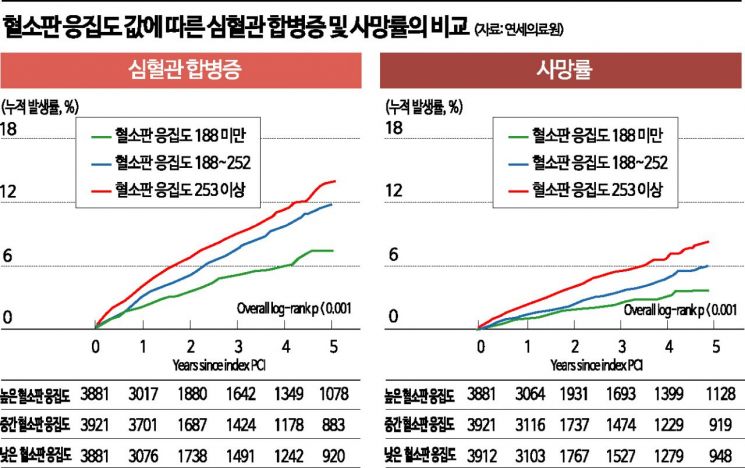
 It was confirmed that the platelet aggregation values are appropriate when they range between 188 and 252 in the East Asian patient group, and the probability of complications significantly increases when exceeding 252.
[Asia Economy Reporter Lee Gwan-joo] From an academic perspective, humanity is a single species called ‘Homo sapiens sapiens.’ However, from a medical standpoint, there are some differences between East Asians and Westerners. For example, the Rh-negative blood type, which is a small minority, appears in about 15% of Westerners but only about 0.5% of East Asians. This indicates the need to establish treatment standards and information tailored to East Asians and Koreans for certain diseases. While domestic researchers are striving to create Korean-specific standards, noteworthy research results are emerging.
Korean Standard Values for Antiplatelet Therapy Established
Recently, domestic researchers have presented attention-grabbing research findings. The research team led by Professors Kim Byung-geuk and Lee Seung-jun from the Department of Cardiology at Severance Cardiovascular Hospital, along with Professors Lim Do-seon and Cha Jeong-jun from Korea University College of Medicine, identified differences in platelet reactivity units (PRU), a measure of platelet aggregation after drug-eluting stent implantation and antiplatelet therapy, between East Asians and Westerners, and proposed standard values suitable for East Asians. Drug-eluting stent implantation is performed to treat ischemic heart disease caused by severe coronary artery stenosis. At this time, antiplatelet agents such as aspirin or clopidogrel are administered to prevent stent thrombosis and serious complications like myocardial infarction and stroke. However, some patients experience reduced effectiveness of antiplatelet therapy and develop complications. Therefore, medical professionals refer to PRU values as a standard when using antiplatelet agents, but until now, these standards have only been based on Western populations.
The research team measured PRU after antiplatelet therapy in 13,160 patients who underwent drug-eluting stent implantation at 32 institutions nationwide and followed them for up to five years. The results showed that patients with high PRU values had poorer post-procedure outcomes and higher mortality rates. Notably, the average PRU for Western patients was 188, whereas East Asian patients generally showed a higher value of 218. They also confirmed that East Asians have an increased risk of fatal complications when PRU exceeds 252.
This study is significant in that it allows the establishment of stent implantation treatment strategies tailored to East Asians. Professor Kim explained, "There was previously no information on clinical outcomes and patterns based on platelet aggregation in East Asians, including Koreans, but through this research, it has become easier to predict prognosis and apply patient-tailored treatment strategies."
Cholesterol Standards for Korean Adults in Their 20s and 30s Proposed
Through a large-scale study targeting young and healthy Koreans, cholesterol threshold values that increase the risk of cardiovascular and cerebrovascular diseases were also proposed. The research team led by Professor Lee Seung-hwan from the Department of Endocrinology at Seoul St. Mary’s Hospital, Professor Kim Mi-kyung from the Department of Endocrinology at Yeouido St. Mary’s Hospital, and Professor Han Kyung-do from the Department of Information Statistics and Actuarial Science at Soongsil University investigated the association between cholesterol levels and cardiovascular and cerebrovascular diseases in 6.2 million adults aged 20 to 39 without diabetes.
Through this, the team confirmed that even young adults have an increased risk of myocardial infarction, stroke, and other cardiovascular and cerebrovascular diseases if their total cholesterol level exceeds 200 mg/dL or their LDL cholesterol, known as ‘bad cholesterol,’ exceeds 130 mg/dL. This study is meaningful in that it provides actual data-based criteria for drug treatment of dyslipidemia in young adults, which had been ambiguous until now. Professor Lee emphasized, "Dyslipidemia is a major risk factor for atherosclerosis, but compared to other chronic diseases such as diabetes and hypertension, it is often considered a mild condition, leading to missed treatment opportunities and worsening. More proactive management is necessary."
© The Asia Business Daily(www.asiae.co.kr). All rights reserved.

















