North Korea's Nuclear Test Purpose... 'Technical Dimension' and 'Political Necessity'
"Difficult to Attract US Attention, Won't Bear Aftermath"
Need to Strengthen Korea-China Relations... "Restrain and Pressure North Korea Through China"
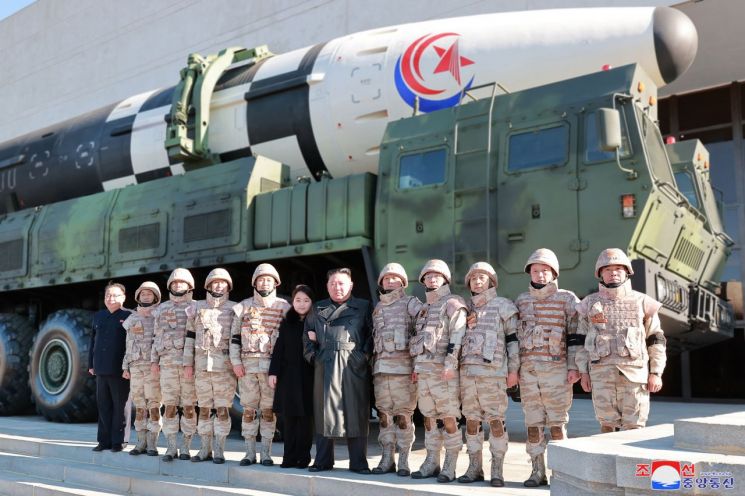 Kim Jong-un, commemorative photo with ICBM contributors... accompanied again by second daughter [Image source=Yonhap News]
[Asia Economy Reporter Jang Hee-jun] Government forecasts predicting the timing of North Korea's 7th nuclear test have repeatedly missed the mark. Experts suggest that considering North Korea's year-end activities and the international situation, the likelihood of a nuclear test within this year is low. However, since there remains a possibility that North Korea will continue its strong confrontation for the time being, there are calls to focus diplomatic efforts on improving relations with China, which can directly pressure North Korea.
Moon Sung-mook, head of the Unification Strategy Center at the Korea Institute for National Strategy, said in a phone interview with Asia Economy on the 2nd, "North Korea's nuclear test should be viewed from two perspectives: 'technical aspects' and 'political necessity.'" He added, "The important factor is the political necessity, which is currently not urgent."
North Korea is assessed to have completed its nuclear capabilities to some extent on the technical side after conducting six nuclear tests. If it carries out an additional nuclear test, it is expected to test the miniaturization of nuclear warheads, including tactical nuclear weapons. North Korea's political necessity is directed toward the United States. North Korea has aimed to be recognized as a nuclear-armed state and has sought to negotiate directly with the U.S., not South Korea.
Moon said, "North Korea will try to create a 'negotiation table' that suits its desires to negotiate with the U.S., but it will judge that it is difficult for things to develop in the desired direction because the U.S. and the international community are showing a tough stance." He added, "Moreover, with the security cooperation among South Korea, the U.S., and Japan strengthening more than ever, the burden on Kim Jong-un's position is likely considerable."
However, he left open the possibility of further provocations, saying, "Since Kim Jong-un recently defined the launch of an intercontinental ballistic missile (ICBM) as a 'milestone in strengthening nuclear capabilities,' North Korea will try to continue strengthening its nuclear forces by any means."
North Korea is believed to have completed the physical preparations for a nuclear test since this spring. Intelligence agencies pointed to the period between the 20th National Congress of the Chinese Communist Party (October 16) and the U.S. midterm elections (November 7) as the most likely timeframe. Additionally, the 29th of last month, marking the fifth anniversary of North Korea's declaration of 'completion of nuclear forces,' was also expected to be a turning point for a nuclear test. However, all these predictions were off.
The unfavorable international situation for North Korea also seems to have played a role. One of its major allies, Russia, is under pressure from the international community while engaged in the war in Ukraine. In China's case, President Xi Jinping secured a third term and has embarked on diplomatic activities. For Xi, both the U.S., which is engaged in a hegemonic competition, and South Korea, an indispensable economic partner, are challenges to address.
Kim Yong-hyun, a professor in the Department of North Korean Studies at Dongguk University, said, "A nuclear test is on a different level from an ICBM launch." He added, "No matter how much China and Russia exercise their veto power at the UN Security Council, conducting a nuclear test would significantly increase the burden."
He continued, "With the U.S. focused on Ukraine, North Korea will likely find it difficult to move the U.S. in the direction it desires."
Professor Kim evaluated the deployment of strategic assets to the Korean Peninsula under the U.S.'s strengthened extended deterrence strategy and the addition of independent sanctions against North Korea as effective measures, but he emphasized that diplomatic efforts toward China must be pursued simultaneously.
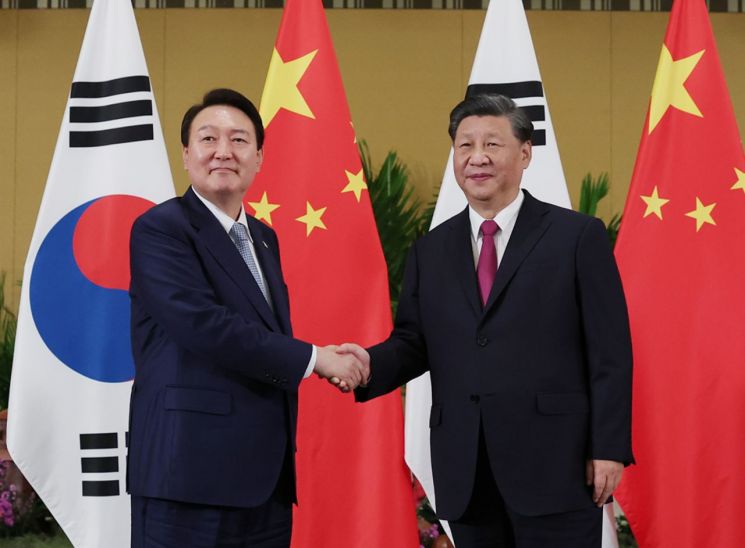
He advised, "While it is important to solidify a series of security cooperation and the South Korea-U.S. alliance, there is a regrettable lack of diplomatic efforts with China, which can directly pressure North Korea. Through improving and strengthening South Korea-China relations, China should be enabled to restrain and persuade North Korea."
© The Asia Business Daily(www.asiae.co.kr). All rights reserved.
![Clutching a Stolen Dior Bag, Saying "I Hate Being Poor but Real"... The Grotesque Con of a "Human Knockoff" [Slate]](https://cwcontent.asiae.co.kr/asiaresize/183/2026021902243444107_1771435474.jpg)

















