TOEIC 40th Anniversary: Graduation, Employment, and Promotion 'Essential'
Test Fee Increase from 18,400 KRW to 48,000 KRW
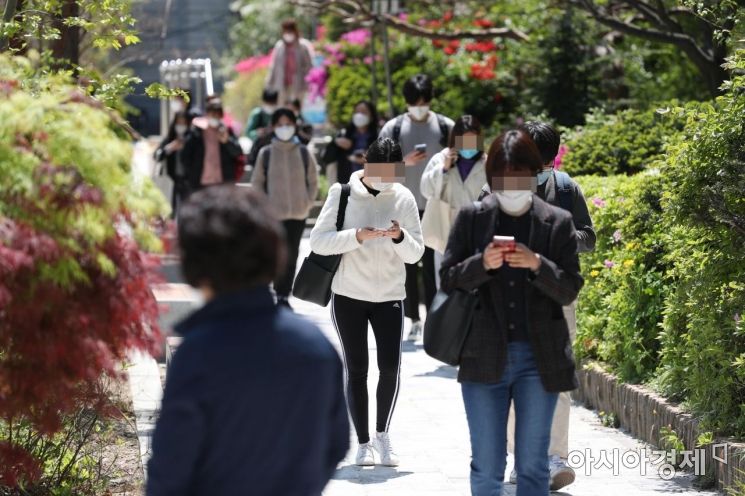 On the 26th, test takers who completed the 398th TOEIC exam, resumed after more than two months due to the spread of the novel coronavirus disease (COVID-19), are leaving the test site set up at Kyungwon Middle School in Seocho-gu, Seoul. Photo by Moon Honam munonam@
[Asia Economy Reporter Yoon Seul-gi] "This time, I have to escape my shoe size." "Can I score over 250 this time?"
The reason why the legendary shoe size story continues in relation to the TOEIC test, known as the 'English proficiency measure' for Koreans, is related to the nature of the exam. Some university students take their first test with no prior knowledge of TOEIC (novice) and end up with a disastrous score equivalent to their shoe size (250~280 points). Those who checked their score reports in mock exams held at universities were astonished.
It has been 40 years since countless job seekers have laughed and cried over TOEIC. TOEIC remains a difficult exam. Although the accumulation of past TOEIC questions and the proliferation of high-score 'tips' have made it somewhat easier than before, TOEIC is still a challenging test where you must solve 200 questions in RC (Reading Comprehension) and LC (Listening Comprehension) within 120 minutes.
According to YBM Korea TOEIC Committee on the 2nd, this year marks the 40th anniversary of TOEIC's introduction in Korea. Introduced in 1982, TOEIC has established itself as a representative English test used as a graduation requirement for university students, an essential qualification for job seekers, and for promotion among office workers.
TOEIC is a relative evaluation English test consisting of RC (Reading Comprehension) and LC (Listening Comprehension). Each section has 100 questions, totaling 200 questions, and the allotted test time is 120 minutes. Considering the time needed for marking the OMR (computer-scored answer sheet), the time to solve the questions is quite tight for test takers.
The high test fee has also been a significant burden for test takers. In 1982, it was $23, which, calculated at 800 won per dollar, is about 18,400 won. This year's test fee is 48,000 won. Considering that the per capita real national income was 5.46 million won then and 36.56 million won in 2021, the cost burden was considerable.
Over time, the difficulty and question trends of the test have also changed. TOEIC was revised twice, in 2006 and 2016. Especially from the 310th TOEIC test in 2016, the 'New TOEIC' was implemented, introducing new question types for each part.
According to the Korea TOEIC Committee, the New TOEIC's listening evaluation added conversations involving three or more people, and question types that require understanding the relationship between dialogues or explanations and visual information, in addition to the existing two-person conversation type. The reading evaluation included messenger conversations, online chats, and text message dialogues.
Although there were concerns that the New TOEIC would increase difficulty, the average score actually rose by 10 points from 677 in 2015 to 687 after the New TOEIC was introduced. Since TOEIC is a relative evaluation test, sudden score drops due to changes in difficulty did not appear.
 The photo is not related to the specific content of the article.
Currently, TOEIC is widely used as a measure of English proficiency. The TOEIC score required for graduation at universities is usually in the 700~800 range. For job applications, many aim for higher scores, with 900 points or above considered stable for final acceptance.
However, achieving a high score on TOEIC is a concern for many young people. Although the required TOEIC scores have been standardized upward, making 900 points seem not difficult, in reality, achieving a high score requires considerable effort. Mr. A, who took TOEIC for university graduation, said, "It was hard to study TOEIC with no English base after the CSAT English test," adding, "I had to score 700 points to graduate, but I underestimated it and ended up applying for graduation deferment because my score was insufficient."
In fact, the average TOEIC score has only risen about 130 points since its introduction. The average score for Korea's regular tests was about 550 points in 1992 and about 680 points in 2022.
Retaking TOEIC repeatedly is also a burden since the validity period is only two years. The test fee is close to 50,000 won, and purchasing RC and LC workbooks, which cost 20,000 to 30,000 won each, adds to the expense.
Mr. Kim, preparing for a media company’s public recruitment exam where TOEIC scores are essential, said, "Since university, I have repeatedly taken TOEIC to achieve a high score or because my score expired," and added, "I started studying TOEIC again as my score was about to expire, but the burden of online lectures, test registration, and buying workbooks is heavy."
Meanwhile, the number of regular TOEIC tests has increased from three times a year at the initial introduction to 26 times, expanding test takers' opportunities.
© The Asia Business Daily(www.asiae.co.kr). All rights reserved.

















