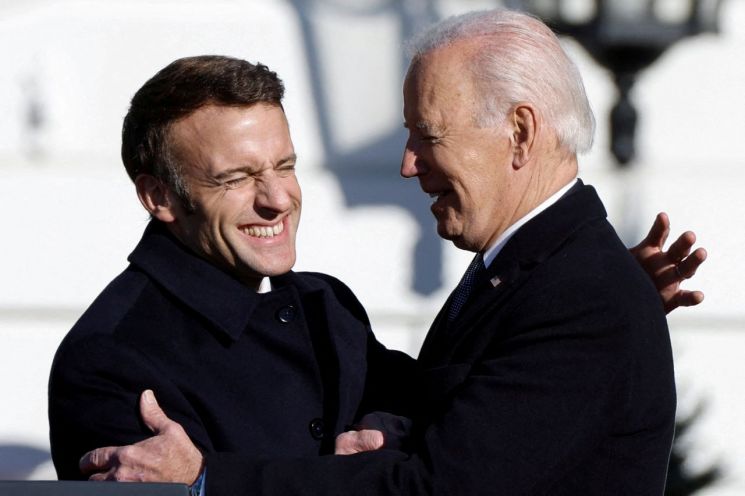
[Asia Economy New York=Special Correspondent Josel Gina] U.S. President Joe Biden has officially indicated for the first time that he may adjust the Inflation Reduction Act (IRA). This move comes after French President Emmanuel Macron, who was on a state visit to the U.S., strongly criticized the law, prompting concerns about cracks in the alliance and causing Biden to take a step back. Attention is now focused on whether the issue of subsidy discrimination against Korean electric vehicles can also be resolved accordingly.
On the 1st (local time), immediately after a summit meeting with President Macron held in Washington D.C., President Biden said at a press conference, "We discussed the Inflation Reduction Act in detail," and stated that through discussions with the European Union (EU), they would "adjust" their differences in position. The Inflation Reduction Act, which provides up to $7,500 in tax credits to electric vehicle buyers, primarily limits eligibility to North American-made vehicles.
President Biden acknowledged that there are several "glitches" in the law that need to be amended. He also emphasized, "There was never an intention to exclude (European companies)," adding, "We will continue to create manufacturing jobs, but we will not sacrifice Europe." It is unusual for President Biden to admit problems related to the Inflation Reduction Act, which is one of his signature legislative achievements.
The joint statement released immediately after the summit included the phrase, "We look forward to the activities of the U.S.-EU task force (TF) on the Inflation Reduction Act." President Macron also confirmed that the two leaders "agreed to more broadly resynchronize the Inflation Reduction Act and industrial policies."
This is widely seen as a move to appease allies. Rising dissatisfaction among allies, including the EU, over the Inflation Reduction Act inevitably poses a burden on the Biden administration. There is a risk of cracks forming in the allied front that has aligned on international issues such as the Ukraine war and China's hegemonic rise.
However, some assessments suggest that President Biden’s remarks indicate only a "tweak" adjustment rather than a full legislative revision. In this case, there may be limitations in reflecting the claims of the EU, South Korea, and others. Local forecasts suggest that modifications will be made in detailed regulations, including core mineral requirements and the scope of application for commercial vehicles. The U.S. Treasury Department is currently collecting opinions to establish detailed regulations related to the Inflation Reduction Act by the end of the year.
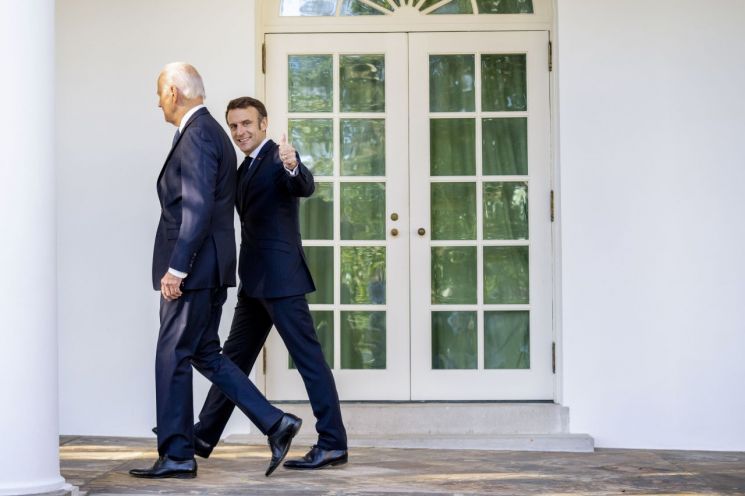
The EU, South Korea, and others excluded from subsidy eligibility view the discrimination as likely violating the ‘national treatment and most-favored-nation treatment principles’ of free trade agreements (FTA) and the World Trade Organization (WTO), and have already expressed concerns multiple times. Valdis Dombrovskis, the EU Executive Vice President for Trade, revealed on his Twitter on the same day that he held talks with Andeok Geun, Director-General for Trade Negotiations at South Korea’s Ministry of Trade, Industry and Energy, stating, "Like-minded, we agreed to cooperate in efforts to restore fairness."
On the same day, Makoto Uchida, CEO of Nissan Motor Co., Ltd. in Japan, also urged revisions to the Inflation Reduction Act in an interview with Bloomberg held in New York. He argued that the law is creating difficulties in the short term and called for a grace period in the electric vehicle subsidy regulations.
© The Asia Business Daily(www.asiae.co.kr). All rights reserved.
![From Hostess to Organ Seller to High Society... The Grotesque Scam of a "Human Counterfeit" Shaking the Korean Psyche [Slate]](https://cwcontent.asiae.co.kr/asiaresize/183/2026021902243444107_1771435474.jpg)

















