Daejeon Mayor Lee Jang-woo and Jeju Governor Oh Young-hoon Indicted Without Detention for 'Pre-Election Campaigning' Charges
Twice as Many Prosecuted Local Leaders from People Power Party... Lee Won-seok: "Investigation Regardless of Party Affiliation or Faction"
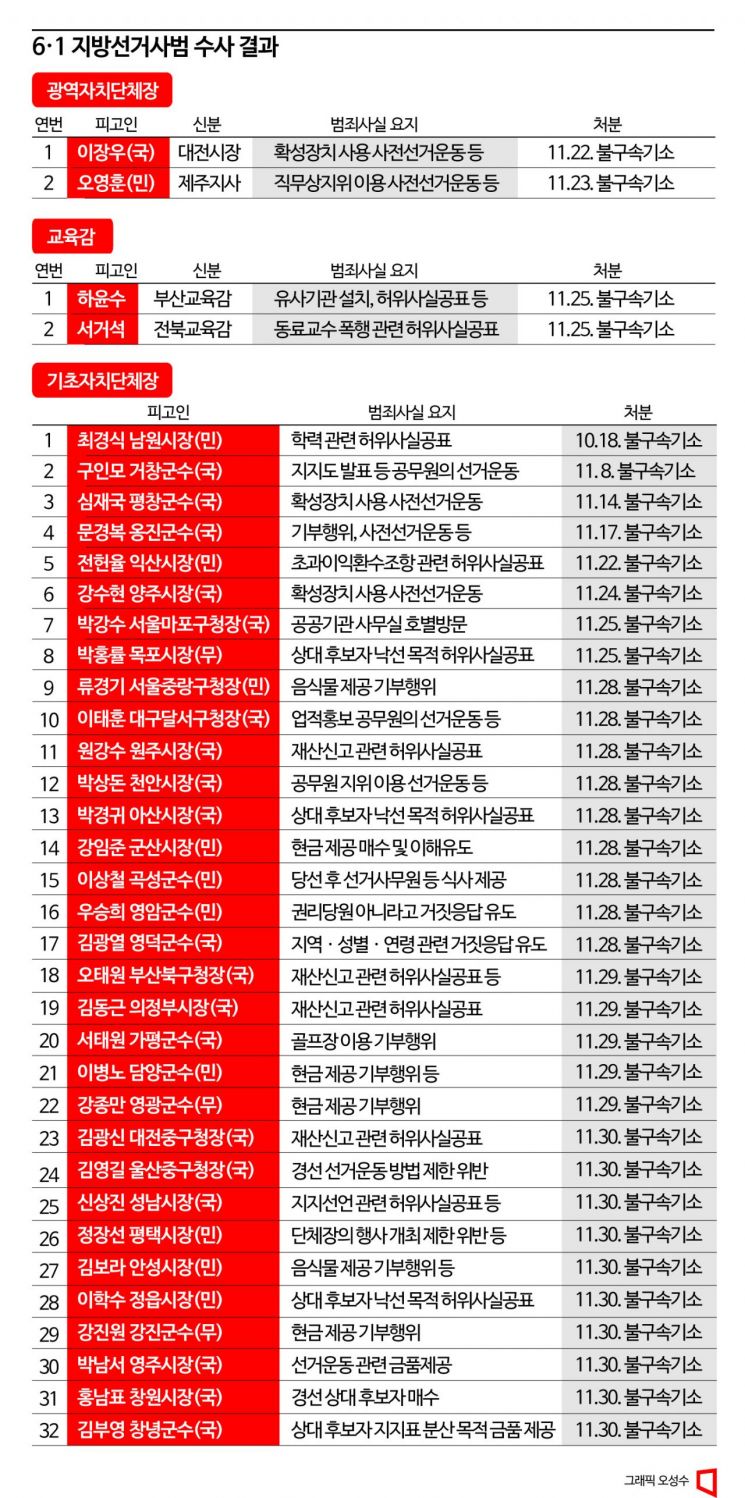
[Asia Economy Reporter Heo Kyung-jun] The prosecution has sent over 1,400 election offenders to trial in connection with the June 1 local elections. Lee Jang-woo, mayor of Daejeon Metropolitan City, and Oh Young-hoon, governor of Jeju, were sent to trial on charges of pre-election campaigning.
The Public Investigation Department of the Supreme Prosecutors' Office announced on the 2nd that it had indicted 1,449 out of a total of 3,790 people booked by the statute of limitations deadline the previous day. Compared to the 7th local elections held four years ago, the number of people booked decreased by 9.9%, and the number indicted decreased by 20%.
The prosecution sent a total of 134 elected officials from the June 1 local elections to trial, including 2 metropolitan government heads, 32 basic local government heads, 20 metropolitan council members, 78 basic council members, and 2 superintendents of education (Ha Yun-su, superintendent of Busan Education, and Seo Geo-seok, superintendent of Jeonbuk Education). Among the indicted basic local government heads, 19 belong to the People Power Party, 10 to the Democratic Party of Korea, and 3 are independents. Compared to the previous local elections, the number of people booked slightly increased, but both the number indicted and indictment rate decreased.
Regarding this, Prosecutor General Lee Won-seok said to reporters on his way to work that day, "I understand that indictments against the ruling party are about twice as many as those against the opposition party," adding, "Investigations are conducted solely based on evidence and legal principles, regardless of party affiliation, camp, position, or ideology."
By type, among the total booked individuals, black propaganda accounted for the highest proportion at 30.9%, followed by vote-buying at 26.4%. Illegal primary election activities accounted for 7.3%, and election interference by public officials was 1.7%. Illegal primary election activities surged from 85 cases in the previous election to 227 cases. The prosecution believes that as primary election victories increasingly lead to election wins, various illegal acts such as inducing false responses in opinion polls and falsifying mobile phone billing address changes have increased.
There were 2,695 bookings based on complaints and accusations, 1,006 bookings through police investigations, and 89 bookings through prosecution investigations. Since this was the first local election after the adjustment of investigative authority, the number of direct investigations by prosecutors decreased due to restrictions on prosecutors' direct investigations.
The prosecution judged that, following the investigation of the last presidential election offenders, the abolition of prosecutors' investigative directive authority last year revealed issues with the short statute of limitations in the investigation of this local election offenders case as well.
Considering the application of a short statute of limitations and the characteristics of election crimes that are organized and planned, it is necessary to specify charges through prompt compulsory investigations and meticulous legal review from the initial investigation stage. However, with the abolition of the investigative directive authority, prosecutors cannot be involved in cases during the police investigation stage, and more than 600 election offense cases are concentrated and transferred to the prosecution within one month before the statute of limitations expires, limiting thorough review and supplementary investigations.
A prosecution official said, "It is necessary to completely abolish the current ultra-short six-month statute of limitations or extend the statute of limitations for election offenses to at least one to two years to guarantee a minimum investigation period," adding, "The prosecution and police should make it mandatory to present and exchange opinions on matters to be investigated and the application of laws at least three months before the statute of limitations expires."
© The Asia Business Daily(www.asiae.co.kr). All rights reserved.

















