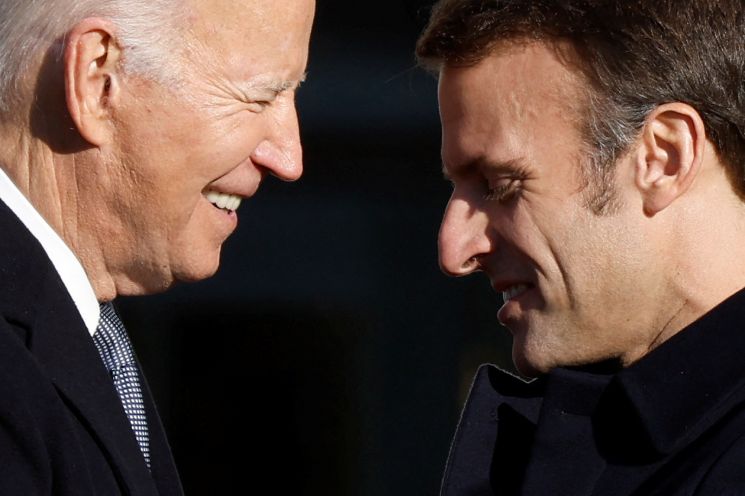
[Asia Economy New York=Special Correspondent Joselgina] U.S. President Joe Biden has officially announced his intention to adjust the Inflation Reduction Act (IRA) considering the backlash from allies such as the European Union (EU). This move came immediately after French President Emmanuel Macron, who was on a state visit to the U.S., strongly criticized the legislation, raising concerns about a rift in the so-called 'Atlantic alliance.' The two leaders also confirmed their plan to continue broad cooperation on issues ranging from the war in Ukraine to climate change, economy, and energy response during their summit.
◆Biden: "Discussing Inflation Reduction Act... No Intention to Exclude EU"
President Biden, at a press conference held after his summit with President Macron in Washington D.C. on the 1st (local time), said, "I had detailed discussions with President Macron about the Inflation Reduction Act," and "there was never any intention to exclude (European companies)."
He stated that the U.S. does not apologize for legislation like the Inflation Reduction Act, saying, "The U.S. does not apologize. Neither do I," but acknowledged that there are some "glitches" in the bill that need to be fixed. He also mentioned that they will "adjust" their positions through discussions with the European Union (EU). He added, "We will continue to create manufacturing jobs, but we will not sacrifice Europe."
President Macron also confirmed that the two leaders "agreed to more broadly resynchronize the Inflation Reduction Act and industrial policies." U.S. media reported that this exactly matches Macron's earlier demands when he criticized the Inflation Reduction Act. At the press conference, Macron repeatedly emphasized that efforts by the U.S. and Europe to expand manufacturing jobs will be "strongly integrated."
This policy was briefly reflected in the joint statement released immediately after the press conference. The statement said, "The two leaders look forward to the activities of the U.S.-EU task force on the Inflation Reduction Act to further strengthen the U.S.-European Union (EU) partnership on clean energy and climate in mutually beneficial ways."
President Biden's remarks came in response to President Macron's strong criticism of some Biden administration initiatives, including the Inflation Reduction Act, which he said boost U.S. industry at the expense of European companies. Macron, who visited the U.S. Congress the day before, described the Inflation Reduction Act's limitation of subsidies to North American electric vehicles as "very aggressive" toward French industry, stating, "The U.S. may be able to solve the problem, but our problem will only get bigger."
The growing dissatisfaction among allies, including the EU, over the Inflation Reduction Act inevitably places a burden on the Biden administration. Allies who have been aligned on international issues such as the war in Ukraine, China's technological dominance, and North Korea's nuclear missile provocations could turn away, potentially causing fractures. However, since Biden's remarks were seen as "minor adjustments," it is also assessed that he did not imply legislative amendments. In this case, there are expectations that the demands of Europe and other allies may only be partially reflected.
The Inflation Reduction Act, which provides up to $7,500 in tax credits to electric vehicle buyers, limits eligibility to North American-made vehicles. It also includes conditions that at least 40% of the critical minerals used in electric vehicle batteries must be mined or processed in the U.S. or countries with which the U.S. has free trade agreements (FTA), and at least 50% of battery components must be North American-made. As a result, electric vehicles from the EU, Japan, and South Korea were excluded from subsidies, inevitably causing export disruptions. The South Korean government has already expressed concerns multiple times, viewing the subsidy discrimination as likely violating the Korea-U.S. FTA and the World Trade Organization (WTO) principles of national treatment and most-favored-nation treatment.
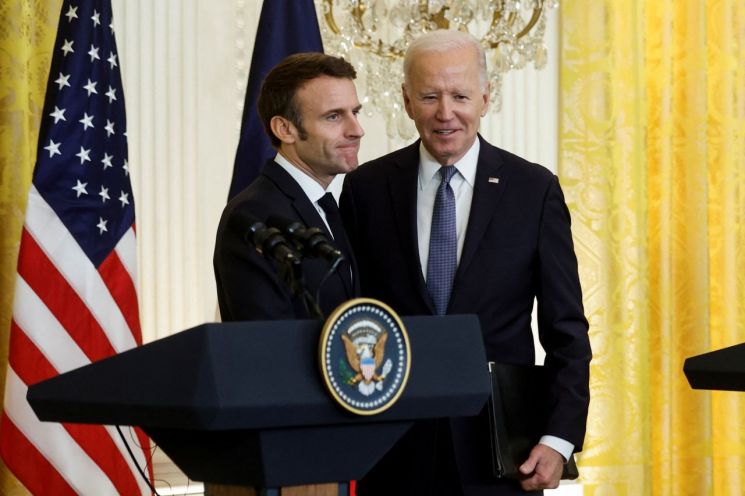
◆"War Crimes" Condemning Putin... "Willing to Talk If There Is a Will to End the War"
The two leaders strongly condemned Russian President Vladimir Putin, who invaded Ukraine, but also signaled a willingness to engage in dialogue with allies if there is a genuine intention to end the war.
President Biden emphasized that there are no immediate plans for talks with President Putin. However, he did not completely close the door to dialogue. Biden said, "If he is genuinely interested in finding a way to end the war," they can talk, adding, "If so, I will sit at the table with France, NATO friends, and see what President Putin wants." However, Biden also noted that Putin is not currently acting in that way.
President Macron said in English that support for Ukraine is about "our values." He stated, "If we give up respect for these principles, there will be no stability in this world." He reaffirmed that military support for Ukraine will be strengthened. He also emphasized, "We will not force Ukrainians to accept an unacceptable compromise."
In the joint statement released immediately after the summit, the two leaders strongly condemned Russia's invasion of Ukraine as an illegal war of aggression and war crimes. The statement said, "Deliberately targeting civilians and civilian infrastructure constitutes war crimes," and "Russia's illegal attempts to annex Ukrainian sovereign territory are clear violations of international law."
Additionally, the two leaders announced at the summit that they will strengthen broad cooperation on economy, climate change, space, and energy policies. They also condemned North Korea's ballistic missile provocations. The two leaders said, "We strongly condemn North Korea's unprecedented number of illegal ballistic missile tests this year," adding, "These violate multiple United Nations Security Council resolutions and threaten peace and stability in the region."
Furthermore, they will enhance cooperation in the Indo-Pacific region, where China is expanding its influence. They stated, "We coordinate concerns in response to China's challenges to international order, including human rights, and will cooperate with China on important global issues such as climate change," adding, "Maintaining peace and stability in the Taiwan Strait is important."
© The Asia Business Daily(www.asiae.co.kr). All rights reserved.


















