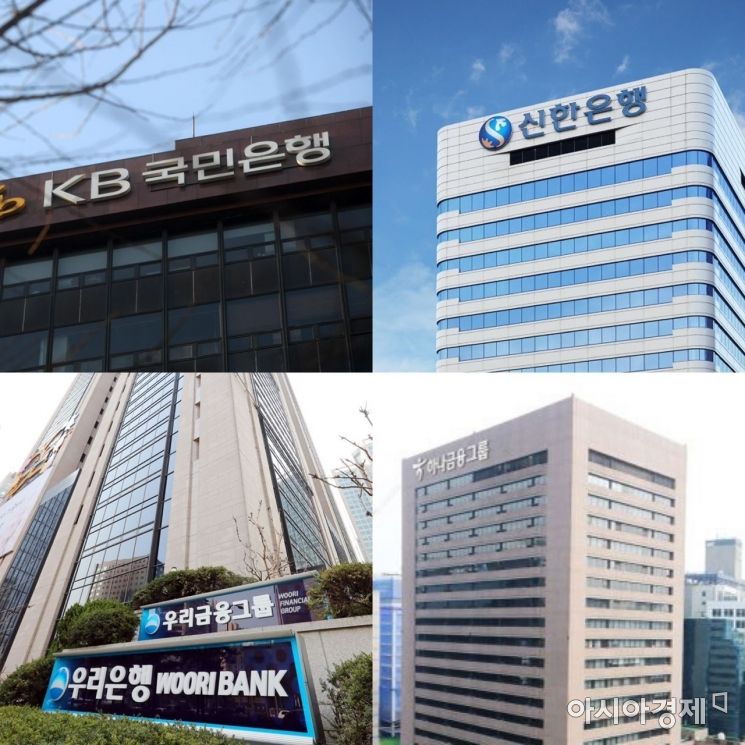
[Asia Economy Reporter Song Hwajeong] As this year is expected to be the peak of bank earnings, the combined net profit of the four major financial holding companies is projected to exceed 16 trillion won.
According to financial information firm FnGuide on the 2nd, the consensus sum of the annual net profit attributable to controlling shareholders for the four major financial holding companies?KB Financial Group, Shinhan Financial Group, Hana Financial Group, and Woori Financial Group?is estimated at 16.6529 trillion won this year. This represents a 14.5% increase compared to last year's 14.5429 trillion won.
Shinhan's net profit consensus is 5.0519 trillion won, marking a 25.7% increase from the previous year, and is expected to be the only one among the four major financial holding companies to surpass 5 trillion won. KB Financial is estimated to record 4.8213 trillion won, up 9.34%, Hana Financial 3.6558 trillion won, up 3.68%, and Woori Financial 3.1239 trillion won, up 20.71%.
Following last year, interest income is expected to increase significantly this year as well, driving overall performance growth. The combined interest income of the four major financial holding companies is expected to exceed 65 trillion won, estimated at 65.6721 trillion won. Interest income is projected to increase by 25.52% for KB, 22.37% for Shinhan, 40.22% for Woori, and 35.12% for Hana compared to the previous year. With the continued rise in interest rates this year, interest income has also increased substantially. According to the Bank of Korea, the loan interest rate of deposit banks in October was 5.26%, up 2.01 percentage points from the end of the previous year. The household loan interest rate was 5.34% per annum, rising 1.68 percentage points compared to the end of last year.
The sharp earnings growth of banks is expected to ease next year. In particular, the recent rise in banks' funding costs is likely to act as a burden on earnings. Kim Jae-woo, a researcher at Samsung Securities, analyzed, "Funding costs have risen sharply since the fourth quarter, and due to high interest rates, the growth rate of bank assets is inevitably slowing down. The steep rise in funding costs could increase pressure to reduce net interest margin (NIM). Additionally, as high interest rates raise the default rate among borrowers, credit costs may gradually increase."
Household loans, which have been slowing down since this year, are expected to remain weak next year. According to Samsung Securities, the growth rate of bank household loans slowed from 11.5% in 2020 to 7.3% last year, and this year, until October, it shifted to a 0.1% decrease compared to the beginning of the year. Household loans are expected to contract even more severely next year than this year.
The rapid increase in corporate loans this year is also likely to slow down next year. Recently, as the corporate bond market has contracted, companies have flocked to banks, causing a sharp rise in corporate loans; however, this situation is not expected to continue next year. Furthermore, if the economy slows down next year, corporate loan demand will inevitably decrease compared to this year.
© The Asia Business Daily(www.asiae.co.kr). All rights reserved.
!["The Woman Who Threw Herself into the Water Clutching a Stolen Dior Bag"...A Grotesque Success Story That Shakes the Korean Psyche [Slate]](https://cwcontent.asiae.co.kr/asiaresize/183/2026021902243444107_1771435474.jpg)
















