Increase in Repeat Test Takers in 5 out of 7 CSATs Held the Year After the World Cup
CSAT Difficulty in World Cup Years: 'Mulsuneung' or 'Bulsuneung'
[Asia Economy Culture Reporter Intern] An analysis revealed that the number of repeat test-takers for the College Scholastic Ability Test (CSAT) unusually increases in the year following the World Cup, and the difficulty level of the CSAT changes drastically in the year the World Cup is held.
According to Jongno Academy on the 1st, since the 1994 USA World Cup, out of seven CSATs conducted in World Cup years, five showed an increase in repeat test-takers the year after the World Cup.
In the years following the 1994 USA World Cup (▲10,039), 1998 France World Cup (▲18,864), 2002 Korea-Japan World Cup (▲4,192), 2014 Brazil World Cup (▲3,541), and 2018 Russia World Cup (▲7,897), the number of repeat test-takers increased.
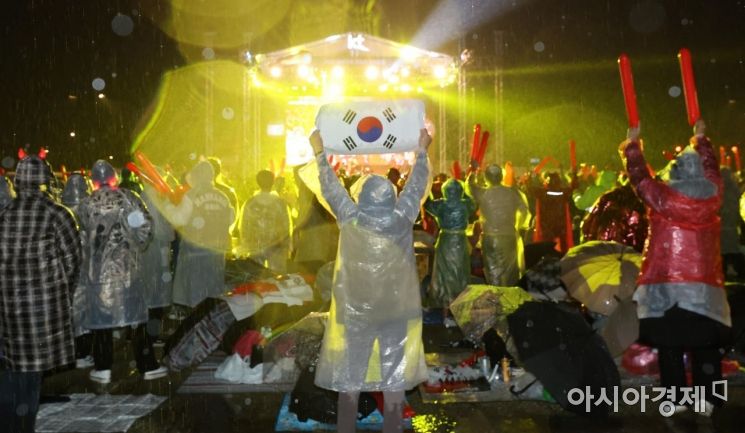 On the 28th of last month, during the second match of Group H in the 2022 Qatar World Cup between South Korea and Ghana, citizens passionately cheered at Gwanghwamun Square in Seoul. Photo by Hyunmin Kim kimhyun81@
The year after the 2006 Germany World Cup saw a decrease in repeat test-takers compared to the previous year. However, this is analyzed to be due to the full revision of the CSAT to a grading system starting in 2008. The 2012 CSAT, held the year after the 2010 South Africa World Cup, also saw a decrease in repeat test-takers. Jongno Academy analyzed that this was likely caused by the 2012 curriculum revision, which included calculus in the CSAT for liberal arts students, increasing the burden on test-takers.
Lim Seong-ho, CEO of Jongno Academy, said, "Except for the changes in the 2008 CSAT system and the expansion of the liberal arts math test scope in 2012, it can be said that the number of repeat test-takers generally increased the year after the World Cup."
Lim added, "The increase in repeat test-takers the year after the World Cup does not correlate with the number of high school seniors in the previous year, indicating that there is no proportional relationship between the number of high school seniors and repeat test-takers. The increase after the World Cup can be seen as a distinctive phenomenon."
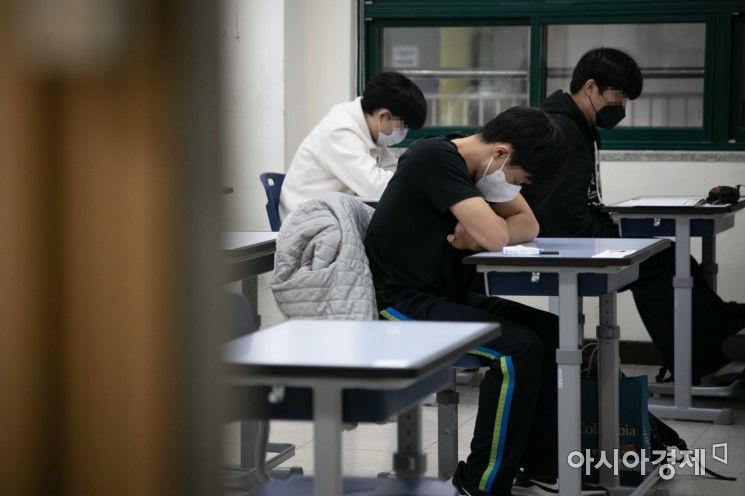 On the morning of November 17, when the 2023 College Scholastic Ability Test was held, examinees were waiting for the exam to start at a high school test site in Seoul.
 Photo by Joint Press Corps
Additionally, the CSAT held in the same year as the World Cup shows a peculiar pattern where the difficulty level either sharply rises or falls compared to the previous year. In the last four World Cups, the perceived difficulty of the CSAT suddenly became easier or harder in the same year.
In the 2006 Germany World Cup year CSAT, the highest standard score in the English subject dropped from 142 points the previous year to 134 points, while the percentage of perfect scorers surged from 0.29% to 1.02%. For Mathematics Type B, the highest standard score fell from 152 points to 140 points, and the percentage of perfect scorers increased significantly from 0.33% to 1.76%.
Conversely, the 2011 CSAT, held the year after the 2010 South Africa World Cup, was considered a "difficult test" as Korean, Mathematics, and English subjects all became significantly harder than the previous year. The 2019 CSAT, held the year after the 2018 France World Cup, was also labeled a "difficult test" for the Korean subject, with the highest standard score surpassing 150 points, making it the hardest since 2005. English was also made more difficult due to the introduction of absolute grading, with the top grade rate dropping from 10.0% in 2018 to 5.3% in 2019.
© The Asia Business Daily(www.asiae.co.kr). All rights reserved.


















