Only Twice Complied with Legal Deadlines Since the National Assembly Advancement Act
Disagreements Between Ruling and Opposition Parties Persist in Budget Increase and Decrease Process
Democratic Party Indicates Possibility of Unilateral Passage of Reduced Budget Proposal
Negotiations Expected to Continue Until the End of the Regular Session on the 9th
[Asia Economy Reporter Lee Hyun-joo] As the budget battle between the ruling and opposition parties repeats again this year, it is expected that next year’s budget bill will once again fail to meet the constitutional deadline.
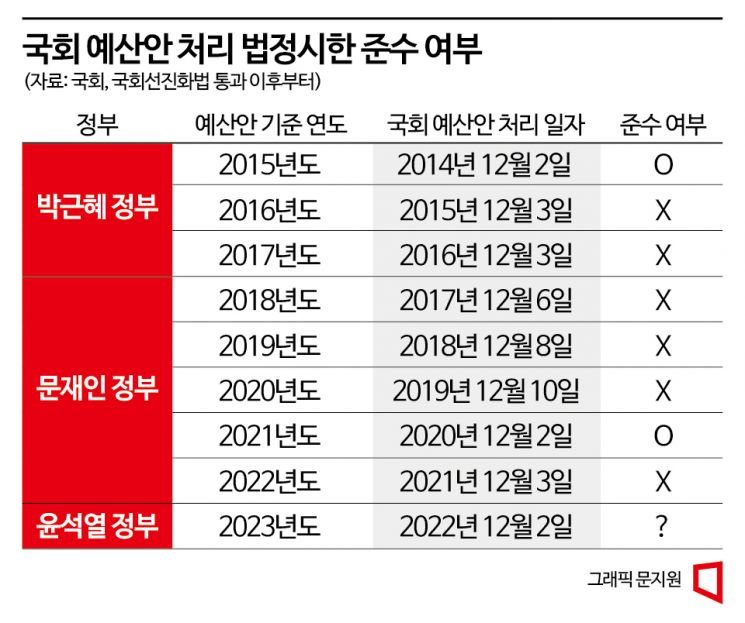
According to the National Assembly on the 2nd, Article 54 of the Constitution stipulates that the government must submit the budget bill to the National Assembly at least 90 days before the start of the fiscal year, and the National Assembly must approve it at least 30 days before the start of the fiscal year. The legal deadline for budget approval is December 2 of the previous year.
However, it has been very rare for the new year’s budget bill to be passed by the legal deadline. From 2002 to 2014, the National Assembly failed to meet the legal deadline for 12 consecutive years.
As cases of missing the legal deadline for the budget repeated several times, the ruling and opposition parties introduced an automatic submission system for the budget bill when they enacted the National Assembly Advancement Act in May 2014. According to Article 85-3 of the National Assembly Act, if the review of the budget bill and related revenue budget bills is not completed by November 30, it is deemed that the review is completed the next day and the bill is immediately submitted to the plenary session. This grants the qualification (submission) to be placed on the plenary session without the review authority of the standing committee.
Thanks to the effect of the Advancement Act, the 2015 budget bill was passed by the legal deadline of December 2, 2014. However, for two years, the budget bill was processed one day past the legal deadline. In 2018, it took 4 days past the legal deadline to pass, 6 days in 2019, and 8 days in 2020. The 2021 budget was passed within the legal deadline for the first time in six years.
The reason why the ruling and opposition parties rarely reach an agreement on the government budget bill is that political interests become entangled in the process of cutting and increasing the budget. This year was no different. On the 25th, Joo Ho-young, floor leader of the People Power Party, said at a floor strategy meeting, "While our party members walked out, (the Democratic Party) is unilaterally pushing through a reckless move to slash even the budget for the core policies and pledges of the Yoon Seok-yeol administration." In the National Assembly Land, Infrastructure and Transport Committee, the budget for the Yongsan Park development project (16.5 billion KRW) and the budget for the sale housing, which was a campaign pledge of President Yoon, (1.13 trillion KRW) were cut. On the other hand, controversy arose as the Democratic Party increased the budget related to public rental housing by 5.7 trillion KRW, which the Yoon administration had cut, in the Land Committee’s budget subcommittee.
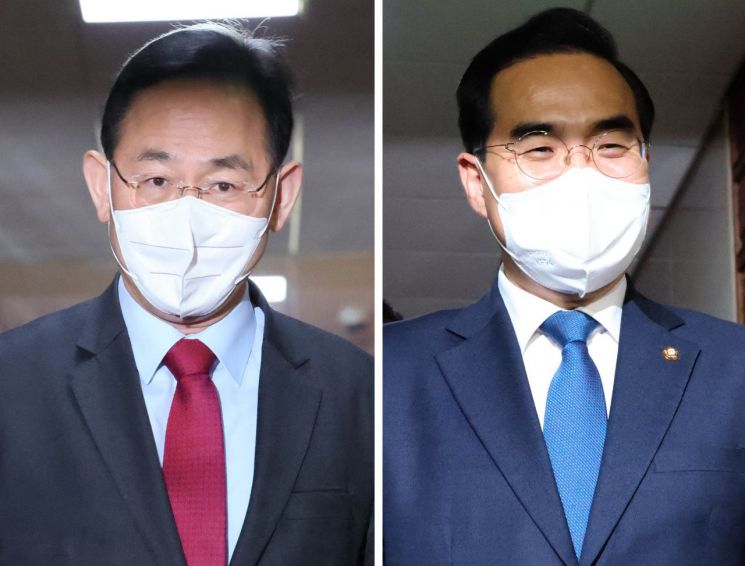
The floor leaders of the ruling and opposition parties had previously agreed to conduct a parliamentary audit after the budget bill was processed, but the Democratic Party’s submission of a motion to dismiss Minister of the Interior and Safety Lee Sang-min as a party resolution has made the budget bill process even more difficult. Park Hong-geun, floor leader of the Democratic Party, said at a policy coordination meeting held on the 1st, "The National Assembly is in chaos due to the ruling party’s delay tactics over the government budget bill. With only one day left before the legal deadline for next year’s budget bill, the People Power Party seems to be turning into a party specializing in political strife," adding, "They have started to stall by linking the parliamentary audit, the motion to dismiss Lee Sang-min, and the budget bill process." Floor leader Park emphasized that the motion to dismiss and the budget bill are separate matters.
Currently, since the National Assembly is in a situation where the ruling party has fewer seats than the opposition, there are concerns that the National Assembly Advancement Act could be nullified. If the Democratic Party, which holds the majority of seats, refuses to process the automatically submitted budget bill, next year’s budget could be prepared as a "quasi-budget." A quasi-budget is a provisional budget executed by the government based on the previous year’s budget if the next year’s budget is not passed within the legal deadline. The related revenue budget bills, which are also automatically submitted, could all be rejected if there is no agreement with the Democratic Party.
The Democratic Party has also shown willingness to submit and approve a budget bill prepared solely by themselves. Lee Jae-myung, leader of the Democratic Party, said at the party’s Supreme Council meeting on the 28th of last month, "The Democratic Party cannot agree to the police bureau budget or tax cuts for the wealthy," adding, "If necessary, exercising our authority and choosing the Democratic Party’s revised bill is also an option." The "Democratic Party revised bill" strategy means rejecting the government’s original budget bill, which is automatically submitted, and submitting and approving a revised bill prepared solely by the Democratic Party. Since increasing the budget without government consent is impossible, and the Democratic Party has enough seats, they can effectively pass a budget bill that only reduces the budget if they so desire.
With the ruling and opposition parties continuing their disputes without even one day left before the legal deadline, the highest possibility at present is that the budget bill will be agreed upon and processed on the 9th, the last day of the regular session. Woo Won-shik, chairman of the National Assembly Budget and Accounts Committee and a Democratic Party member, said on a radio program on the 1st, "We will try our best until tomorrow (the 2nd), and if it still doesn’t work, we will try to process it by the 9th after this regular session ends."
© The Asia Business Daily(www.asiae.co.kr). All rights reserved.
!["The Woman Who Threw Herself into the Water Clutching a Stolen Dior Bag"...A Grotesque Success Story That Shakes the Korean Psyche [Slate]](https://cwcontent.asiae.co.kr/asiaresize/183/2026021902243444107_1771435474.jpg)

















