Bank of Korea Evaluates Housing Market Trends at 'Monetary Policy Workshop'
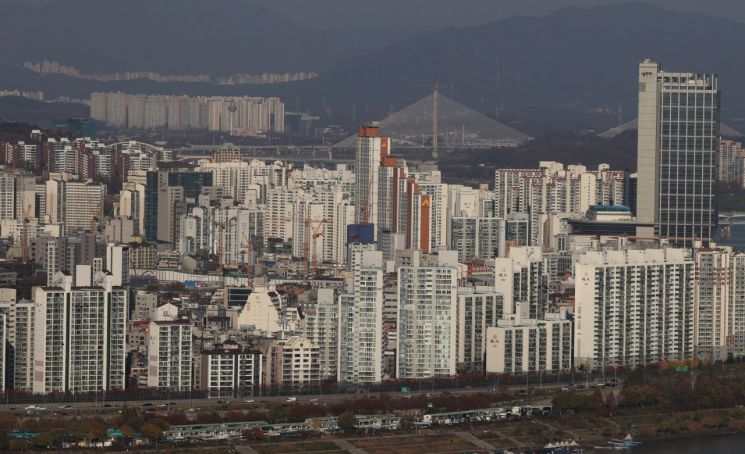 View of downtown apartments from ASEM Tower in Samseong-dong, Gangnam-gu, Seoul [Image source=Yonhap News]
The Bank of Korea recently explained that although house prices have slightly declined, they still remain at high levels, and with the rising loan interest rates increasing the burden of interest payments, downward pressure on house prices is expected to remain strong going forward. It is anticipated that house prices may fall more sharply in regions such as Sejong and Gyeonggi-do, where the price increases had been significant.
At the '2022 Monetary Policy Workshop' held on the 1st, Kwon Jun-mo, head of the Regional Economy Department at the Bank of Korea's Research Bureau, presented the 'Regional Housing Market Trends and Risk Assessment,' forecasting this outlook. He analyzed, "Housing sale prices showed a steep upward trend until December last year following the pandemic, but have turned downward since June this year, with the decline gradually expanding. Recently, the decline in housing prices has been more pronounced in the Seoul metropolitan area and major cities, showing differentiated patterns by region."
According to the Bank of Korea, compared to the 2019?2021 period of rising house prices, regional differentiation became more distinct during the adjustment period. The decline in the Seoul metropolitan area was greater than in non-metropolitan areas, and regions such as Sejong and Daegu experienced strong downward trends. Conversely, some non-metropolitan areas like Jeonbuk continued to rise until August but shifted to a decline starting in September.
Kwon explained, "Regions that showed high growth during the rising period experienced larger price declines during the adjustment period," adding, "The price drop from the peak was generally larger in regions where the decline began earlier, such as Sejong (-10.5%), Daegu (-5.1%), Incheon (-3.3%), and Daejeon (-3.2%)."
The Bank of Korea used data from 17 metropolitan cities and provinces to quantitatively assess the downside risk of housing prices in each region. The results showed that overall, downward factors in the housing market, such as overvaluation of housing prices and worsening borrowing conditions, outweighed upward factors like supply shortages, and that the downside risk of housing prices has rapidly increased since the end of last year.
Kwon emphasized, "High levels of household debt during a period of rising interest rates significantly increase borrowers' principal and interest repayment burdens," and added, "Regions such as Sejong, Gyeonggi, Daegu, and Incheon, where the loan-to-income ratio (LTI) is high or has sharply increased compared to just before the price rise, are likely to experience stronger downward pressure."
© The Asia Business Daily(www.asiae.co.kr). All rights reserved.
![A Woman Who Jumps Holding a Stolen Dior Bag... The Mind-Shaking, Bizarre Con of a "Human Knockoff" [Slate]](https://cwcontent.asiae.co.kr/asiaresize/183/2026021902243444107_1771435474.jpg)
















