Ministry of Economy and Finance, 'Key Findings and Implications of the 2022 Household Financial Welfare Survey'
[Asia Economy Sejong=Reporter Kwon Haeyoung] Last year, income distribution indicators such as the Gini coefficient and the income quintile ratio worsened as government support funds, including the nationwide disaster relief fund, decreased.
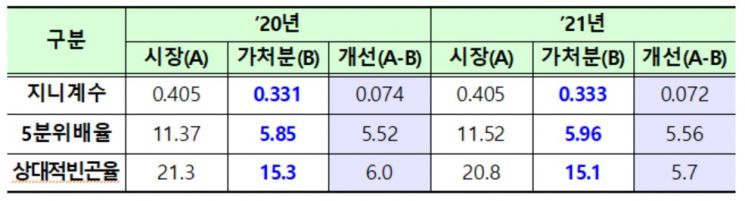
On the 1st, the Ministry of Economy and Finance released the report "Key Contents and Implications of the 2022 Household Financial Welfare Survey," diagnosing that "despite stable market income distribution conditions due to economic and employment recovery, the Gini coefficient slightly worsened as public transfer income for low-income groups decreased."
According to the Household Financial Welfare Survey results announced by Statistics Korea on the same day, the Gini coefficient, which indicates income inequality, recorded 0.333 based on disposable income last year, an increase of 0.002 compared to the previous year. A Gini coefficient of '0' means perfect equality, and '1' means perfect inequality, so this indicates a deterioration in the indicator. The income quintile ratio, calculated by dividing the income of the top 20% by that of the bottom 20%, was 5.96 times based on disposable income last year, up 0.11 points from 5.85 times the previous year.
However, the relative poverty rate decreased by 0.2 percentage points to 15.1% from 15.3% the previous year.
A Ministry of Economy and Finance official stated, "We will strengthen welfare for vulnerable groups by enhancing employment and social safety nets," adding, "We will alleviate the burden on low-income households through price stabilization and continue to promote economic vitality so that income and distribution conditions can improve mainly in the private sector."
Regarding the increase in net assets per household, it was analyzed that there is a time lag with the current economic situation. According to Statistics Korea, the average household assets were 547.72 million KRW, and average liabilities were 91.7 million KRW, increasing by 9% and 4.2% respectively compared to the previous year.
A Ministry of Economy and Finance official said, "Due to recent interest rate hikes and the continued decline in real estate prices, there may be discrepancies between the current perceived economic situation and the 2022 survey results," adding, "We will stably manage the slowing growth rate of household loans since the second half of 2021 and continue efforts to ease the financial burden on vulnerable groups."
© The Asia Business Daily(www.asiae.co.kr). All rights reserved.

















