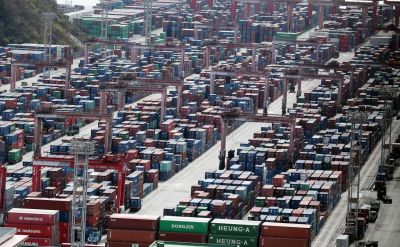
 Containers Piled Up at Busan Port
(Busan=Yonhap News) Photo by Kang Deok-cheol = On November 30, the seventh day of the Cargo Solidarity general strike, containers were piling up at the open yard of Sinsundae Pier in Nam-gu, Busan. 2022.11.30
kangdcc@yna.co.kr
(End)
<Copyright(c) Yonhap News Agency, Unauthorized reproduction and redistribution prohibited>
[Asia Economy Sejong=Reporter Lee Jun-hyung] Concerns that this year's annual trade balance would turn to a deficit for the first time in 14 years since the 2008 financial crisis have virtually materialized. The accumulated trade deficit from the beginning of this year to last month has surpassed $40 billion. Semiconductor exports, which had played a key role in driving exports, have also fallen into a recession. With the global economic downturn expected to continue next year, there are growing concerns that trade, the 'growth engine' of the Korean economy, could fall into a structural deficit.
According to the Ministry of Trade, Industry and Energy on the 1st, the cumulative trade deficit from January to November this year was $42.6 billion, the largest in 66 years since trade statistics began in 1956. This is the result of eight consecutive months of trade deficits from April to last month. The trade balance recorded a deficit of $7.01 billion last month alone. At this rate, the cumulative trade deficit could exceed $50 billion within this month.
The record-high trade deficit is largely due to energy prices. Last month, imports of the three major energy sources?crude oil, gas, and coal?amounted to $15.51 billion, a 27.1% increase compared to the same period last year ($12.21 billion). From January to November this year, imports of the three major energy sources totaled $174.1 billion, an increase of $74.8 billion (75.3%) over the past year. This figure exceeds the accumulated trade deficit ($42.6 billion) from the beginning of this year to last month by more than $30 billion.
Exports Also in the 'Recession Swamp'
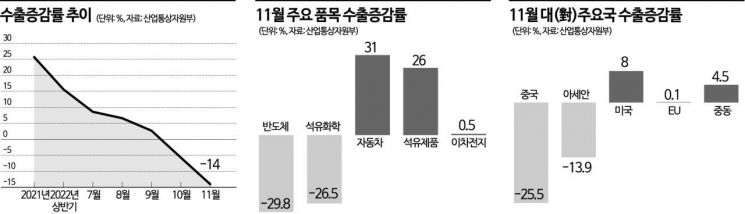
Exports, which have served as an economic pillar, have also fallen into a 'recession swamp.' Last month, exports amounted to $51.91 billion, a 14% decrease compared to the same period last year. This marks two consecutive months of negative growth following the export decline in October this year (-3.7%), the first since October 2020 when the COVID-19 pandemic struck directly. Moreover, the rate of decline increased by 8.3 percentage points from 5.7% to 14% in just one month.
The decline in exports is largely due to deteriorating trade with China, which has served as Korea's 'dollar box.' Last month, exports to China were $11.38 billion, down 25.5% over the past year. China's implementation of the 'Zero COVID' policy, which involved lockdowns in major cities, led to a simultaneous contraction in exports of key items such as semiconductors (-36.1%), petrochemicals (-26.2%), general machinery (-21.1%), and wireless communication (-8.2%). Exports to China have been declining for six consecutive months since June.
Semiconductor exports, a key export item, have also been declining for four consecutive months. In particular, last month's semiconductor exports amounted to $8.45 billion, a sharp 29.8% decrease compared to the same period last year. Previously, semiconductor exports fell below $10 billion for the first time since April 2021, recording $9.23 billion in October this year. This is due to the continued decline in prices of memory semiconductors such as DRAM and NAND flash, as well as accumulated corporate inventories amid the global economic slowdown. The fixed price of DRAM was $2.21 last month, down 40.4% over the past year.
Additional Blow from Cargo Truckers' Union Strike
Adding insult to injury, the cargo truckers' union strike has also overlapped. As the strike entered its eighth day, it inevitably had a negative impact on last month's exports. The Ministry of Trade, Industry and Energy also acknowledged that the strike is not unrelated to the decline in exports. Minister Lee Chang-yang stated, "The refusal of transportation by the Cargo Truckers' Union contributed to the expanded decline in exports last month compared to the previous month," adding, "If the collective transportation refusal prolongs, production disruptions may occur, which could negatively affect exports this month as well."
The problem is that the outlook for next year is not bright either. The Korea Institute for Industrial Economics and Trade (KIET), a government-affiliated research institute, forecasted in its recently released '2023 Economic and Industrial Outlook' report that the trade deficit will reach $26.6 billion next year. KIET's analysis suggests that the trade deficit could reach $20.4 billion in the first half of next year alone. Professor Ha Jun-kyung of Hanyang University's Department of Economics said, "The global economy is the biggest variable, and it is expected to slow down more than previously anticipated next year," adding, "There is a high possibility that downward risks will continue for a considerable period."
In response, the Ministry of Trade, Industry and Energy has expressed its commitment to fully mobilize measures to revitalize exports. Minister Lee said, "We will steadily implement customized export support plans for key industries such as semiconductors and expand comprehensive support including trade finance," adding, "We plan to consolidate export support capabilities of all government ministries and related organizations centered on the Export Support Council."
© The Asia Business Daily(www.asiae.co.kr). All rights reserved.


















