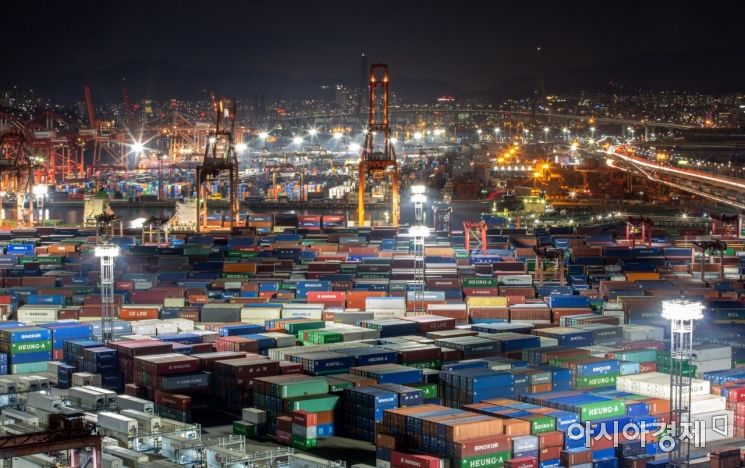
 The Busan New Port Terminal, piled high with import and export cargo, brightly illuminates the night sky to continue nighttime operations. South Korea surpassed $640 billion in annual export value in 2021, setting a new record. Since recording its first $100 million in 1964, the country exceeded $10 billion in 1977, $100 billion in 1995, $600 billion in 2018, and this year surpassed $640 billion, marking a new milestone in 66 years of trade history.
 Busan ? Photo by Kang Jin-hyung aymsdream@
[Asia Economy Sejong=Reporter Dongwoo Lee] The Ministry of Oceans and Fisheries announced that starting from the 1st, it will fully allow foreign-flagged vessels to conduct domestic coastal transportation of export and import container cargo to ensure smooth transportation.
The Ministry stated, "On the 28th, the crisis alert level for land cargo transportation was raised to 'severe,' and with the breakdown of negotiations between the government and the Cargo Solidarity Union, there are concerns about a prolonged collective transportation refusal. Therefore, this measure is being implemented proactively."
Coastal transportation refers to transportation between domestic ports limited to vessels registered in the country according to the Ship Act. Most countries prohibit foreign-flagged vessels from transporting cargo between their ports to protect their domestic coastal shipping industries. South Korea also prohibits foreign-flagged vessels from coastal transportation except for the routes between Busan Port and Gwangyang Port, and between Incheon Port and Gwangyang Port.
According to this measure, until the Cargo Solidarity Union's collective transportation refusal ends, foreign-flagged vessels are temporarily allowed to transport container cargo between 14 nationally managed trade ports nationwide.
The Ministry explained that this applies regardless of whether the cargo transported is the vessel's own cargo or another company's cargo, and regardless of export, import, transshipment, or empty containers. Shipping companies wishing to transport container cargo via coastal routes using foreign-flagged vessels only need to load container cargo onto the vessel and report the transportation to the local Maritime Affairs and Fisheries Office by the day after departure, without any separate permission procedures.
Minister of Oceans and Fisheries, Seung-hwan Cho, said, "This measure is expected to significantly reduce the burden of land transportation of container cargo and also help the operation of container yards at ports."
© The Asia Business Daily(www.asiae.co.kr). All rights reserved.

















