Budget Supplementary Bill Faces Major Disagreement Between Ruling and Opposition Parties
Inheritance Tax Law Amendment Completely Excluded from Agreement Discussions
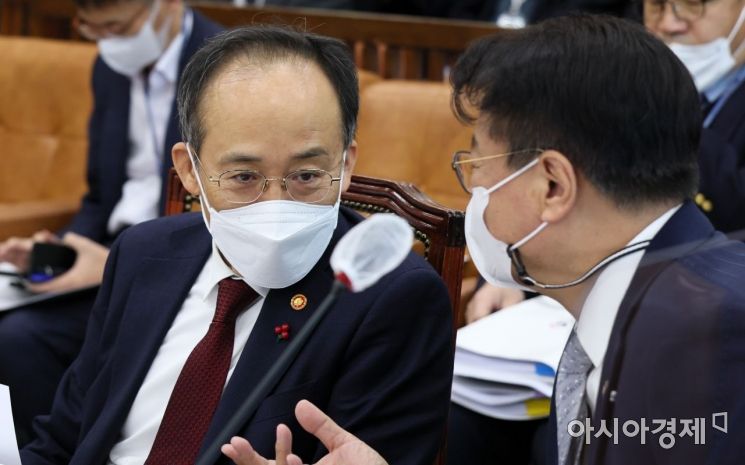 Deputy Prime Minister for Economy Choo Kyung-ho attended the full meeting of the Planning and Finance Committee held at the National Assembly on the 1st and is seen talking with First Vice Minister Bang Gi-seon before the meeting started. Photo by Yoon Dong-joo doso7@
[Asia Economy Reporter Lee Hyun-joo] As contentious bills such as the Financial Investment Income Tax (Fin-Invest Tax) and the Comprehensive Real Estate Holding Tax (CREHT) have been automatically submitted to the plenary session of the National Assembly, the ruling and opposition parties have begun discussions to reach a consensus. If no agreement is reached between the parties, there is a possibility that the Democratic Party of Korea may reject these contentious bills through a plenary vote.
The National Assembly's Strategy and Finance Committee held a tax subcommittee meeting immediately after its plenary session on the 1st to review budget-related bills. The amendment to the Income Tax Act, which includes provisions for postponing the Fin-Invest Tax and easing the CREHT, is a budget-related bill that must be processed along with next year’s budget. According to the National Assembly Act, 21 budget-related bills under the jurisdiction of the Strategy and Finance Committee were automatically submitted to the plenary session the previous day. In such cases, discussions and conclusions are typically made by the floor leaders of each party or the secretaries of the Special Committee on Budget and Accounts rather than the standing committee. However, since the tax subcommittee has expressed its intention to create a revised bill through bipartisan agreement, discussions are ongoing. A committee official said in a phone interview that "the party secretaries will continue discussions to create an alternative at the committee level" and "there is a high possibility that an alternative will be prepared by early next week and submitted to the plenary session."
However, preparing an alternative is expected to be difficult due to significant differences in views between the ruling and opposition parties on contentious bills such as the Fin-Invest Tax and CREHT. In particular, the amendment to the Inheritance and Gift Tax Act, which includes expanding the business succession deduction target companies up to 1 trillion won, is strongly opposed by the Democratic Party, and it is reported that this bill has already been excluded from the committee’s alternative preparation discussions. In this case, the original government bill on the Inheritance and Gift Tax Act will be submitted to the plenary session according to the law, but the Democratic Party has stated that it may reject it through a vote.
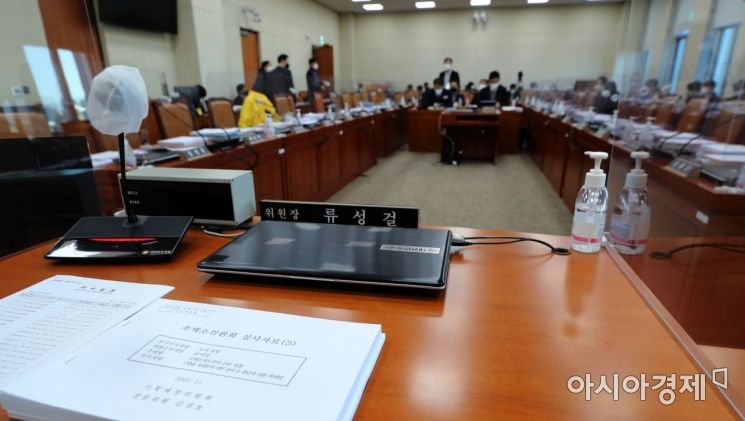 The Tax Subcommittee of the National Assembly's Planning and Finance Committee could not be held on the 30th. Photo by Yoon Dong-joo doso7@
The tax subcommittee of the Strategy and Finance Committee, which reviews budget-related bills, has struggled over the past week without being properly convened. The day before, the ruling and opposition parties agreed to include additional agenda items such as bills under the jurisdiction of the Economic and Fiscal Subcommittee and to submit the Basic Social Economy Act and others after processing the budget and budget-related bills, leading to a dramatic decision to reconvene the subcommittee. At the plenary session of the Strategy and Finance Committee that day, the bills agreed upon the previous day were collectively submitted. The agenda included the amendment to the National Finance Act proposed by Park Dae-chul, chair of the Strategy and Finance Committee, which establishes the legal basis for introducing fiscal rules, as well as the bill on the Operation of Public Institutions proposed by Lee Jae-myung, leader of the Democratic Party of Korea, which requires parliamentary approval procedures when merging, adjusting functions, or privatizing public institutions.
Ryu Seong-geol, the ruling party secretary of the Strategy and Finance Committee, said, "We conducted reviews until late last night," and added, "We will do our best to reach an agreement on other budget-related bills, including those designated by the Speaker of the National Assembly, as soon as possible." It is reported that the tax subcommittee has reached an agreement on some non-contentious bills, such as the Special Tax Treatment Control Act, which is set to expire the previous day.
© The Asia Business Daily(www.asiae.co.kr). All rights reserved.


















