'2040 Seoul Urban Master Plan' and '2030 Seoul Urban Residential Environment Improvement Master Plan'
Approved by Seoul City Review
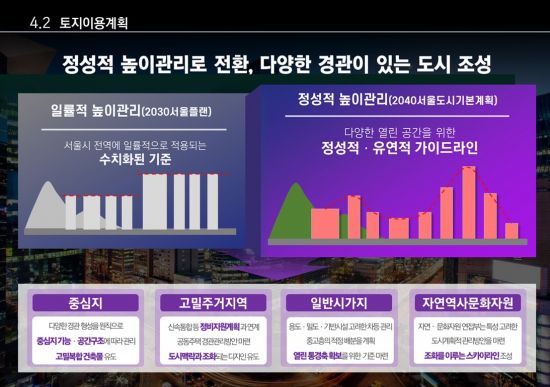 Key contents of the '2040 Seoul Plan' approved by the Metropolitan Government Deliberation Committee. (Provided by Seoul City)
[Asia Economy Reporter Kim Hyemin] The Seoul Metropolitan Government has finalized the abolition of the '35-floor rule.' As the number of redevelopment zones increases and green spaces are secured, height regulations will also be relaxed.
On the 30th of last month, Seoul held the 12th Urban Planning Committee meeting and announced on the 1st that it had finalized the '2040 Seoul Urban Master Plan' and the '2030 Seoul Urban and Residential Environment Maintenance Basic Plan (Urban Maintenance-type Redevelopment Project Section)' containing these details.
The Seoul Urban Master Plan is the highest-level spatial plan that serves as a guideline for various plans promoted by the city and is a statutory plan under the National Land Planning and Utilization Act. It outlines the future vision of Seoul's urban space for the next 20 years.
In March of this year, the city announced a plan (2040 Seoul Plan) to abolish the 35-floor height restriction on apartments, and with the recent approval by the Urban Planning Committee, it has effectively completed all administrative procedures. Follow-up measures will be taken, and the plan is expected to be finalized and announced within the year.
The 2040 Seoul Urban Master Plan removes the previous height standard of 'residential buildings up to 35 floors' specified in the '2030 Seoul Urban Master Plan' and calls for the creation of skylines suited to the surrounding conditions. Specific floor counts will be determined at the individual maintenance plan review stage.
Additionally, the plan introduces the concept of 'Beyond Zoning,' which completely reorganizes the land-use zoning system. When Beyond Zoning is applied, the designated area can be freely defined without distinguishing land uses such as residential, commercial, or park, allowing for flexible and mixed-use development. Other goals include ▲creating pedestrian-friendly daily zones ▲restructuring waterfront-centered spaces ▲innovating central functions.
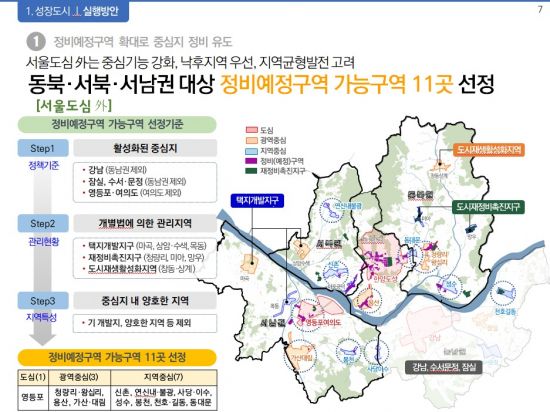 Key contents of the '2030 Seoul City Urban Residential Environment Improvement Basic Plan' approved by the Deliberation Committee. (Provided by Seoul City)
The '2040 Urban and Residential Environment Maintenance Basic Plan,' which was also approved on the same day, is a city-level statutory plan that sets the basic direction for urban maintenance-type redevelopment projects targeting commercial, semi-industrial, and semi-residential areas. It is established every 10 years and revised every 5 years. The city had previously disclosed the draft plan in September and has now passed the review.
The newly established plan expands the redevelopment-eligible maintenance zones and adjusts public contributions according to the conditions of each zone. In the downtown area, the Dongdaemun district, which was deregulated in 2016, has been redesignated as a maintenance-eligible zone. Considering the contents of the '2040 Seoul Urban Master Plan' and regional balanced development, 11 other areas outside the downtown have also been designated as redevelopment-eligible zones.
Redevelopment-eligible zones refer to areas where designation as maintenance zones is possible if detailed criteria such as building aging and public infrastructure are met. Yeongdeungpo, Cheongnyangni·Wangsimni, Yongsan, Gasan·Daerim, Sinchon, Yeonsinnae·Bulgwang, Sadang·Isu, Seongsu, Bongcheon, Cheonho·Gildong, and Dongdaemun have been designated. These zones will receive floor area ratio incentives when introducing uses aimed at fostering and promoting each region.
In the downtown area, parks accessible to citizens will be prioritized. The concept of 'open green spaces' accessible to citizens within private land has been introduced, establishing a principle that at least 30% must be mandatorily created during maintenance projects. Meanwhile, the existing height limit, previously set at 90 meters or less, will be relaxed up to a maximum of 157.1 meters. Floor area ratio and height incentives can also be applied for exceeding the required public open space.
Additionally, the plan includes introducing various residential types in the downtown area, such as apartments, officetels, urban-style residential housing, co-living houses, and share houses. If residential use is introduced as the main use, the existing policy principle of applying a residential ratio of up to 90% of the total floor area ratio will be maintained. However, the allowable floor area ratio incentives given according to the residential mixed-use ratio when introducing residential use in the downtown will be expanded from the previous maximum of 50% to 100%.
Yeo Jang-kwon, Director of the Seoul Metropolitan Government's Balanced Development Headquarters, said, "Through the establishment of this basic plan, we have prepared execution measures for major city policies such as the '2040 Seoul Urban Master Plan' and the 'Green Ecological Urban Re-creation Strategy.' We will establish specific standards through the Green Ecological Urban Master Plan and implement the vision by formulating public maintenance plans."
© The Asia Business Daily(www.asiae.co.kr). All rights reserved.


















