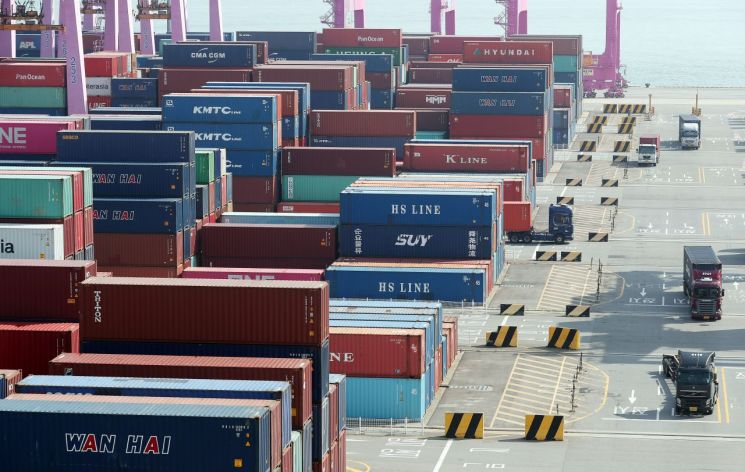
The trade balance recorded a deficit for eight consecutive months for the first time in 25 years since 1997. The annual trade deficit this year has exceeded $40 billion. Exports, the backbone of the Korean economy, fell by 14.0% compared to the same period last year, marking two consecutive months of negative growth.
According to the "November Export-Import Trends" released by the Ministry of Trade, Industry and Energy on the 1st, the trade deficit last month was $7.01 billion. During the same period, exports amounted to $51.91 billion, down 14.0% year-on-year, while imports increased by 2.7% to $58.93 billion. The trade balance has been in deficit for eight consecutive months since April. Exports declined for two consecutive months after turning negative for the first time in two years since October 2020 (-3.9%).
However, cumulative export performance from January to November this year recorded $629.1 billion, up 7.8% compared to the same period last year, surpassing $600 billion in exports in November for the first time ever.
The cumulative trade deficit up to last month this year stands at $42.6 billion. This is the first time since trade statistics began in 1956 that the cumulative trade deficit has exceeded $40 billion. The previous highest annual trade deficit was $20.62 billion recorded in 1996, just before the Asian financial crisis.
Imports of the three major energy sources?crude oil, gas, and coal?are cited as the main cause of the widening deficit. Last month, imports of these three energy sources totaled $15.51 billion, a 27.1% increase compared to $12.21 billion in the same period last year, accounting for about 26.3% of total imports.
A sharp decline in semiconductor exports, a key item, also impacted the trade balance. Semiconductor exports fell by 29.8% year-on-year, marking four consecutive months of negative growth since August. While exports of automobiles (31.0%) and petroleum products (26.0%) increased, petrochemicals (-26.5%) and wireless communication (-18.7%) decreased. Exports to regions such as China (-25.5%) and ASEAN (-13.9%) declined, whereas exports to the United States (8.0%), the Middle East (4.5%), and the European Union (EU, 0.1%) increased.
The Ministry of Trade, Industry and Energy stated, "Both China and Japan recorded declines in exports, leading to a worsening trade balance in manufacturing-based export powerhouses," adding, "Through the 1st Export Strategy Meeting, we plan to implement customized export strategies by major markets and industry-specific export support measures, and provide comprehensive support for export and order management."
© The Asia Business Daily(www.asiae.co.kr). All rights reserved.

















