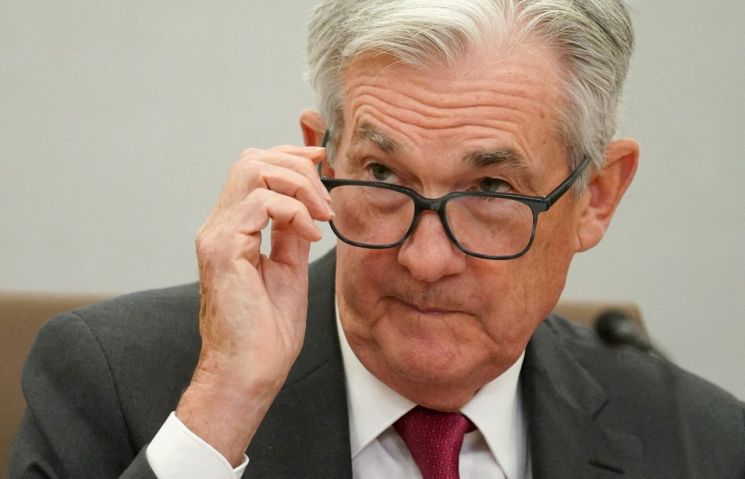
[Asia Economy New York=Special Correspondent Joselgina] "We do not want over-tightening."
The reason Jerome Powell, chairman of the U.S. Federal Reserve (Fed), reaffirmed the policy of slowing down ahead of the December Federal Open Market Committee (FOMC) on the 30th (local time) is due to concerns that excessive tightening could trigger an unnecessary economic recession. Having raised the benchmark interest rate by a whopping 3.75 percentage points this year, it is now time to ease off the accelerator and closely examine the cumulative impact of tightening on the economy and inflation.
The Beige Book released by the Fed on the same day contained assessments that economic activity has slowed in many regions recently. Pessimism among companies worried about economic uncertainty has also increased.
◇ Powell Signals Slowing Pace
The message delivered by Chairman Powell in his speech at the Brookings Institution on this day is not much different from the press conference following the November FOMC, which decided on an unprecedented four consecutive giant steps (0.75 percentage point increases in the benchmark interest rate). Starting as early as December, the pace of rate hikes will slow, but the benchmark rate will be raised to a higher level over a longer period.
However, Powell drew a line against the market’s expectation of a pivot (policy shift), saying, "There is still a long way to go to price stability." Regarding the recent signs of slowing in the U.S. Consumer Price Index (CPI), he pointed out, "A single decline does not mean a permanent drop." He also noted that wage growth remains too high to tame inflation. As long as the labor market remains overheated, it is not yet time to discuss easing tightening.
Powell’s remark that "the terminal rate could be higher" is expected to be reflected in the December dot plot, which can help temper market expectations for a pivot. The terminal rate forecast in the dot plot released in September was 4.5?4.75% (median 4.6%). Currently, Wall Street has largely priced in a 5% range.
On this day, Powell self-assessed the Fed’s decision to raise the benchmark rate by a whopping 3.75 percentage points this year, saying, "I think it was good to act quickly." However, he also said, "We do not want over-tightening," and expressed a desire to believe that a soft landing is still achievable. These remarks also imply that the Fed acknowledges that achieving a soft landing has become more difficult. Regarding criticism that the Fed’s aggressive tightening is fueling a strong dollar and affecting the global economy, he dismissed it by saying, "It is better to control inflation quickly for the U.S. and the global economy."
On the same day, Fed Governor Lisa Cook also said, "The Fed should soon ease off the accelerator," but added that the duration of maintaining restrictive rates will be determined based on inflation conditions. This aligns with the Fed’s long-emphasized data-driven policy approach. Key indicators the Fed is watching include the employment report on December 2 and the November CPI on December 13.
◇ Beige Book: "Growth Slows in Some Regions"
The Beige Book, the Fed’s economic report released on the same day, also showed signs that economic activity has slowed recently due to cumulative tightening. This Beige Book evaluated economic trends in the 12 Federal Reserve Banks’ districts from mid-October to November 23. It also serves as a basis for the regular FOMC meeting on December 13?14.
According to the Beige Book, economic activity in the U.S. during this period was "flat or slightly expanding." This falls short of the "moderate growth" noted in the previous Beige Book. Five regions recorded "slight" or "moderate growth," but the remaining seven showed no change or a slight decline. The Beige Book stated, "Interest rates and inflation continue to weigh on economic activity," and "Many companies expressed greater anxiety and pessimism."
Due to improvements in supply chains and weakening demand, the overall rate of price increases slowed. Prices of some commodities such as lumber and steel showed a downward trend. However, the Beige Book predicted that "U.S. inflation will slowly decline from a high level," indicating that high inflation will persist for some time.
The labor market showed moderate growth in most regions. However, two regions confirmed weakening demand. There were also layoffs mainly in technology, finance, and real estate sectors.
Concerns about recession among companies have increased. The Beige Book reported that many companies expressed worries that "uncertainty has increased" and "pessimism has grown" regarding the year-end economic outlook.
© The Asia Business Daily(www.asiae.co.kr). All rights reserved.

















