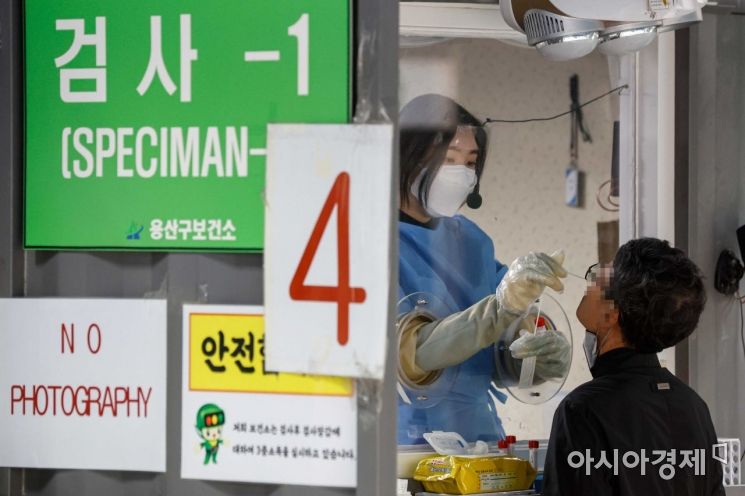
 On the 15th, 72,883 new COVID-19 cases were reported, an increase of 49,118 from the previous day. Citizens visiting the screening clinic set up at Yongsan-gu Public Health Center in Seoul are undergoing tests. Photo by Jinhyung Kang aymsdream@
[Asia Economy Reporter Kim Young-won] As the number of severe and critical COVID-19 patients has been increasing for a month, the number of confirmed cases in infection-vulnerable facilities, where cluster infections are a concern, is also on the rise.
According to the Central Disease Control Headquarters on the 1st, the average daily number of severe and critical patients hospitalized during the 4th week of November (20-26) was 460, an increase of 15.3% compared to the previous week. The average daily number of severe and critical patients has been rising for four weeks, from 238 in the 4th week of October to 294 in the 1st week of November, 349 in the 2nd week, and 399 in the 3rd week. In particular, the number of severe and critical patients is increasing more than the increase in confirmed cases. During the same period, the number of confirmed COVID-19 cases increased by only 2.9% compared to the previous week.
The severity rate, which shows the proportion of patients who progress to severe illness or death after monitoring confirmed cases for two weeks, is also rising again. The severity rate for confirmed cases in the 2nd week of November was 0.19%, up 0.03 percentage points from 0.16% the previous week. This is the highest figure since February this year, along with the 1st week of October.
The problem is that confirmed cases in infection-vulnerable facilities, which are prone to cluster infections, are also increasing. As of the 3rd week of November, confirmed cases in infection-vulnerable facilities reached 15,980, increasing over three weeks. They account for 4.4% of weekly confirmed cases.
Especially in nursing hospitals where elderly people vulnerable to severe illness and death reside, the number of confirmed cases has increased by more than 400 each week. The number of confirmed cases in nursing hospitals was 3,311 in the 4th week of October, 4,130 in the 1st week of November, 5,736 in the 2nd week, and 6,242 in the 3rd week. Among all types of infection-vulnerable facilities, nursing hospitals account for the largest proportion of confirmed cases at 39.1%.
Earlier, the authorities operated a ‘Winter Intensive Vaccination Period’ from the 21st of last month to the 18th of next month, strengthening contact and visitation standards for nursing hospitals and facilities. Even those who received the 3rd or 4th additional vaccination or were previously confirmed cases must receive the Omicron-targeted bivalent vaccine after 120 days from vaccination or confirmation to be allowed to go out or stay overnight. Previously, those who had received the 4th vaccination or had a history of confirmation after at least two doses could go out or stay overnight.
The Central Disease Control Headquarters repeatedly urged people aged 60 and over, immunocompromised individuals, and those in infection-vulnerable facilities to get vaccinated promptly, but the vaccination rate is still low compared to the 4th dose. As of midnight the previous day, the 4th dose vaccination rate for those aged 70 and over was over 50%. The additional winter vaccination rate is 23.9% for those in their 70s and 22.8% for those aged 80 and above.
© The Asia Business Daily(www.asiae.co.kr). All rights reserved.
![Clutching a Stolen Dior Bag, Saying "I Hate Being Poor but Real"... The Grotesque Con of a "Human Knockoff" [Slate]](https://cwcontent.asiae.co.kr/asiaresize/183/2026021902243444107_1771435474.jpg)











