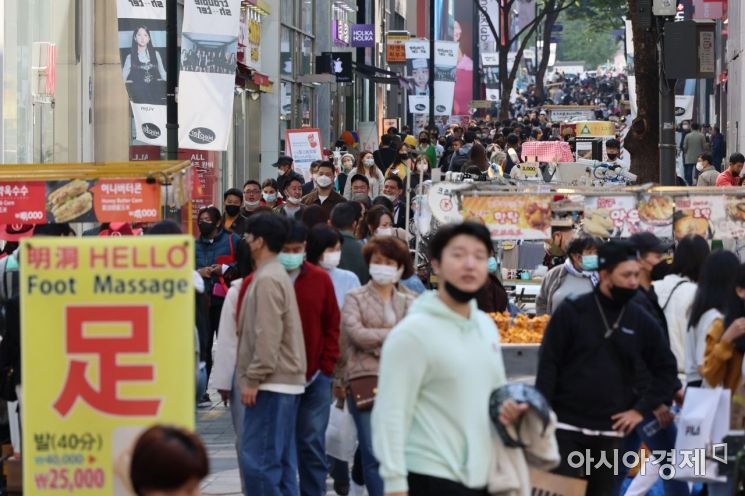
 On the 23rd, Myeongdong Shopping Street in Jung-gu, Seoul, is bustling with many shoppers, including foreign tourists. Photo by Dongju Yoon doso7@
[Asia Economy Reporter Seo So-jeong] The South Korean economy grew by 0.3% quarter-on-quarter in the third quarter, driven mainly by private consumption and facility investment.
On the 1st, the Bank of Korea announced that the real gross domestic product (GDP) growth rate for the third quarter of this year (preliminary figure, quarter-on-quarter) was 0.3%. This is the same figure as the flash estimate (0.3%) released on October 27.
The quarterly growth rates recorded negative figures in the first (-1.3%) and second (-3.0%) quarters of 2020 when COVID-19 spread, followed by 2.3% in the third quarter, 1.2% in the fourth quarter, 1.7% in the first quarter of 2021, 0.8% in the second quarter, 0.2% in the third quarter, 1.3% in the fourth quarter, 0.6% in the first quarter of this year, 0.7% in the second quarter, maintaining a growth streak for nine consecutive quarters including this one.
Looking at the third quarter growth rate by sector, exports, private consumption, and government consumption all increased.
Private consumption rose by 1.7%, centered on semi-durable goods such as entertainment and hobby products and service consumption such as food and accommodation. Government consumption increased by 0.1%, mainly due to spending on goods, but construction investment decreased by 0.2% due to a decline in civil engineering construction.
Facility investment increased by 7.9%, with both machinery and transportation equipment rising.
Exports increased by 1.1%, centered on transportation equipment and service exports, despite a decline in semiconductors, while imports rose by 6.0%, mainly due to crude oil and natural gas.
By industry, manufacturing decreased while services showed growth, similar to the previous quarter.
Manufacturing declined by 0.8%, centered on computers, electronic and optical equipment, and chemicals and chemical products, while construction increased by 1.3%, mainly in building construction.
Services increased by 0.8%, with growth in wholesale and retail, accommodation and food services, information and communication, culture, and other services.
The real gross national income (GNI) in the third quarter decreased by 0.7% quarter-on-quarter. Although real net primary income from abroad increased from 4.4 trillion won to 7.3 trillion won, the deterioration in terms of trade caused real trade losses to expand further from 28 trillion won to 35.7 trillion won, falling short of the real GDP growth rate (0.3%).
The total savings rate fell by 1.5 percentage points quarter-on-quarter to 32.7%. This was because the final consumption expenditure growth rate (2.2%) was higher than the gross national disposable income growth rate (0.0%).
The Bank of Korea stated, "Compared to the flash estimate, the growth rates of private consumption and construction investment were revised downward by 0.2 percentage points and 0.6 percentage points respectively, but facility investment, exports, and imports were revised upward by 2.9 percentage points, 0.1 percentage points, and 0.1 percentage points respectively."
© The Asia Business Daily(www.asiae.co.kr). All rights reserved.

















