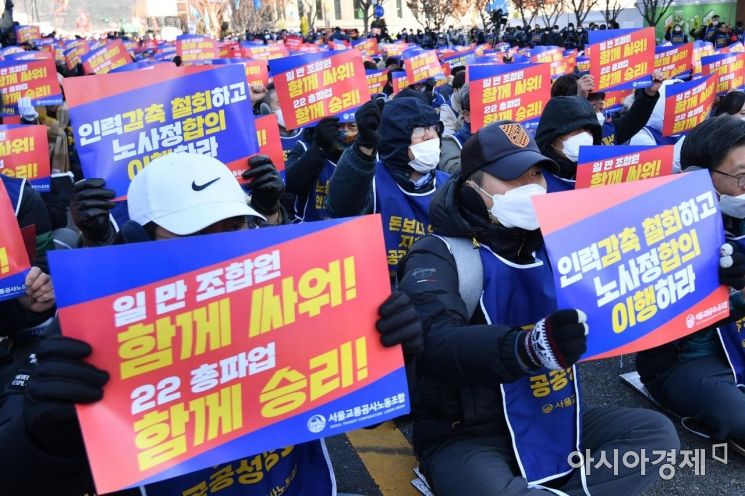
 Workers of the Seoul Metro Union are holding a general strike kickoff rally near Seoul City Hall on the 30th. The union's strike is the first in six years since September 2016, based on Lines 1 to 8. Photo by Hyunmin Kim kimhyun81@
[Asia Economy Reporter Kwon Jae-hee] The Seoul Metro Workers' Union, which launched a general strike on the 30th, resumed negotiations with management around 8 p.m. that day. However, after a recess of about five minutes, they entered into working-level talks, leaving the outcome uncertain.
According to the Seoul Metro labor-management relations, the parties resumed negotiations at the headquarters in Seongdong-gu around 8 p.m., but after about five minutes, they suspended the main negotiations and declared a recess. Afterwards, both sides entered into working-level negotiations again.
Earlier, the joint negotiation team composed of the two major unions affiliated with the Korean Confederation of Trade Unions and the Federation of Korean Trade Unions held main collective agreement negotiations with management at 2 p.m. the previous day but recessed after 10 minutes. Subsequently, they conducted working-level talks for eight hours over management’s proposal to temporarily suspend restructuring and plans to increase personnel, but failed to find a compromise and declared the negotiations broken off around 10 p.m.
As announced, on the 30th, the subway operation sector began striking from the first train, and flexible workers started the strike from the time they began daytime shifts.
The strike by the Seoul Metro union operating lines 1 to 8 is the first in six years since September 2016.
Management sent an official letter around 10 a.m. that day requesting the resumption of negotiations, and the union accepted, reopening the negotiation table.
The previous day, management proposed temporarily suspending the personnel reduction plan to cut 1,539 employees by 2026 and implementing the previously agreed measures to fill long-term vacancies and increase train crew personnel by the first half of next year.
However, the union rejected this, calling it a regressive proposal compared to the special labor-management agreement made on September 13 last year, which decided not to enforce forced restructuring due to the financial crisis.
On the first day of the strike, the company and Seoul City deployed substitute personnel intensively during the morning rush hour to maintain normal operation rates. However, during the evening rush hour, when fewer substitutes were deployed, train operations were significantly delayed, causing severe congestion with crowds spilling out beyond ticket gates at major subway stations.
© The Asia Business Daily(www.asiae.co.kr). All rights reserved.
![Clutching a Stolen Dior Bag, Saying "I Hate Being Poor but Real"... The Grotesque Con of a "Human Knockoff" [Slate]](https://cwcontent.asiae.co.kr/asiaresize/183/2026021902243444107_1771435474.jpg)
















