Passed away at age 96... Undergoing treatment for leukemia and other illnesses
Did not appear even at the 20th Party Congress, fueling 'health deterioration' rumors
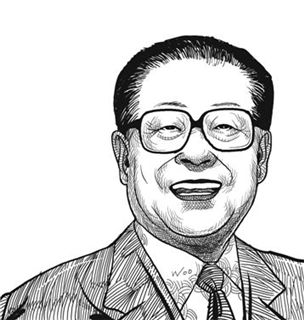 Jiang Zemin, Former President of China
[Asia Economy Beijing=Special Correspondent Kim Hyun-jung] Jiang Zemin, the third-generation top leader of China and former state president, passed away on the 30th, according to a report by China's state-run news agency Xinhua.
According to the report, former President Jiang died at 12:13 PM (local time) while receiving treatment in Shanghai due to leukemia and subsequent organ failure. Born in 1926 in Yangzhou, Jiangsu Province, he was 96 years old.
He was the third-generation top leader of China, following Mao Zedong-Zhou Enlai (in power from 1949 to 1976, first generation) and Deng Xiaoping-Zhao Ziyang-Hu Yaobang (in power from 1977 to 1992, second generation).
Regarded as the leader of the "Shanghai Gang (上海幇)," one of China's three major power factions, he worked at an automobile company in his youth and became the deputy director of the Shanghai Institute of Electrical Science in 1962. After the Cultural Revolution and the death of first-generation leader Mao Zedong, Deng Xiaoping, who rose to second-generation leadership, appointed him as vice minister of the Ministry of Electronics Industry in 1983. The following year, Jiang gained prominence as a technical bureaucrat by successfully launching Changcheng-3, China's first geostationary communications satellite.
He began to stand out after being elected mayor of Shanghai in 1985. During the 1989 Tiananmen Square incident, he directly suppressed the protests, gaining Deng Xiaoping's favor and becoming a core figure of power. Subsequently, he took over the position of Communist Party General Secretary from the ousted Zhao Ziyang, served as chairman of the National Military Commission and the Communist Party Central Military Commission, and in 1993, assumed the presidency of the country.
After Deng Xiaoping's death in 1997, Jiang became the de facto top leader of China. He was the first person to hold the positions of state president, Communist Party General Secretary, and chairman of the Central Military Commission simultaneously.
Jiang abandoned Deng Xiaoping's foreign policy of "Tao Guang Yang Hui (韜光養晦, hiding one's capabilities and biding one's time)" and introduced the concept of "You Suo Zuo Wei (有所作爲)," meaning to play a necessary role as a major power. In terms of policy, he is credited with rapidly transforming China into an economic powerhouse through reform and opening-up. Notably, he proposed the "Three Represents" theory, which emphasized that the Communist Party should represent not only workers and peasants but also intellectuals and entrepreneurs, showing his attention to the market.
In 2002, he handed over the position of party general secretary to Hu Jintao, who belonged to the Communist Youth League faction, another major power group alongside the Shanghai Gang, and the following year, he passed on the presidency. In 2005, he also stepped down as chairman of the Central Military Commission but continued to wield significant influence behind the scenes as a political elder.
However, as Xi Jinping, from the princeling faction (a political group composed of descendants of senior officials), rose to power, Jiang gradually lost his presence. Especially, he did not attend the 20th National Congress of the Communist Party held last month, sparking rumors that his health had severely deteriorated.
© The Asia Business Daily(www.asiae.co.kr). All rights reserved.
















