Japan November Consumer Price Index Up 3.6% Year-on-Year
Special Allowances Paid to Boost Morale as Employees' Real Wages Decline
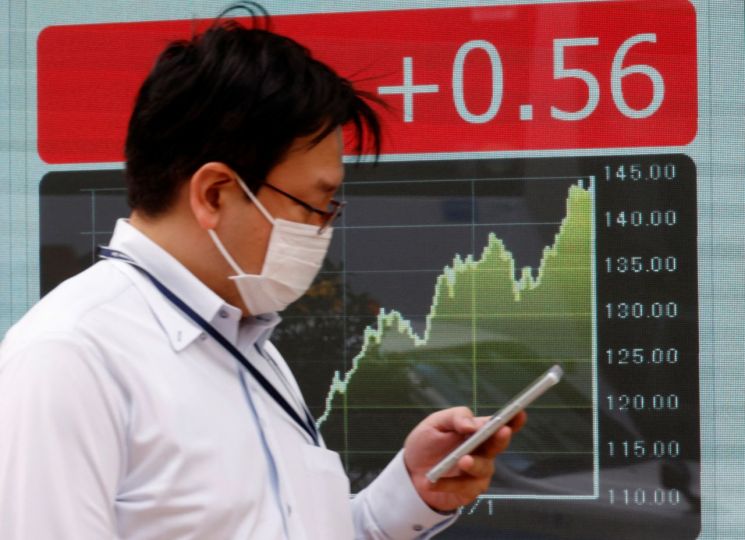 Last September, a Japanese citizen stood in front of a brokerage in Tokyo displaying the yen-dollar exchange rate. Photo by Reuters·Yonhap News
[Asia Economy Reporter Yoon Seul-gi] Amid record inflation in Japan this year, the number of companies providing 'inflation allowances' is increasing. This appears to be a measure introduced to boost employee morale as real wages decline due to soaring prices.
According to the Nihon Keizai Shimbun (Nikkei) on the 30th, Mitsubishi Motors will pay a one-time special support payment of 100,000 yen (approximately 950,000 KRW) to 12,000 full-time employees excluding managers on November 2. About 2,000 non-regular employees and part-timers will receive 70,000 yen (approximately 670,000 KRW).
Japan Special Steel also distributed 50,000 yen (approximately 470,000 KRW) to full-time employees and 20,000 yen (approximately 190,000 KRW) to non-regular employees among about 8,800 workers this month. Mitsubishi Gas Chemical paid up to 60,000 yen (approximately 570,000 KRW) this month to about 1,900 regular employees excluding managers, based on the number of family members, as a living support measure.
Market research company Oricon and restaurant operator Eat & Holdings have been adding inflation allowances to monthly salaries and paying them monthly since October.
In a survey conducted last month by Japanese credit information company Teikoku Databank targeting about 1,200 Japanese companies, 26.4% of companies responded positively to paying inflation allowances. The average payment amount was 53,700 yen as a lump sum and 6,500 yen as a monthly allowance.
Japanese companies have started providing such 'special allowances' because recent sharp price increases have reduced workers' real wages. Japan, accustomed to chronic deflation known as the 'Lost 30 Years,' is now experiencing record inflation due to rising raw material prices and a weak yen. According to the Ministry of Internal Affairs and Communications, Tokyo's core consumer price index in November rose 3.6% compared to the same period last year.
Accordingly, Japan's real wages have recorded negative growth for six consecutive months. According to the preliminary monthly labor statistics released by the Ministry of Health, Labour and Welfare on the 9th, real wages adjusted for price changes decreased by 1.3% compared to a year ago, marking six consecutive months of decline.
In response, Japan's labor unions have set a policy to demand a 5% wage increase in next spring's wage negotiations. This is the first time in 28 years that they have proposed a 5-6% increase. Tomoko Yoshino, chairperson of the Japanese Trade Union Confederation, the largest labor union in Japan, held a central executive committee meeting on the 20th of last month and stated, "The sharp rise in prices is severely impacting our lives," adding, "To cope with this, we will raise wages in line with inflation."
© The Asia Business Daily(www.asiae.co.kr). All rights reserved.

















