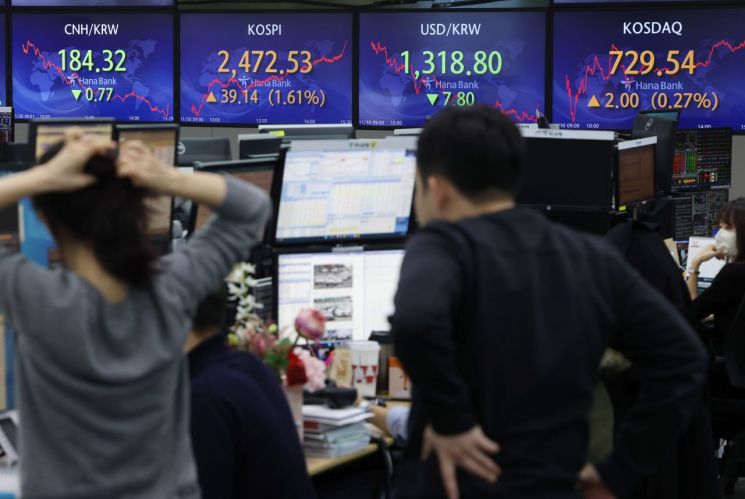
[Asia Economy Reporter Lee Jung-yoon] The KOSPI index recorded a rise of over 1.6% as foreign investors, who had been showing a selling bias, turned to net buying.
On the 30th, the KOSPI index closed at 2,472.53, up 39.14 points (1.61%) from the previous day. This marks two consecutive days of gains. The index started the day at 2,424.44, down 8.95 points (0.37%), and widened its losses initially. However, it showed an upward trend as foreign investors returned to net buying. Foreign investors recorded net buying for two consecutive trading days. Individual investors showed net buying initially but switched to a selling bias. Foreign investors purchased approximately 1.017 trillion KRW worth of shares, while individuals and institutions sold 603.4 billion KRW and 360.6 billion KRW worth, respectively.
Among the top market capitalization stocks, most showed gains. LG Energy Solution and LG Chem rose more than 3%. Following them were Samsung Electronics (2.64%), NAVER (2.47%), POSCO Holdings (2.04%), Kia (1.93%), SK Hynix (1.55%), Samsung SDI (1.53%), and Samsung Biologics (0.23%). Hyundai Motor remained flat.
By sector, the gains were led by Electric & Electronics (2.54%), Insurance (2.51%), Electric & Gas Utilities (2.37%), Manufacturing (1.70%), and Services (1.54%). Machinery (-1.44%) and Non-metallic Minerals (-0.98%) declined.
Lee Kyung-min, a researcher at Daishin Securities, explained, "China's November Manufacturing Purchasing Managers' Index (PMI) was 48, indicating an expanded contraction level, but its impact on the stock market was limited. The focus is more on the Chinese health authorities' mention of easing the zero-COVID policy."
The Manufacturing PMI is compiled by surveying purchasing managers from about 700 manufacturing companies nationwide on five sub-indices: new orders, production, shipments, inventory, and employment. A reading above the baseline of 50 indicates an expansion phase, while below 50 indicates a contraction phase.
Kim Seok-hwan, a researcher at Mirae Asset Securities, said, "During the day, the Chinese stock market rebounded on expectations of easing zero-COVID measures, leading to a rebound buying inflow into the KOSPI, which successfully turned to an upward trend. The exchange rate also fell, expanding foreign buying inflows due to the won's appreciation." On the day, the USD-KRW exchange rate closed at 1,318.8 won, down 7.8 won from the previous day's closing price.
At the same time, the KOSDAQ index closed at 729.54, up 2.00 points (0.27%) from the previous trading day. The index started lower and dropped to 722.40 but fluctuated before closing higher. Individuals and institutions recorded net buying of 10.4 billion KRW and 17.2 billion KRW, respectively, while foreign investors net sold about 15.3 billion KRW.
Among the top market capitalization stocks, EcoPro (3.47%) recorded the largest gain. Following were EcoPro BM (2.99%), Kakao Games (2.23%), L&F (1.43%), Rino Industrial (0.47%), Celltrion Healthcare (0.46%), HLB and Celltrion Pharm (0.15%), and Chunbo (0.08%). Pearl Abyss fell 0.68%.
© The Asia Business Daily(www.asiae.co.kr). All rights reserved.
![Clutching a Stolen Dior Bag, Saying "I Hate Being Poor but Real"... The Grotesque Con of a "Human Knockoff" [Slate]](https://cwcontent.asiae.co.kr/asiaresize/183/2026021902243444107_1771435474.jpg)
















