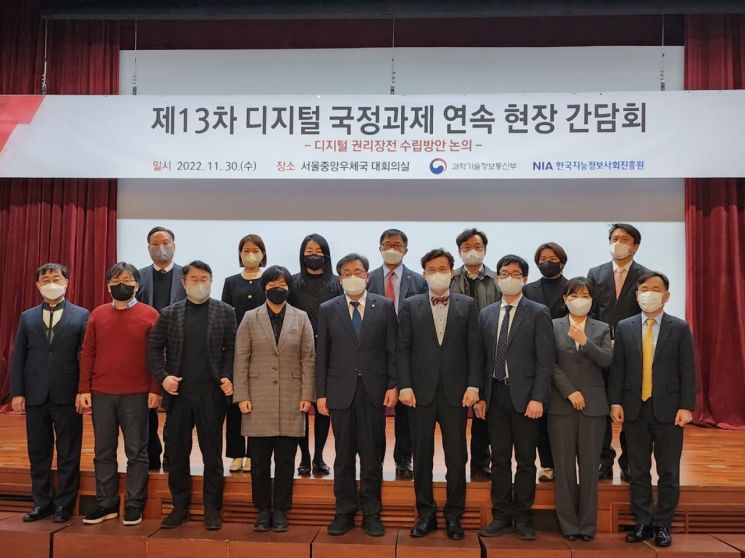
 Park Yoon-kyu, 2nd Vice Minister of the Ministry of Science and ICT (center in the first row), is attending the "13th Continuous On-site Meeting on Digital National Tasks" held at Seoul Central Post Office on the 30th and taking a commemorative photo with officials.
[Asia Economy Reporter Lim Hye-seon] Park Yoon-kyu, the 2nd Vice Minister of the Ministry of Science and ICT, emphasized the need to establish a "Digital Bill of Rights" to protect the universal values of humanity in the digital age.
Vice Minister Park attended the "13th Digital National Agenda Continuous On-site Meeting" held at Seoul Central Post Office on the 30th and stated, "Since the process of gathering broad opinions and reaching social consensus is important, it must be thoroughly reviewed and promoted."
The new government announced the "Korea Digital Strategy" to concretize the tone and philosophy following the "New York Initiative" declaration in September aimed at leading the global digital transformation. Among the detailed tasks was the establishment of a "Digital Bill of Rights" to guarantee digital universal rights. At this meeting, government officials and experts from various private sectors gathered to discuss various measures to ensure that citizens' fundamental rights are thoroughly protected in all online and offline areas in the digital era.
Professor Kim Myung-joo of Seoul Women’s University explained the development of ethical principles, from "Internet Ethics" in the information age to "Artificial Intelligence Ethics" and "Metaverse Ethics" in the 4th Industrial Revolution era, to minimize side effects and dysfunctions caused by the digital transformation. Professor Kim stated, "To continuously and consistently guarantee the rights of all citizens in a changing society, digital ethics must be established." A research report from Seoul National University, produced through a policy research project on digital fundamental values by the Ministry of Science and ICT this year, identified ten core values. These ten fundamental values are human rights (dignity), freedom, equality, justice, labor, education, safety, sustainability, peace, and democracy.
Hong Seon-gi, Research Fellow of Public Law and Human Rights Law at the German Institute of Political Economy, said, "One of the most emphasized topics in the UNDP Digital Strategy 2022-2025 report, a UN subsidiary organization, is the digital divide," adding, "Europe has prepared a draft Digital Charter of Fundamental Rights in response to this." He continued, "The United States is also currently working on a Digital Bill of Rights," and warned, "The later the Digital Bill of Rights is established, the more delayed the guarantee and enjoyment of digital-related rights will be."
He analyzed, "The Digital Bill of Rights is a document that defines individual rights in the digital era. Although it has no binding force, it can serve as a guideline indicating legislative directions for protecting rights in the digital age in the future," and added, "It will help citizens indirectly cultivate awareness of digital rights."
Experts attending the meeting included Professor Byun Soon-yong of Seoul National University of Education, Professor Lee Sang-wook of Hanyang University, Professor Choi Nan-seolheon of Yonsei University, Professor Kim Myung-joo, Chairman Hong Seon-gi, and Park Sung-ho, Chairman of the Korea Internet Corporations Association.
© The Asia Business Daily(www.asiae.co.kr). All rights reserved.

















